Too Tired to Go to the Gym? Use This Simple Rule
When you’re too tired to go to the gym, it can feel like this little trickle of poison, threatening to undo all the hard work you’ve been putting in.
I used to battle it myself. I’d come home from an 8-hour shift on my feet, my shoes kicked off by the door, the only appealing thought being the exact contour of the couch cushion. The mental debate would start before my bag even hit the floor… “Should I go?” or “Am I just too tired?”
The real cost of skipping isn’t one workout. It’s the doubt and cognitive fatigue that wear you down. The quiet questioning of whether you’re still “a person who works out,” or whether that version of you was just a phase.
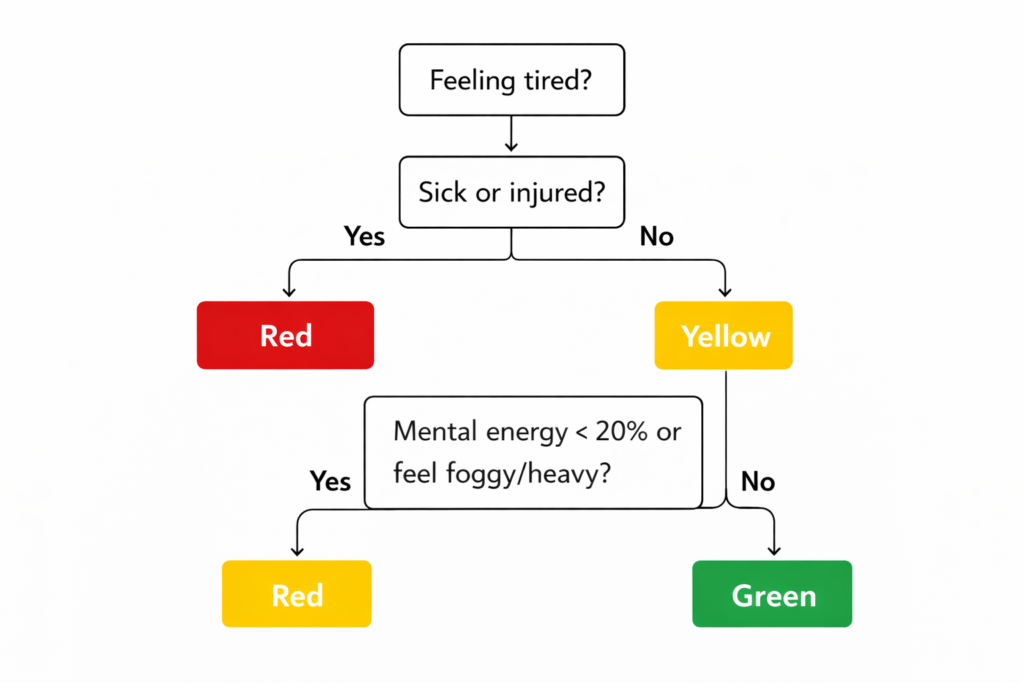
The Green-Yellow-Red rule ends the internal debate. It turns a messy (and quite normal) emotional moment into a simple decision with a clear next step.
This isn’t a cheap gimmick. It’s a system designed to keep you on track.
The Green-Yellow-Red rule for tired days
“Tired” isn’t one category. Some tired is not enough to stop you from going to the gym. Some tired needs a simplified plan. Some tired is a stop sign.
First, diagnose which type of tired you are. Then act accordingly.
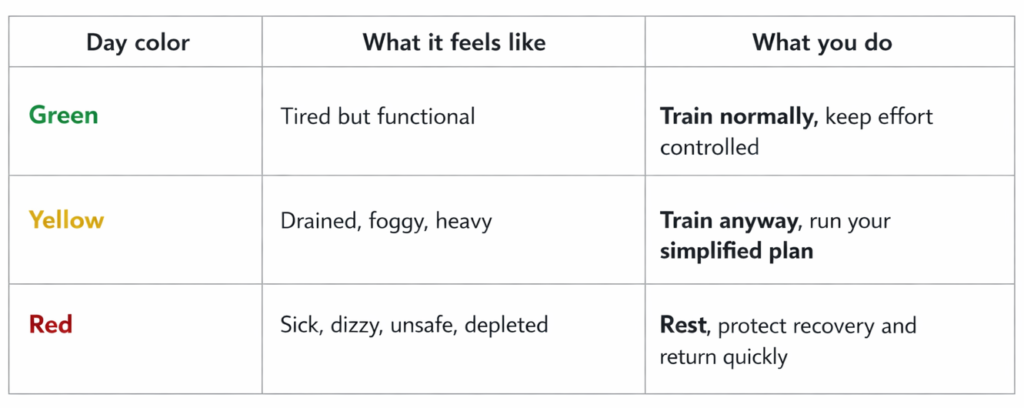
Green means you’re tired but still fully functional, so you show up and execute like a professional. Yellow means you’re drained, foggy, or heavy, so you train anyway but switch to your simplified, pre-defined plan. Red means your body is waving a stop sign, so you rest on purpose and protect the next week of training.
I started treating ‘tired’ like the weather. You don’t get angry at rain; you just grab a coat or an umbrella. This table is your umbrella for tired days.
Quick-reference table you can screenshot
Green days mean you train normally
Green means you’re tired but you can still get in there and move your body. You’re not sick, you’re not dizzy, and nothing hurts in a way that changes how you move.
On Green days, the win is showing up as The Professional. Train as written, keep it controlled, and leave a couple reps in reserve. Over time, consistent training is strongly linked with improved energy and reduced fatigue. (1)
If you’re still building a plan that doesn’t require constant decisions, start with this complete beginner gym routine. When consistency is in place, you can move on to one of these tried and true weightlifting routines for beginners.
Yellow Days: Where “The Tactician” Wins
Yellow means you feel drained, mentally or physically, but you are still safe to train.
This is the day your brain starts the internal debate. It builds a case for skipping that sounds mature and reasonable, and it usually lands on the same conclusion: “Rest today, be better tomorrow.” The problem is that tomorrow becomes another debate, and your habit slowly becomes something you only do when conditions are perfect.
Yellow is where you protect and affirm your identity.
On Yellow days, the decisive win is strategic perseverance. You don’t overpower fatigue. You outsmart it with a plan that works even when your motivation is missing.
The 5-Minute Pre-Game Reset
Do this before you decide what color the day is. When you’re tired, your mental story gets louder than your body’s actual signals. This reset quiets the story enough to make an honest call.
First, drink a large glass of water and take five deep, slow breaths. Let your shoulders drop as you exhale. You’re not trying to feel “hyped.” You’re trying to feel present.
Next, put on your workout clothes. I know, sometimes even that feels like a huge ask. But I’ve never once regretted putting the clothes on. I have, however, regretted spending 45 minutes in my sweatpants debating, feeling worse by the minute.
This is a psychological trigger, not a fashion choice. It tells your brain, “We’re the kind of person who shows up.”
Then set a timer for five minutes and move gently. Walk, stretch, pace, do a few easy bodyweight reps. Nothing heroic. Just enough movement to shift your state. After that, use the G-Y-R rule. The physical state can influence the mental narrative more than people want to admit.
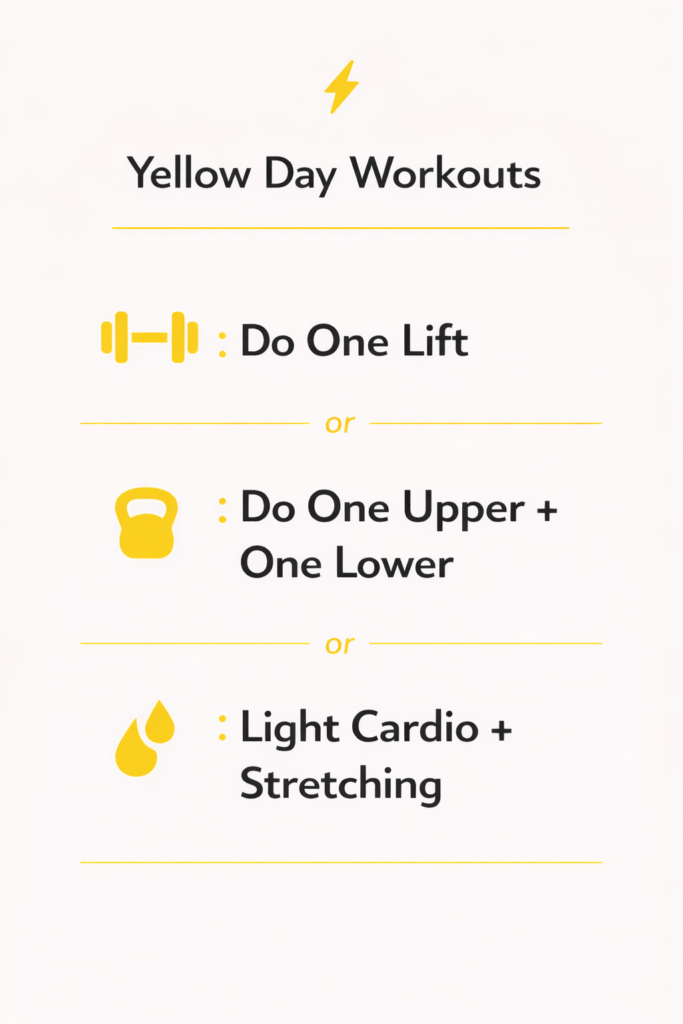
Your “Do Anything” Yellow Workout Templates
Your only job is to pick one and start. You have permission to leave after 10 minutes. (But you probably won’t.)
- Show up and do one lift
Warm up briefly, choose one big lift pattern you can do safely, and complete three solid sets at an easy-but-real effort. Leave a few reps in reserve, then leave feeling better than when you walked in. - Two-move full body
Pick one lower-body movement and one upper-body movement, then do two to three sets of each. Keep it familiar, keep it stable, and stop while you still feel capable. - Sweat and reset
Do easy cardio and some stretching. It counts because it keeps the appointment and improves your state without digging a recovery hole.
If you want Yellow days to start more smoothly, use a short runway that reduces decision fatigue before you even touch a weight. This simple pre-workout routine for beginners is built for that exact problem.
A quick note on the psychology: mental fatigue can make effort feel harder than it actually is. That doesn’t mean you’re doomed to a bad session. Here’s the funny thing: some of my most focused, strongest sessions have happened on exactly these foggy, Yellow days. When I had zero energy for a ‘go-get-it’ workout, I just did the work. No fanfare, no extra reps. Just pure, simple execution.
It turns out, the research backs this up. A bias-sensitive review suggests mental fatigue does not reliably hurt exercise performance across the board. (2)
The practical takeaway stays the same: mental exhaustion is a reason to simplify, not automatically skip.
Red days are stop signs, and stop signs are training decisions
Red means you are not safe to train. You’re sick, dizzy, injured, your coordination is off, or you’ve stacked multiple nights of very poor sleep and your system is clearly depleted.
A Red day is not failure. It’s a strategic retreat.
I learned this the hard way. I’ve tried to reason with a Red day before, pushing through a headache or a tickle in my throat just to move… Only for a minor blip to spiral into a longer recovery. Now, when my body gives a clear stop signal, I respect it. It’s not losing a battle; it’s choosing the right war.
This is where The Architect shows up. The Architect doesn’t sacrifice the whole week to win one day.
Resistance training is associated with improvements in sleep quality across reviews, and regular physical activity is linked with better sleep and mood over time. (3) (4) But you don’t get those benefits by ignoring stop signs. You get them by recovering and returning quickly.
If rest days trigger guilt and that guilt turns into a spiral, handle it directly. This guide on rest day guilt will help you keep recovery in its proper place.
Your Yellow-Day Decision-Making Checklist
Yellow days fail for one reason: too many decisions.
So you remove them.
- Choose machines over complex free-weight setups when you’re mentally fried
- Use the same exercises every Yellow day
- Keep sets low and predictable
- Avoid learning anything new
Less thinking. More doing.
And if even getting to the gym feels like the hard part on Yellow days, adjustable dumbbells are one of the simplest ways to keep training without turning your place into a full-on gym.
Make it automatic
If you’re too tired to go to the gym, your brain will try to make it a moral issue. Lazy or disciplined. Serious or not serious. That framing turns one tired moment into a full-blown identity crisis.
You’re not on trial. You’re running a protocol. That’s the mindset shift that produces results.
Make it automatic: Screenshot the table and the Yellow workout templates above. Save them to your phone as your personal quick-reference guide for tired days. When you feel tired, you don’t think. You check and execute.
Then anchor everything to a simple, repeatable base plan. If you want one strong “home base” routine to pair with the rule, use this beginner gym routine as your foundation. It cuts decision fatigue and makes Green and Yellow days far easier to follow through on.
System, Not a Savior
This rule isn’t about always training. It’s about never having the internal civil war again. Green is go. Yellow is smart. Red is wise. Your only job is to diagnose the color honestly. The ultimate win is a more peaceful mind and a habit that lasts for years, not weeks.
That’s the goal: fewer debates with yourself, and more quiet confidence that you know exactly what to do, even on the days you don’t feel like doing it.
References
- Wender, C. L. A., et al. (2022). The effect of chronic exercise on energy and fatigue states: A systematic review. Sports Medicine, 52(7), 1421–1441. https://pmc.ncbi.nlm.nih.gov/articles/PMC9206544/
- Holgado, D., Sanabria, D., Perales, J. C., & Vadillo, M. A. (2020). Mental fatigue might be not so bad for exercise performance after all: A systematic review and bias-sensitive meta-analysis. Journal of Clinical Medicine, 9(12), 4002. https://pmc.ncbi.nlm.nih.gov/articles/PMC7546119/
- Kovacevic, A., Mavros, Y., Heisz, J. J., & Fiatarone Singh, M. A. (2018). The effect of resistance exercise on sleep: A systematic review of randomized controlled trials. Sleep Medicine Reviews, 39, 52–68. https://pubmed.ncbi.nlm.nih.gov/28919335/
- Centers for Disease Control and Prevention. (2025). Benefits of physical activity. https://www.cdc.gov/physical-activity-basics/benefits/index.html