
What to Do When You Miss a Workout Day (Without Spiraling)
Missing a workout won’t hurt your progress. What happens next might.
The missed session itself is almost irrelevant. One day off doesn’t touch your strength, your muscle, or your momentum in any meaningful way. Your body is more resilient than your brain is giving it credit for right now.
The problem is the story that follows.
The guilt. The “I’ll restart Monday” internal dialogue. The make-up session that turns into back-to-back hard days and a wrecked recovery week. That sequence (not the missed Tuesday) is what quietly unravels most people’s consistency.
So this isn’t really about the workout you missed. It’s about the next 48 hours, and making sure one skipped session doesn’t become the first domino.
Here’s how to handle it.
Start Here: What to Do When You Miss a Workout Day
This is simple and takes five minutes. No pep talk. No motivational video.
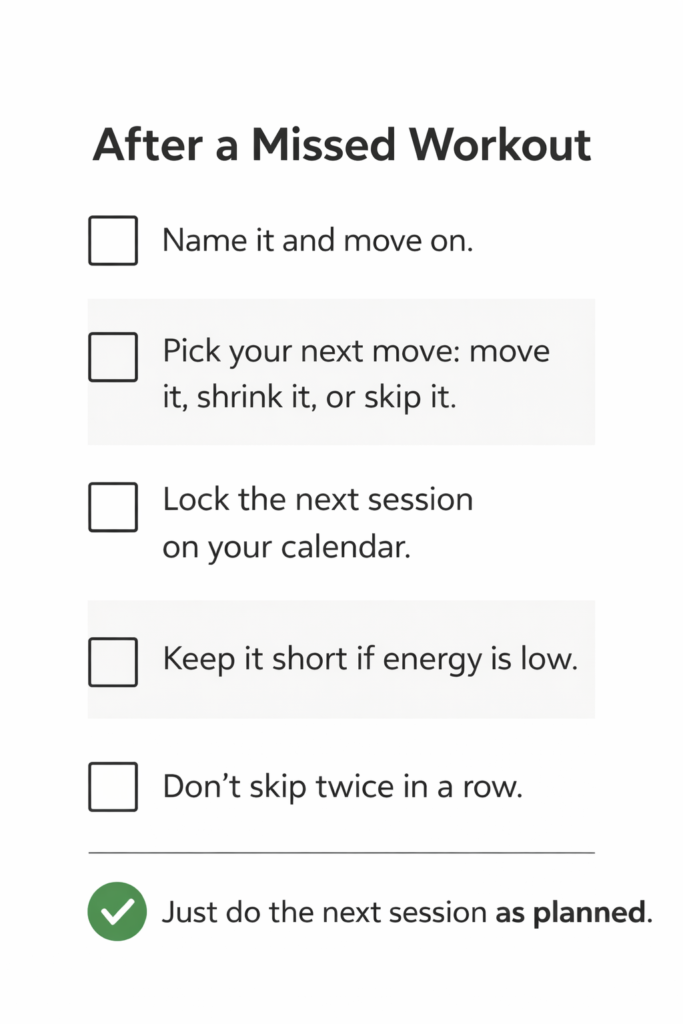
Start with this. Name what happened without making it mean something: “I missed a workout,” not “I’m falling off” or “I blew it.” Then pick the next move: either shift the workout to the next day or two, do a shorter version today, or let it go and hit the next planned session as normal. Whichever you pick, lock it on your calendar with a specific day and time. Not “sometime this week.” An actual slot.
That’s it. Three steps, five minutes.
Remind yourself of one thing:
“I don’t have to make up for it. I just have to show up next.”
That’s the reset.
Now pick the right move, so one missed workout doesn’t turn into a messy week.
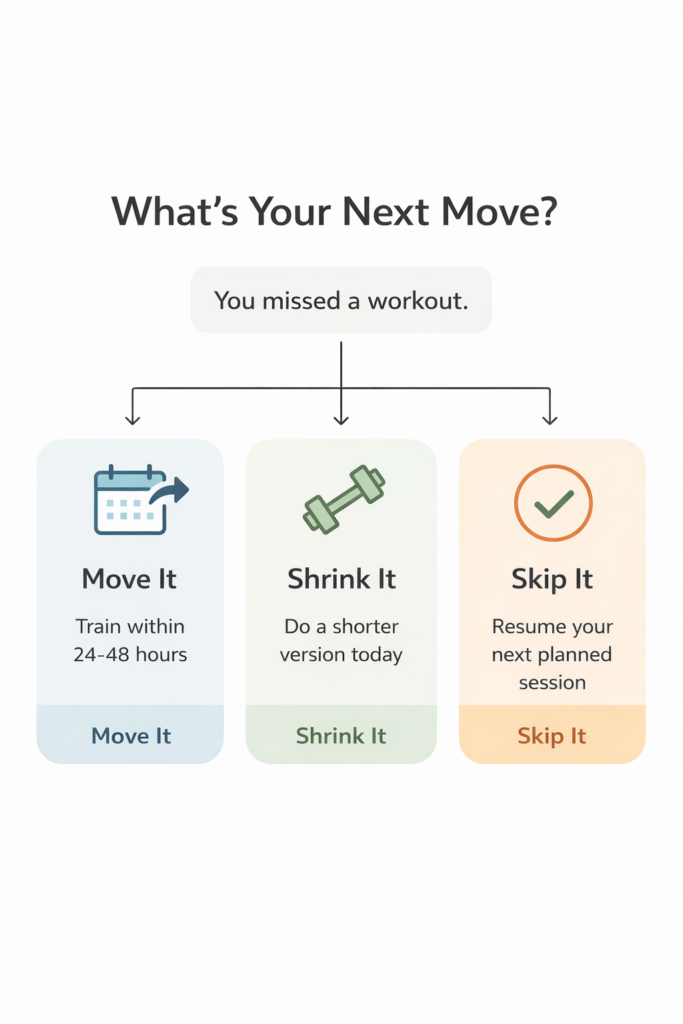
The Only Decision That Matters: Move It, Shrink It, or Skip It
If you decide fast, you can usually avoid the spiral.
Quick Decision Guide
Situation: You missed a workout but you can train tomorrow
Best move: Move it
Why: You reduce the gap and keep the routine intact.
Situation: You missed it and you’re exhausted (sleep, stress, energy)
Best move: Shrink it
Why: You keep the habit without digging a recovery hole.
Situation: You missed it and moving it would cause back-to-back hard/unproductive days
Best move: Skip it
Why: You avoid turning “make up” into needless fatigue and soreness.
Situation: You’re sick, injured, or truly depleted
Best move: Skip it (real rest)
Why: Training isn’t helpful when it’s unsafe.
Situation: You miss workouts often
Best move: Shrink the plan
Why: That’s a plan-dose problem, not a character problem. Simply reduce the dose.
Here’s what each option looks like in real life.
Option 1: Move It (the Cleanest Fix Most of the Time)
If you missed Monday, train Tuesday or Wednesday. Pretty simple.
The only catch: don’t create a “dumb week”.
Bad example: heavy squats Tuesday, heavy deadlift Wednesday, because you “have to catch up.”
That’s not discipline. That’s you investing in soreness, fatigue, and (at worst) injuries in the very near-term future.
Say you missed lower body day. You train it the next day, take your normal rest day, and resume the plan. That’s all there is to it.
If you run an A/B plan (Upper A, Lower A, Upper B, Lower B), treat workouts like a rotation. You don’t “miss Monday.” You didn’t complete the next workout in the queue. So you do the next one when you return.
This is also why “shift everything one day later” works so well for beginners: it keeps your week from getting crowded, and it keeps recovery sane.
Option 2: Shrink It (the Minimum Workout that Still Counts)
This is the move that saves people who are right on the edge of inconsistency.
A minimum workout is not a consolation prize. It’s habit protection.
Here’s how to do it: If you’re at the gym, pick one lower move, one push, and one pull, two sets each, and then leave. That’s ten to twenty minutes. If you’re at home, a round or two of squats, push-ups, and rows (backpack rows) does the same job in under fifteen. And if your energy is genuinely shot, an easy incline walk, a bike, or a short mobility flow for ten minutes counts.
You’re not trying to have the best workout of your life here. You’re just keeping the habit alive.
The habit is what matters. The workout is just proof that the habit is intact.
Option 3: Skip It (Yes, Sometimes That’s the Right Call)
People ask all of the time, “is it okay to skip the gym for a day?” Yes.
Missing a workout does not erase progress. Detraining is real, but it kicks in over weeks, not days. Research on the subject focuses on extended breaks, and even then strength declines in the short term are modest. One missed session doesn’t register physiologically. (1)
So if you missed a workout and the best option is to simply resume your plan, do that.
But skipping has one condition:
Don’t let “skip” turn into “skip again.”
If you miss once, fine. If you miss twice in a row, you start teaching your brain that disappearing is an option. That’s the part that spreads. If you truly want to reach your fitness goals, it’s important to stem the spread here.
“Is It Okay to Skip a Workout for 2 Days?”
Also yes.
But, didn’t I just say that skipping twice in a row is bad?
Yes, but the distinction matters here. Two days off because life got heavy, or because your body genuinely needed rest, is not a crisis. It might even help if you were carrying fatigue. Two days off because you feel guilty (or lazy) and avoidance is easier… that’s what we want to avoid.
Either way, the risk isn’t your muscles evaporating. It’s the narrative inside your head: “See? This is why I can’t stay consistent.”
So if you find yourself two days out, don’t punish-catch-up. That’s when you try to cram two missed sessions into one, or add extra training days to “get back on track”, basically making yourself do more work than normal because you feel guilty. It never helps. You end up sore, tired, and more likely to miss the following week too. Just do the next planned session as written, and if you feel rusty, start with a slightly lighter first set and train normally from there.
If your routine depends on perfect weeks, it’s too fragile.
The Biggest Mistake After a Missed Workout
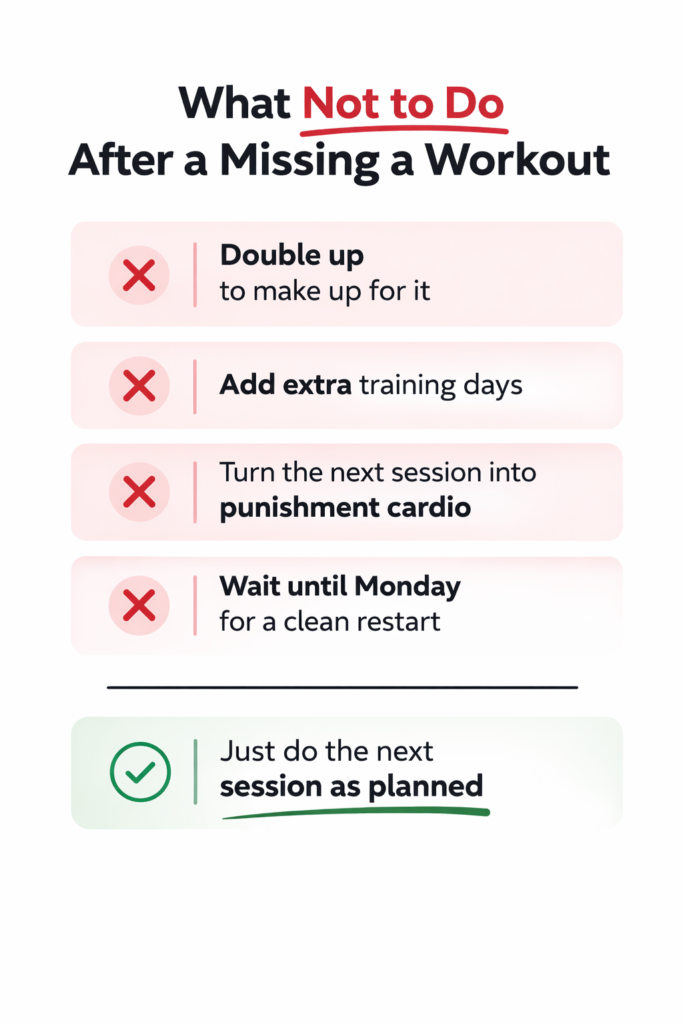
Most people double the next workout to “make up for it,” add extra days and blow up recovery, turn the next session into punishment cardio, or wait until next Monday so it feels like a clean restart. All of these make you more likely to miss again.
Also, frequency of training is not magic if the total work stays the same. A hypertrophy meta-analysis found strong evidence that training frequency doesn’t meaningfully impact muscle growth when volume is equated. (2)
Translation: you don’t need to cram. You need to return.
If You Keep Missing Workouts, Your Plan is Probably Overdosed
If missing workouts has become a pattern rather than an occasional thing, that’s not bad luck.
That’s your program asking for more than your life can reliably give.
Two quick fixes that work for beginners and early-intermediates:
- Cap sessions at 45 minutes.
Long sessions create dread. Dread creates skips. - Drop one training day for a month.
If you “plan” five days but hit three, you’re not a five-day lifter. You’re a three-day lifter with guilt.
A smaller plan done consistently beats a bigger plan done occasionally. Always.
Make It Less Likely You Miss Again
Pick one obstacle that causes most of your missed workouts (late work, low energy, gym anxiety, decision fatigue/paralysis), then write one “if-then” plan.
Example:
“If work runs late, then I do my minimum workout at home.”
Implementation-intention style planning like this has been shown to increase physical activity and confidence under time constraints in a randomized pilot trial. In plain terms: deciding in advance what you’ll do when things go wrong works better than trying to figure it out in the moment. (3)
You’re not trying to win a motivation contest. You’re reducing the number of moments where you renegotiate with yourself.
Next Step Resources (Keep These Near Your Back Pocket)
If you want this to feel easier week after week, these help, and they match what we just did here:
- Read rest day guilt if the emotional spiral is the main issue.
- Use too tired to go to the gym when low energy is the culprit.
- If motivation keeps disappearing at the exact wrong time, read how to get motivated to workout.
- For the full “minimum workout” system and the don’t-skip-twice rule, use how to stay consistent with working out.
- If home options would remove a lot of excuses, here’s a straight answer on whether adjustable dumbbells are worth it or not.
The Bottom Line
A missed workout is normal.
Handle the next 48 hours well, and nothing unravels.
The only thing that matters now is what you do next.
References
- Mujika I, Padilla S. Detraining: loss of training-induced physiological and performance adaptations. Part I: short term insufficient training stimulus. Sports Medicine. 2000;30(2):79-87. doi: 10.2165/00007256-200030020-00002. PMID: 10966148.
- Schoenfeld BJ, Grgic J, Krieger J. How many times per week should a muscle be trained to maximize muscle hypertrophy? A systematic review and meta-analysis of studies examining the effects of resistance training frequency. Journal of Sports Sciences. 2019;37(11):1286-1295. doi: 10.1080/02640414.2018.1555906. PMID: 30558493.
- Robinson SA, Bisson AN, Hughes ML, Ebert J, Lachman ME. Time for change: using implementation intentions to promote physical activity in a randomised pilot trial. Psychology & Health. 2019;34(2):232-254. doi: 10.1080/08870446.2018.1539487. PMID: 30596272. PMCID: PMC6440859.