Weightlifting Routines for Beginners: 4 Programs That Actually Work
If you’re new to lifting, often the hardest part isn’t just the effort. It’s picking a plan you can trust.
I’ve handpicked four weightlifting routines for beginners which have been around for years because they work. They’re simple, predictable, and built around big lifts that add muscle and strength without requiring fancy equipment or “secret” techniques.
I’ll walk you through each option, how to do them without overthinking, and how to decide which one to choose. Then you’ll be able to pick a weight lifting routine and start training this week.
Prefer video? Watch the full breakdown here:
Beginner Weight Lifting Routine: 3-Day + 4-Day Options
Pick your schedule:
- If you can train 3 days/week → pick GreySkull LP or Classic PPL
- If you can train 4 days/week → pick Westside for Skinny Bastards III (WS4SBIII)
- If you want long-term structure → pick 5/3/1
What Makes a Beginner Weight Lifting Routine “Dependable”?
A good beginner plan does three things well:
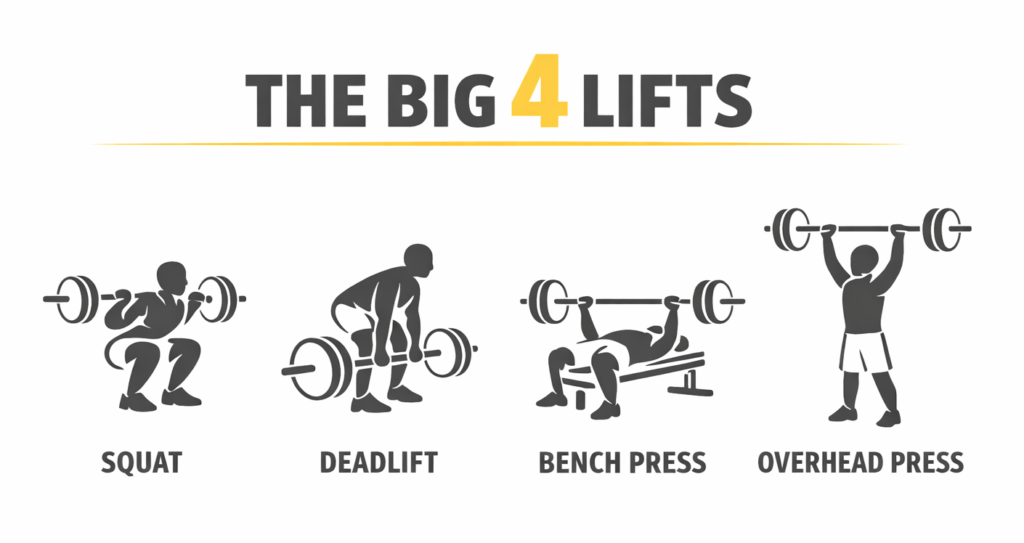
- Uses compound lifts (squat, deadlift, bench, overhead press, rows, chin-ups, etc.)
- Progresses in a clear way (you know when and how to add weight).
- Respects recovery (you can train hard without getting crushed every session).
If a routine is missing one of those, it’s usually not “beginner-friendly.” It might still work, but it’s harder to stick to.
The Four Routines Summarized (For People in a Hurry)
WS4SBIII (4 days/week): Heavy + speed + hypertrophy in one plan, with good recovery baked in.
5/3/1 (3-4 days/week): Long-term strength framework with a clear progression model, a built-in starting max to keep weights realistic, and planned deloads.
Classic PPL (3-day): Straightforward push/pull/legs split built around compound lifts, simple to follow, solid for muscle gain.
GreySkull LP (3 days/week): Simple linear progression with AMRAP sets for fast early progress and built-in motivation.
Quick pick: For muscle gain, choose WS4SBIII or Classic PPL. For strength, choose GreySkull LP or 5/3/1.
Days per week: 4 days → WS4SBIII or 5/3/1. 3 days → Classic PPL or GreySkull LP (or 3-day 5/3/1).
Skip to a 3-day routine → Classic PPL
Skip to a 4-day routine → WS4SBIII
Long-term strength option → 5/3/1
Fast strength start → GreySkull LP
1) Westside for Skinny Bastards III (WS4SBIII)
Joe DeFranco’s Westside for Skinny Bastards, Part 3 is a classic for a reason. It blends heavy strength work, speed work, and higher-rep muscle-building days in a weekly structure that feels athletic and fun. (1)
It’s especially good if you’re the classic “skinny beginner” who wants to add size while still getting noticeably stronger. It’s also a top choice for those who want to be in the gym more than three days per week.
The Basic Weekly Split
DeFranco gives options, but a common layout looks like this:
- Mon: Max Effort Upper
- Tue: Dynamic Effort Lower
- Wed: Off
- Thu: Repetition Upper
- Fri: Max Effort Lower
- Sat: Off
- Sun: Off
There’s also an alternate weekly flow that shifts the days around if your schedule demands it. The point is the same: two upper days, two lower days, and plenty of recovery time.
Week at a Glance
Mon: Lower (heavy)
Tue: Upper (heavy)
Thu: Lower (speed + assistance)
Fri: Upper (speed + assistance)
Progression: Add a small amount of weight when you hit all sets cleanly (don’t grind).
Why It Works for Beginners
- You practice heavy lifting without maxing out every week.
- You build muscle on the repetition day (where beginners often need more volume).
- You get structure without being locked into one exact exercise forever.
DeFranco also discusses variations like the “Washed-up Meathead” template, which swaps out the dynamic lower day for a more aesthetic-focused bodybuilding day.
Best for: beginners who can train 4 days/week and want size and strength together.
2) Jim Wendler’s 5/3/1
Jim Wendler’s 5/3/1 is a no-drama strength system that emphasizes slow, steady progress. It’s the opposite of “PR every workout.” You build strength by stacking good training cycles. (2)
The key concept is the Training Max: you start with a conservative number (often 90% of your true 1-rep max) and base your work off that.
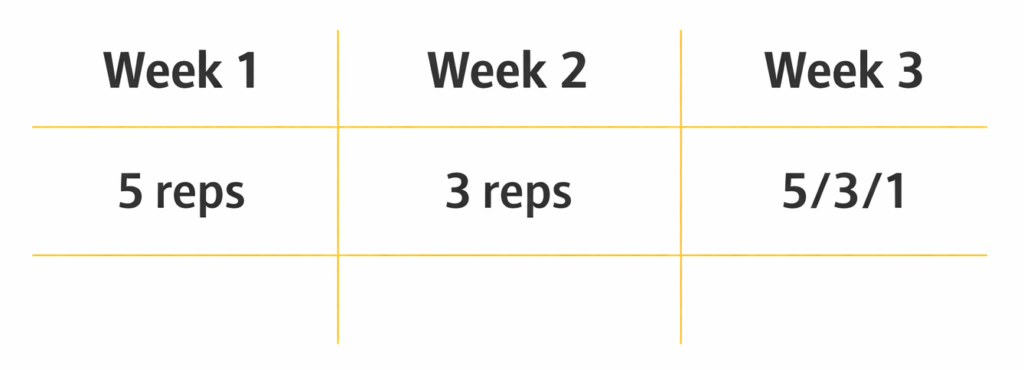
The Basic Three-Week Wave
Wendler’s main lift progression is famously simple:
- Week 1: 3 sets of 5
- Week 2: 3 sets of 3
- Week 3: 5, 3, 1
Then you deload on week 4 in many templates.
Week at a Glance
Main lifts: Squat, Bench, Deadlift, Press (one main lift per session)
Weekly flow: 3 hard-ish weeks → 1 deload week
Assistance: 2–4 accessory moves after the main lift (keep it simple)
Progression: Add a little weight to your starting max each cycle; reps are the goal.
Why It Works for Beginners (Even If It Looks “Advanced”)
- The weights are manageable because the Training Max keeps you honest.
- The progression is baked in so you don’t have to guess.
- Planned deloads help you recover before you stall. (3)
Most versions also add a couple assistance exercises each session, usually done for higher reps to build muscle and reinforce weak points.
Best for: beginners who want a long-term strength plan and prefer training that feels sustainable.
3) Classic Push Pull Legs (PPL) Split
A Push Pull Legs routine is simple on paper and effective in real life: you group muscles by movement pattern and train each group when it’s fresh.
Old School Trainer’s classic 3-day PPL template is a clean entry point because it keeps exercise selection tight and recovery reasonable. (4)
The Split
- Push: chest, shoulders, triceps
- Pull: back, biceps
- Legs: quads, hamstrings, calves
A Monday, Wednesday, Friday schedule works well for most people.
The biggest mistake with PPL is going in cold and turning your first “push day” into a random chest marathon. A simple pre workout routine for beginners helps a lot here, because you’ll actually feel stable on presses and rows instead of rushing through warm-ups.
Week at a Glance
Mon: Push (bench/press focus + triceps/shoulders)
Wed: Pull (row/pulldown focus + biceps/rear delts)
Fri: Legs (squat/hinge focus + quads/hamstrings)
Progression: Add reps first; add weight when you reach the top of your rep range.
The “5×5 Backbone”
Many PPL templates lean on 5×5-style loading for compound lifts. If you’ve seen “5×5” but never understood how to execute it, there are two common ways:
- Straight sets: same weight for all 5 sets
- Ramping sets: add weight each set until your top set (5)
About Rest-Pause (Use It carefully)
This PPL approach also often mentions rest-pause, which is a high-intensity method where you rest briefly and squeeze out more reps. It can be effective, but it’s also easy for beginners to overdo it. (6)
A simple rule: try rest-pause only on safer lifts (machine press, cable row, dumbbell work), not barbell squats or deadlifts.
Best for: beginners who like bodybuilding-style training, want muscle focus, and can commit to consistent 3-day weeks.
4) GreySkull LP (Phraks variation)
GreySkull Linear Progression (GSLP) is a 3-day, full-body routine with a beginner-friendly structure: you hit the main lifts frequently, keep total volume manageable, and progress in a straight line for as long as you can.
A popular beginner-friendly tweak is the Phraks variation, which often includes rows to balance out all the pressing. (You’ll see it referenced widely in beginner lifting communities and trackers.) (7)
A Simple Weekly Structure (3 Days/Week)
Across the week, you rotate the main patterns:
- Pressing: Overhead press and bench (alternating)
- Pulling: Chin-ups and barbell rows (alternating)
- Lower body: Squat most days, deadlift on one day
A common layout looks like this:
- Day 1: Press variation, pull variation, squat
- Day 2: Press variation, pull variation, deadlift
- Day 3: Press variation, pull variation, squat
Week at a Glance
Mon: A Day
Wed: B Day
Fri: A Day (next week: B/A/B)
A Day: Squat + Bench + Row
B Day: Squat + Press + Deadlift
Progression: Add weight each session while reps are solid; use the last set AMRAP to drive progress.
The Feature Beginners Love: AMRAP
GreySkull is known for an AMRAP set on the last set of the main lift (as many reps as possible with good form). Done right, it keeps training fun and helps you push past plateaus without changing the whole program.
A spreadsheet or tracker can make the linear increases easy to manage, especially when you hit a reset.
Accessory Work, Without Getting Lost
Accessories matter, but they come after the main lift they support. So lunges after squats, rows after pressing, curls after pulling.
Pick 1–3 accessory moves per session, keep them simple, and aim to add reps or a little weight over time.
Best for: true beginners who want a clear “do this, add weight, repeat” plan three days a week.
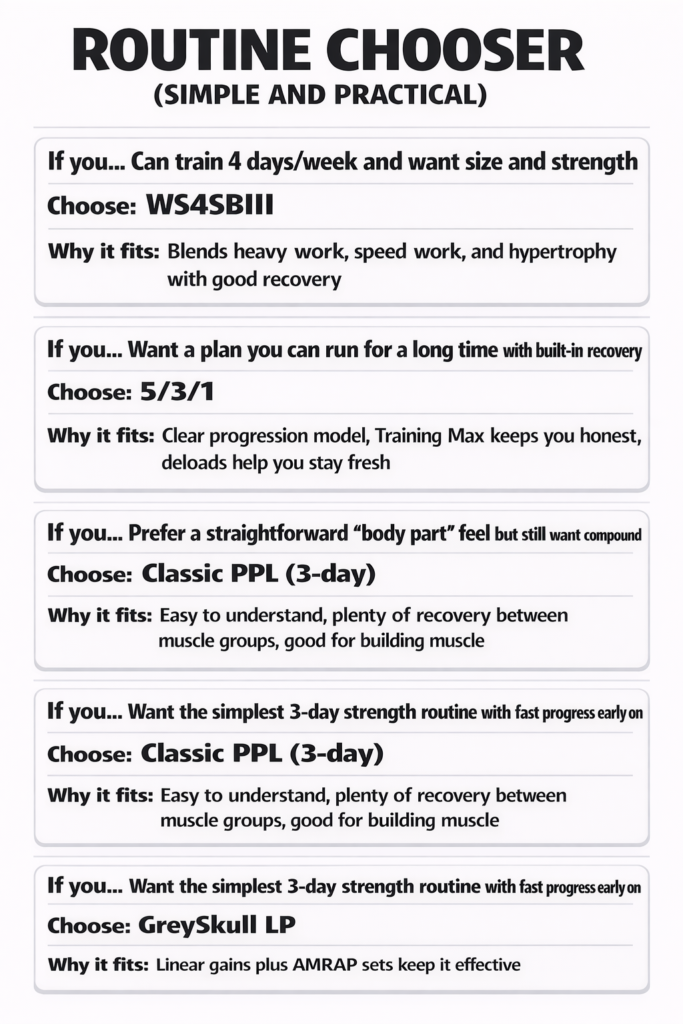
How to Choose Between These 4 Weightlifting Routines for Beginners
If you’re stuck, use this quick filter:
- You can train 4 days/week and want size + strength: WS4SBIII
- You want a long-term strength system with planned deloads: 5/3/1
- You want a muscle-focused split that’s easy to understand: PPL
- You want the simplest path to getting strong, 3 days/week: GreySkull LP
Also be honest about your schedule. The “best” routine is the one you can run for 12 straight weeks. If nerves are the bottleneck, solve that first with fear of the gym and the practical steps in how to start going to the gym alone.
Summary: Pick the routine that matches your weekly availability first, then your training style, and commit for 8–12 weeks before changing anything.
Routine Chooser (Simple and Practical)
How to Make Any Weightlifting Routine for Beginners Work Better
No matter which routine you choose, these rules keep you progressing.
Use Progressive Overload, but Keep Form Clean
Progressive overload can mean:
- add 5 lb next week
- do 1 more rep with the same weight
- add a set to an accessory lift
If your form falls apart, it’s not overload. It’s practice for getting hurt.
Deload Before You’re Forced to
5/3/1 builds this in.
With other programs, take a lighter week every 4–8 weeks if you’re feeling beat up, your sleep is off, or your reps are sliding.
Track Your Lifts Like It’s Your Job
You don’t need a fancy app. You need a log that answers:
- What weight did I use?
- How many reps did I get?
- What do I do next time?
Summary: Add small amounts of weight or reps over time, deload when fatigue piles up, and track everything so progress is automatic.
Your Next Step: Pick One Routine and Run It for 12 Weeks
Here’s the low-friction plan:
- Choose one of the four routines above.
- Print it or put it in your notes app.
- Train it for 12 weeks with consistent sleep and protein.
- Only change things if you’re missing workouts or stalling for multiple weeks.
If you want to eventually build your own program, that’s a great goal. But early on, following a proven template teaches you what “effective training” actually feels like.
Quick Checklist for Your First Week
- ✅ Learn the basic barbell form (ask a coach if you can)
- ✅ Start lighter than you think you need
- ✅ Leave 1–2 reps in the tank on most sets
- ✅ Add weight gradually, not emotionally
References
- Joe DeFranco, “Westside for Skinny Bastards, Part III” (DeFranco’s Training). https://www.defrancostraining.com/westside-for-skinny-bastards-part3/ (defrancostraining.com)
- Jim Wendler, “5/3/1: How to Build Pure Strength” (T-Nation). https://t-nation.com/t/5-3-1-how-to-build-pure-strength/281694 (t-nation.com)
- Jim Wendler, “5/3/1 Philosophy for Beginners” (jimwendler.com). https://www.jimwendler.com/blogs/jimwendler-com/101065094-5-3-1-for-a-beginner (jimwendler.com)
- Old School Trainer, “The Classic Push Pull Legs Routine” (oldschooltrainer.com). https://oldschooltrainer.com/3-day-push-pull-legs/ (oldschooltrainer.com)
- StrongFirst, “StrongFirst on the 5×5 Method” (strongfirst.com). https://www.strongfirst.com/strongfirst-on-5×5/ (strongfirst.com)
- Andy Baker, “Rest-Pause Sets (More Muscle in Less Time)” (andybaker.com). https://www.andybaker.com/rest-pause-sets-more-muscle-in-less-time/ (andybaker.com)
- Lift Vault, “Greyskull Linear Progression Spreadsheet” (liftvault.com). https://liftvault.com/programs/strength/greyskull-linear-progression-spreadsheet/ (liftvault.com)
- Reddit r/Fitness, “Greyskull LP spreadsheet calculator” (u/blacknoir post). https://www.reddit.com/r/Fitness/comments/1sxov5/i_made_a_greyskull_lp_gslp_spreadsheet_calculator/ (reddit.com)