

Upper Lower vs Push Pull Legs: The Real Answer
You’ve spent three days googling ‘upper lower vs push pull legs’ and asking ChatGPT, and somehow you’re more confused than when you started. One guy swears PPL is the only way. Another says upper/lower is ‘elite for natties.’ ChatGPT said ‘both can work depending on your goals.’ Cool, but which one actually works for normal people?
The truth: Upper/lower can be simple and effective. PPL can be simple and effective. The difference is mostly about how you spread your workouts across the week and how much volume and recovery you can handle.
By the end of this post, you’ll know exactly what each split is good at, what it tends to mess up for beginners, and how to pick the one that fits your schedule so you actually stick with it.
You’ll leave with:
- a simple decision rule based on how many days/week you can realistically train,
- a clear breakdown of how 3-, 4–5-, and 6-day PPL schedules actually differ (and why 6 days often backfires),
- a plug-and-play rotating PPL (4–5 days/week) schedule,
- and a beginner-proof upper lower 4 day split you can run for 8–12 weeks without overthinking.
Start here: the 30-second decision rule
Here is the clean, straightforward answer about how to choose between upper lower vs push pull legs:
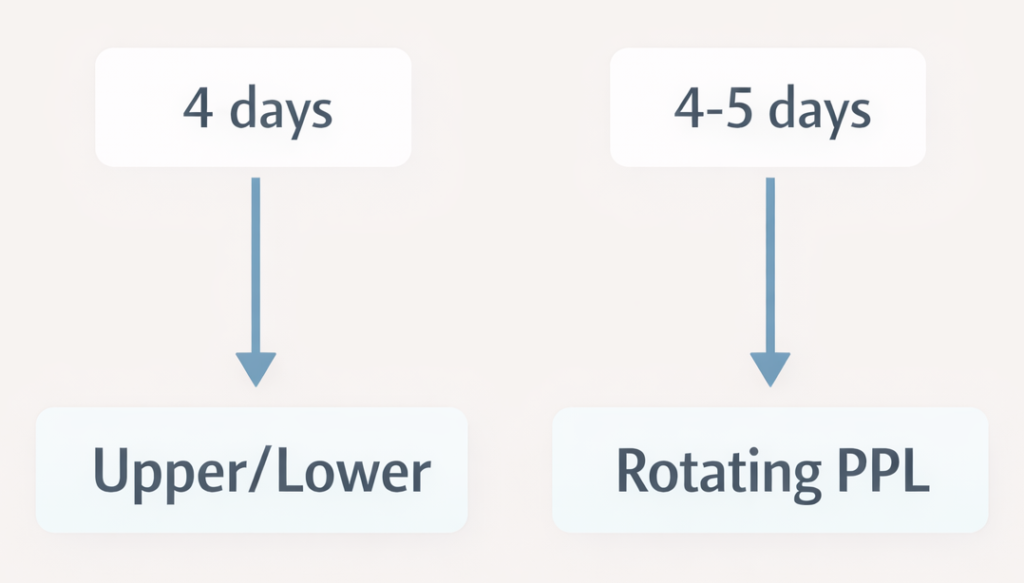
- If you can train 4 days/week consistently: start with Upper/Lower.
- If you can train 4–5 days/week consistently and want more variety: run a rotating PPL.
- If you can only train 3 days/week: PPL can work, but it’s usually slower for beginners than you want (more on that below).
- If you think you can train 6 days/week: awesome… but choose based on your worst normal week, not your best motivated week.
You’re not trying to win a “hardest routine” contest. You’re trying to achieve consistency.
What actually matters (and what doesn’t)
Let’s get this out of the way: your split is not a magic spell.
Results mostly come from:
- Weekly hard sets (volume) per muscle
- Progressive overload (more reps, more weight, better form over time)
- Recovery (sleep, stress, soreness, not constantly limping around)
How often you train matters, but it won’t magically give you results on its own. Research suggests that working a muscle group more frequently can help you build size and strength, mainly because it lets you spread out your hard work across more sessions. However, if you’re doing the same total amount of work each week, it doesn’t make much difference for muscle growth whether you do it in two sessions or four. (1)(2)
Bottom line: the “best” split is the one that lets you train hard, recover, and repeat for months.
Upper/Lower: why it’s a beginner cheat code (in a good way)
An upper/lower split divides the week into:
- Upper: chest, back, shoulders, arms
- Lower: quads, hamstrings, glutes, calves, abs
The classic setup is 4 days/week, training most muscle groups about twice per week.
Why upper/lower works so well when you’re starting to get serious
1) It nails the “practice and recovery” balance.
You get frequent exposure to big movement patterns (squats, rows, presses, etc.) without needing to live in the gym or shred your muscles into oblivion.
2) It forces you to learn the basics.
Beginners usually need more reps on the fundamentals: squat pattern, hinge, press, pull, row. Upper/lower naturally nudges you toward those.
3) It’s hard to screw up.
When the plan is simple, you actually do it. That’s half the battle.
The downside
Upper days can get long if you try to do “everything.” New lifters often turn upper day into a 75–105 minute marathon and then wonder why they dread it.
Fix: pick 2–3 big lifts, then 2–4 accessories. Done.
Push Pull Legs: why it’s so popular (and why people mess it up)
A push pull legs routine groups movements like this:
- Push: chest, shoulders, triceps
- Pull: back, rear delts, biceps
- Legs: quads, hamstrings, glutes, calves
It’s popular because it feels organized. You always know what day it is, and you can focus on fewer muscle groups per session.
Why PPL is great
1) More focus per muscle group per session.
You can hit a muscle with a couple angles and get a good “complete” session.
2) Easy to scale volume.
Want bigger shoulders? Add sets on push days. Want more lats? Add a pulldown or row variation on pull day. Doing more work (volume) each week helps you build muscle, but there’s a limit where more isn’t always better. (3).
3) It’s honestly fun.
You get a clearer pump and a clearer theme to each workout.
The problem: “PPL” can mean three totally different schedules
This is where beginners get trapped.
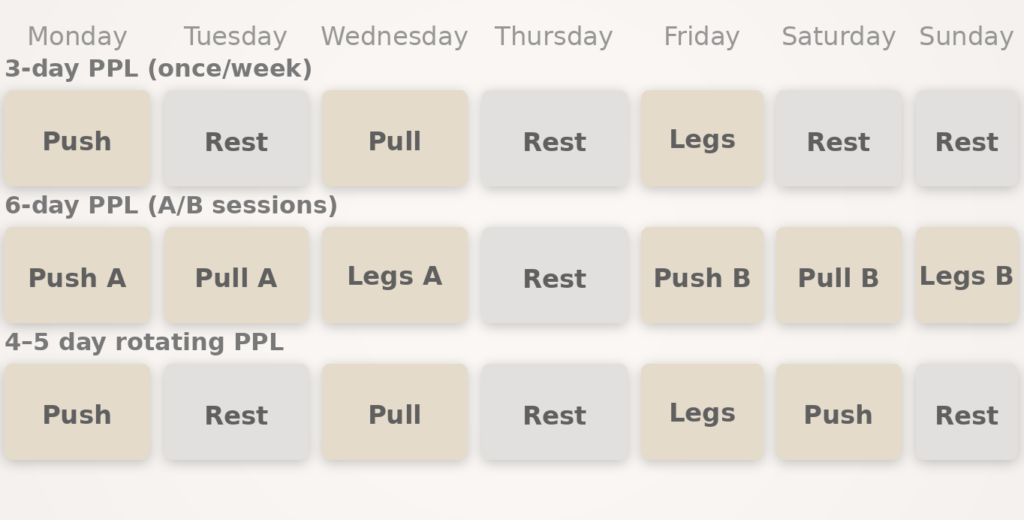
- 3-day PPL: Push/Pull/Legs once per week
- 6-day PPL: Push/Pull/Legs repeated twice per week
- 4–5 day rotating PPL: You rotate through P-P-L across the week with built-in rest
All are “PPL,” but they feel very different.
Why 6 days/week PPL is usually too much (and not necessary)
A classic 6-day PPL hits each muscle group around twice per week and lets you do lots of volume. Sounds amazing, right?
But most people aren’t training in a perfect bubble.
For normal humans, 6 days/week tends to be a problem because:
- Scheduling friction is real. Miss one day and the whole week feels off.
- Recovery becomes a juggling act. Sleep dips, stress spikes, and suddenly every session feels heavy.
- Joints and tendons complain. Especially if you lift hard and don’t manage fatigue.
- Motivation drops. A plan you resent is a plan you won’t repeat.
- Enjoyment declines. You might feel pumped for a couple weeks, but think about it: in the span of 4 weeks, you are doing 24 workouts! That’s a lot, even for gym bros.
Could you do it? Maybe. Is it the smartest move for most beginners? Usually not.
You don’t need six days to grow. You need reliable weeks, done consistently over time.
The best “real life” PPL: rotating 4–5 days/week
Instead of forcing a 6-day loop, you rotate through push, pull, and legs across the week. One week might land on 4 sessions, the next week might land on 5, depending on where you are in the rotation.
It keeps:
- the PPL simplicity,
- the exercise variety,
- the focused sessions…
…but adds breathing room so you can recover and not melt down when life gets busy.
Example rotating PPL schedule (4–5 days/week)
Week 1
- Sun: Push A
- Mon: Pull A
- Tue: Off
- Wed: Legs A
- Thu: Off
- Fri: Push B
- Sat: Pull B
Week 2
- Sun: Off
- Mon: Legs B
- Tue: Off
- Wed: Push A
- Thu: Pull A
- Fri: Off
- Sat: Legs A
Week 3
- Sun: Off
- Mon: Push B
- Tue: Pull B
- Wed: Off
- Thu: Legs B
- Fri: Off
- Sat: Push A
If you track it in a notes app (or a workout log), it’s easy. You simply do the next workout in the rotation when you’re back in the gym.
Sample training splits you can copy today
You don’t need fancy. You need repeatable.
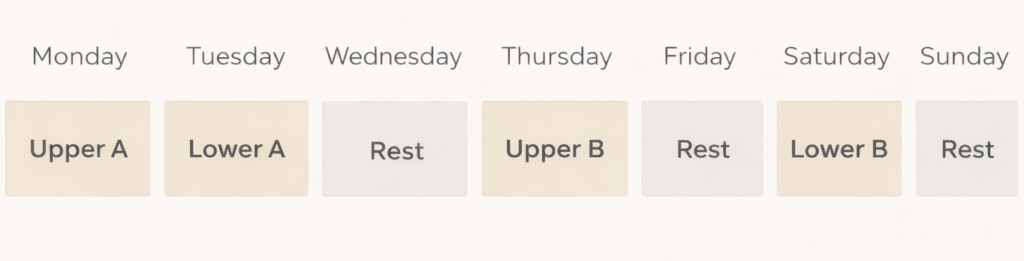
Option 1: Upper Lower 4 day split (beginner-proof)
Time: 60–75 minutes/session
Schedule (simple and sustainable):
- Sunday: Off
- Monday: Upper A
- Tuesday: Off
- Wednesday: Lower A
- Thursday: Upper B
- Friday: Off
- Saturday: Lower B
Upper A
- Row (barbell or cable): 3–4 sets (6–12 reps)
- Incline DB bench: 3–4 sets (6–12)
- Lateral raise: 2–3 sets (12–20)
- Shrug or rear delt work: 2 sets (10–15)
- Curl: 2 sets (10–15)
- Triceps pushdown: 2 sets (10–15)
Lower A
- Back squat (or leg press): 3–4 sets (5–10)
- Pull-throughs or RDL: 3 sets (6–12)
- Standing calf raise: 3 sets (10–15)
- Abs (cable/band crunch): 2–3 sets (10–15)
Upper B
- Overhead press (military or DB): 3–4 sets (5–10)
- Pull-ups or pulldown: 3–4 sets (6–12)
- DB floor press (or flat press): 2–3 sets (6–12)
- Face pulls: 2–3 sets (12–20)
- Hammer curl: 2 sets (10–15)
- Triceps extension: 2 sets (10–15)
Lower B
- Romanian deadlift: 3–4 sets (5–10)
- DB lunge: 2–3 sets (8–12)
- Seated calf raise: 3 sets (10–15)
- Ab circuit: 5–8 minutes
Want more beginner templates? Check out these 4 weightlifting routines for beginners.
Option 2: Rotating PPL (4–5 days/week)
Time: 50–75 minutes/session
How to run it: follow the rotating schedule above, alternating A and B days.
Push A
- Incline DB bench: 3–4 sets (6–12)
- Seated DB shoulder press: 3 sets (8–12)
- Seated lateral raise: 3 sets (12–20)
- Band or cable pullover (optional chest/serratus feel): 2 sets (12–15)
- Overhead triceps extension: 2–3 sets (10–15)
Pull A
- Weighted pull-up or pulldown: 3–4 sets (6–12)
- Seated cable row or machine row: 3–4 sets (8–12)
- Bent-over rear delt fly: 2–3 sets (12–20)
- Barbell curl: 3 sets (10–15)
Legs A
- Back squat: 3–4 sets (5–10)
- Cable/band pull-through: 3 sets (8–12)
- Standing calf raise: 3 sets (10–15)
- Kneeling cable/band crunch: 2–3 sets (10–15)
Push B
- Military press: 3–4 sets (5–10)
- DB floor press: 3–4 sets (6–12)
- Band front raise (optional): 2 sets (12–15)
- DB floor fly (optional): 2 sets (12–15)
- Band pushdown: 2–3 sets (10–15)
Pull B
- Pendlay row (or chest-supported row): 3–4 sets (6–12)
- Lat pulldown (different grip): 3 sets (8–12)
- DB shrug: 2 sets (10–15)
- DB preacher curl: 2–3 sets (10–15)
Legs B
- RDL: 3–4 sets (5–10)
- DB lunge (or hack squat): 2–3 sets (8–12)
- Seated calf raise: 3 sets (10–15)
- Ab circuit: 5–8 minutes
If your workouts feel chaotic before you even touch a weight, a warm-up routine helps. Here’s a quick one: pre workout routine for beginners.
Option 3: PPL routine (3 days/week) if that’s your reality
If you can only train three days, you can still use a push/pull/legs workout. Just know it’s typically less frequent per muscle, so progress can feel slower early on. However, your workouts are going to be slightly longer since you’re only going to be in the gym 3 days per week hitting each muscle once per week. So, you want to make it count.
Time: 60–75 minutes/session
Schedule:
- Mon: Push
- Wed: Pull
- Fri: Legs
Push
- Bench or incline DB: 3–4 sets
- Overhead press: 3 sets
- Cable flys: 3 sets
- Lateral raises: 3 sets
- Front raises: 3 sets
- Triceps: 2–3 sets
Pull
- Pulldown or pull-ups: 3–4 sets
- Row: 3–4 sets
- (Optional) Another row variation: 2-3 sets
- Rear delts: 2–3 sets
- DB or BB Shrugs: 2-3 sets
- Biceps: 2–3 sets
Legs
- Squat/leg press: 4 sets
- RDL: 3 sets
- Lunges: 2–3 sets
- Leg extension/Leg curl: 2-3 sets
- Calves: 2-3 sets
- Abs: 2-3 sets
If you want a 3-day plan that feels more “beginner optimized,” full-body is often the smartest move. But if you love and want to go with a PPL, this version works.
Upper lower vs push pull legs: pros and cons
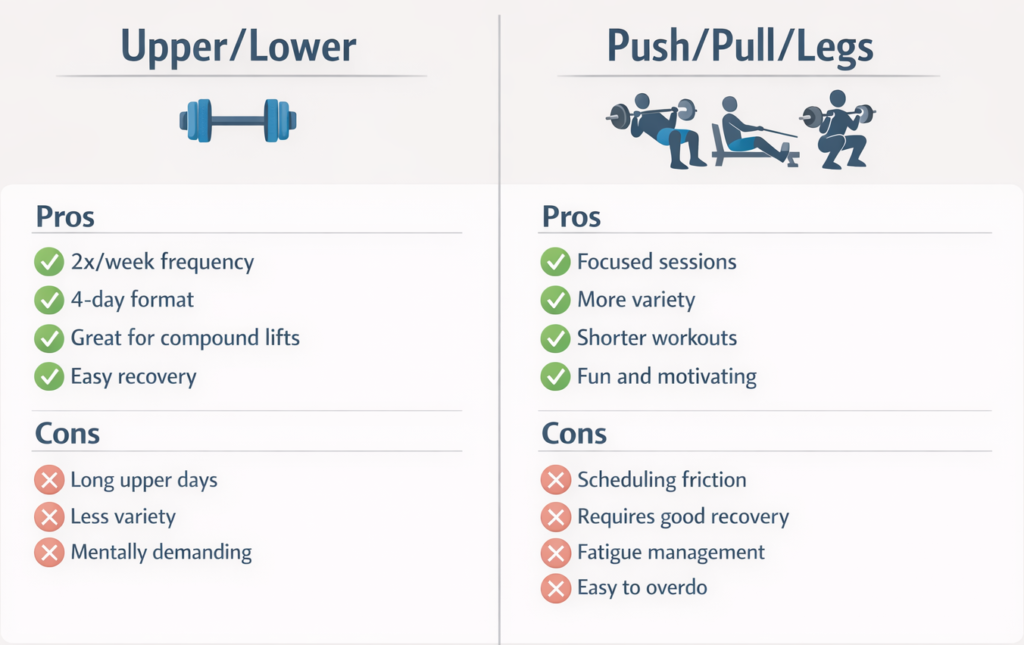
TL;DR Summary: Upper/lower is the safest, simplest bet for most beginners. Rotating PPL is a great next step if you want more variety without the burnout.
“Which split should I choose?” Here’s the honest answer (table)
| If you… | Choose this split |
|---|---|
| • Want a simple plan you can run for months • Can train 4 days/week • Want to get stronger fast on the basics | Upper/Lower (4 days/week) |
| • Enjoy variety and focused sessions • Can train 4–5 days/week • Want more attention per muscle group | Rotating PPL (4–5 days/week) |
| • Already proven you recover well • Your schedule is unusually stable • Enjoy being in the gym almost daily • You’re not constantly getting fatigued | Be cautious, but 6-day PPL can work |
You can always build up. You don’t have to start at the max.
FAQ: Upper Lower vs Push Pull Legs
Is an upper-lower split better than push-pull legs?
Often, yes for beginners, mainly because it’s easier to run well.
- 4 days/week: Upper/lower usually wins (simple, consistent, solid recovery, good frequency).
- 4–5 days/week: Rotating PPL can be just as good if you like more variety.
- 6 days/week: Classic PPL can work, but it’s unnecessary for most people.
What are the disadvantages of upper lower splits?
- Upper days can run long if you add too many exercises.
- Less exercise variety per muscle group compared to PPL.
- Compound-heavy feel, which can be mentally tiring if you always push heavy.
- Weak points (like side delts/arms/calves) may need extra planned sets.
Upper lower vs push pull legs for fat loss: Which is better?
Neither is “better” for fat loss by itself. Diet and consistency drives fat loss.
That said, upper/lower often fits cutting better because it’s usually easier to recover from. If PPL turns into a 6-day grind, it can be harder to sustain in a calorie deficit. Pick the split you’ll hit every week.
What about a push pull upper lower split?
A push/pull/upper/lower hybrid is a solid middle ground: more focus than upper/lower, less grind than 6-day PPL.
Example 4-day layout:
- Mon: Push
- Tue: Pull
- Thu: Upper
- Fri: Lower
Just keep the “Upper” day tight so it doesn’t become a 2-hour mess.
Next step: do this in 10 minutes and stop overthinking
Say this exactly:
“I’m choosing the split I can do on my busiest normal week.”
10-minute checklist
- Pick your weekly training days (4 vs 4–5 is the big fork)
- Choose: upper lower 4 day split or rotating PPL
- Pick 4–6 core lifts you’ll keep for 8–12 weeks
- Write down today’s working weights and reps
- Next week: add 1 rep or 2.5–5 lb to one main lift
That’s it. That’s the game.
References
- Schoenfeld BJ, Ogborn D, Krieger JW. Effects of Resistance Training Frequency on Measures of Muscle Hypertrophy: A Systematic Review and Meta-Analysis. Sports Medicine. 2016;46(11):1689-1697.
- Schoenfeld BJ, Grgic J, Krieger J. How many times per week should a muscle be trained to maximize muscle hypertrophy? A systematic review and meta-analysis of studies examining the effects of resistance training frequency. Journal of Sports Sciences. 2019;37(11):1286-1295.
- Schoenfeld BJ, Ogborn D, Krieger JW. Dose-response relationship between weekly resistance training volume and increases in muscle mass: A systematic review and meta-analysis. Journal of Sports Sciences. 2017;35(11):1073-1082.
- Grgic J, Schoenfeld BJ, Davies TB, Lazinica B, Krieger JW, Pedisic Z. Effect of Resistance Training Frequency on Gains in Muscular Strength: A Systematic Review and Meta-Analysis. Sports Medicine. 2018;48(5):1207-1220.