How to Stay Consistent With Working Out (When Motivation Tanks)
Learning how to stay consistent with working out took me a long time to master. I had many long stretches of inconsistency. But eventually I found a way to do it. To make not showing up feel strange.
This guide is for beginners and early-intermediate gym-goers who genuinely want to stay consistent in the gym but keep falling off. If you think your problem is laziness… I’m here to tell you that you’re wrong. The real problems are complexity, bad timing, and the fact that life doesn’t care about your program.
Staying consistent with working out isn’t about becoming a disciplined robot. It’s about making the next workout feel easy enough to start and predictable enough to repeat.
In this post, you’ll get a simple system to build a workout routine tailor-made for easy consistency wins, plus how to win the mental reframe battle.
Start here: the 10-minute setup that makes workouts “automatic”
Do this today. Seriously. 10 minutes. This isn’t some major commitment or life overhaul… just a small setup that makes tomorrow easier.
- Pick your “minimum workout.” This is your safety net: the smallest workout that still counts (and keeps the habit alive).
- Choose 2–3 weekly workout days you can repeat for a month.
- Pick a workout time and a backup time.
- Reduce future road blocks tonight: pack your bag, set shoes out, charge headphones.
Bottom line: if starting feels annoying, consistency with working out will always feel hard.
The real goal: a consistent workout schedule you can repeat on your worst week
Most people fail because they plan for their “best self.” The version of you who sleeps 8 hours, finishes work on time, helps an old lady cross the street, and saves a kitten on your way home.
So let’s plan for the tired, not 100% “on” version of you (the one where you don’t even notice the kitten trapped in the tree).
A good consistent workout schedule should feel sturdy when your week is messy. Same days most weeks (so you don’t renegotiate with yourself when you aren’t “feeling it”), short enough that you don’t dread it, and flexible enough that one missed session doesn’t feel like a lost chapter you can’t get back.
Why “same day, same time” actually works:
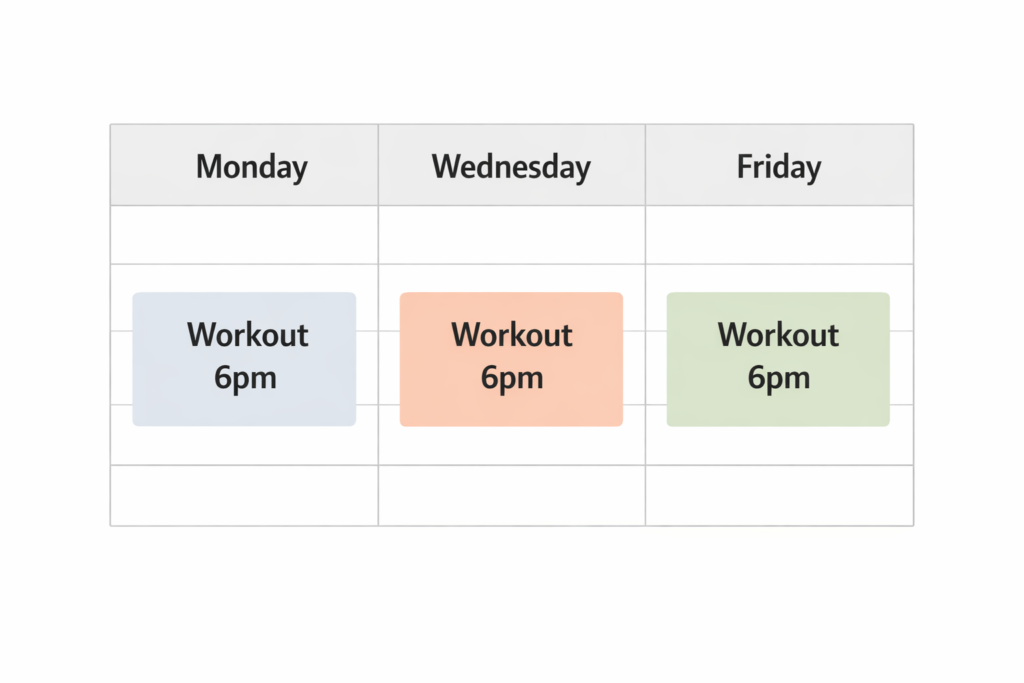
When you work out every Monday at 6pm, your brain stops having to decide. The calendar becomes the trigger. You stop debating whether to go. You just go because that’s what happens on Mondays at 6pm.
This is what psych researchers mean when they say behaviors become automatic with repetition. The decision gets easier because the pattern is already there. (1)
A simple schedule that works for most beginners (3 days/week)
Most beginners (especially those struggling with consistency) do best with 20–45 minutes per session (including warm-up), about three times a week. Keep it simple: each day includes a lower body move plus a push and a pull. Balanced, repeatable, hard to mess up.
If you want established, proven routines, check out these 4 weightlifting routines for beginners.
And if you still feel lost or unsure walking into the gym, read: how to start going to the gym.
Use the “minimum workout” rule (this is how to consistently workout long-term)
Let’s lock this in once, clearly, so it doesn’t keep popping up like a pop quiz.
Your minimum workout is the smallest version of your workout that still counts. It exists for one reason: to protect consistency on the days you’re most likely to quit. You’re not using it to chase progress. You’re using it to keep the habit alive until progress becomes easier to earn. So, paradoxically, by not chasing progress in the short term, you guarantee it in the long term.
Think of it like keeping a campfire lit. You don’t need a bonfire every day. You need a flame. That’s how you get consistent workout results over time: not by being intense, but by being hard to derail.
Habit research backs this up: repetition matters more than intensity, and the “automatic” feeling builds gradually. It doesn’t flip on overnight. (1)
Minimum workouts for every situation
These are intentionally small. That’s the point.
Gym minimum when it’s packed: Do 2 sets of goblet squats (squats holding a dumbbell), 2 sets of machine chest press, then leave. That’s the habit protection in action.
Home minimum when exhausted: 20 squats + 20 push-ups and you’re done. No warm-up drama. Just move.
“I have 8 minutes before a meeting” minimum:
One working set of goblet squats, one set of push-ups, one set of dumbbell rows. Fast, unpleasant, effective, over.
Traveling/hotel minimum:
Find the hotel gym. One set of whatever’s available: dumbbell press, bodyweight squats, or machine row. Something with resistance. 5 minutes, done.
Injured/sore minimum:
10 minutes of mobility work, light stretching, or even just walking. If you’re hurt, your “workout” is showing up for recovery. That still keeps you consistent.
Word-for-word: what to say on low-energy days
Say this exactly: “I only have to do the minimum. Anything extra is a bonus.”
I’ve driven to the gym before, got out of the car, stood in the parking lot for 30 seconds, then got back in and drove home. So, I know what it’s like to just “not have it today”. And ya know what? I wish I had this idea of a minimum workout back in those days.
Don’t skip twice: the rule that protects your identity
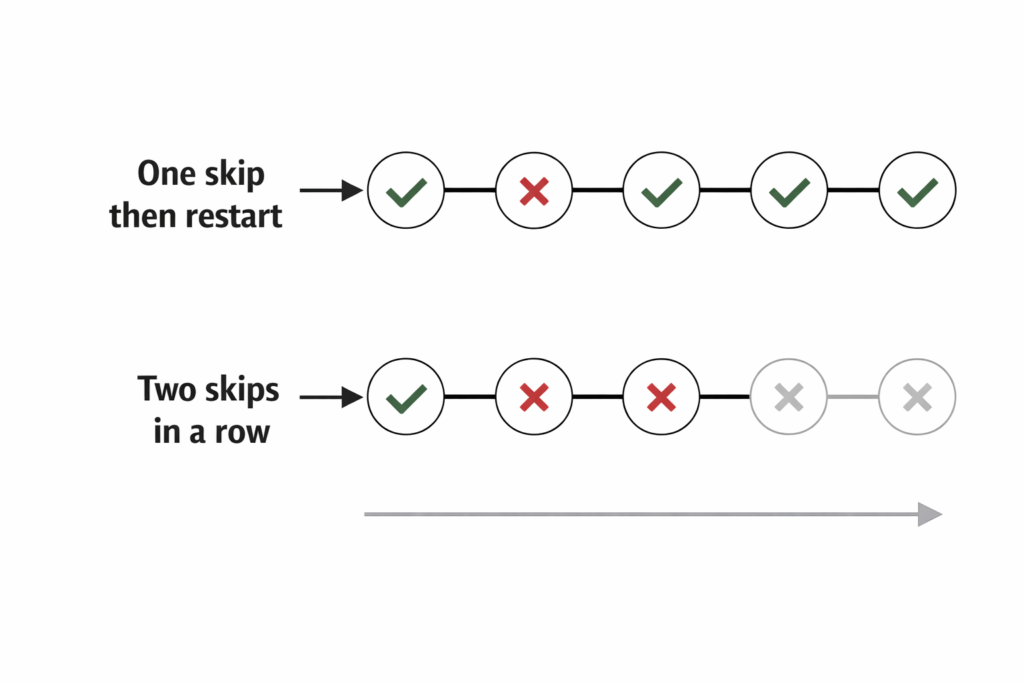
One of the most repeated consistency tips is “don’t skip twice.” Miss once, fine. Life happens. And never forget that. You will miss some workouts here and there. But miss twice in a row, and you start practicing being the person who stops.
Here’s why this rule is so powerful: missing one workout is a scheduling problem. Missing two is an identity shift. After one skip, you’re still “someone who works out but had a rough week.” After two skips, your brain starts categorizing you as “someone who used to work out.” The second skip is when the habit begins to wither away.
So if you miss Monday, you MUST hit Wednesday. That’s the rule. Not for the workout itself, but to protect who you’re becoming.
The 24-hour rule: what to do the day after you skip
This is the part competitors almost never say out loud, and it matters.
If you miss a workout, don’t wait for your next scheduled day like it’s a train you can only catch at one station. Waiting extends the gap. And the longer the gap, the harder it feels to restart because your brain starts treating the skip like “proof” you don’t do this anymore.
So here’s the exact recovery sequence for the day after you skip:
Wake up → Don’t dwell on the skip → Do your minimum workout that same day.
Not tomorrow. Not “when you’re feeling it.” That day. Your only job is to shrink the gap back down.
And when your brain tries to drag you into a guilt spiral, say this to yourself:
“Yesterday doesn’t exist. Today I’m the person who works out.”
Make an “if-then” plan so you don’t rely on willpower
You know that moment when you’re about to leave work and your brain goes, “Nah… not today”?
That’s a decision point. Decision points are dangerous because you’re tired, distracted, and your brain will always argue for comfort.
So you pre-decide. That’s what “if-then” plans do. Instead of relying on motivation, you attach a simple action to a predictable obstacle. Research on implementation intentions shows this kind of pre-planning improves follow-through because you’re not improvising under stress. (3)
A few examples to steal: if you get home late, you do your minimum at home. If the gym is packed, you do dumbbells and machines only. If you’re sore, you do a lighter session and leave earlier.
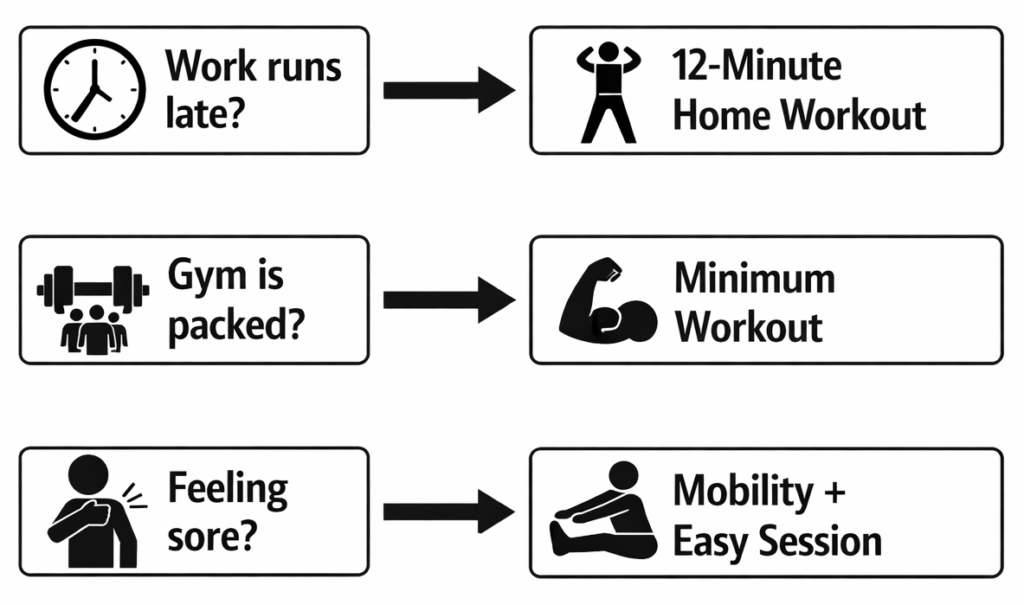
The 5pm decision: how to win the moment that kills most workouts
Let’s call it what it is: 4–7pm is the danger zone. You’ve burned through willpower at work, you’re hungry, your brain is loud, and decision fatigue is doing donuts in your head.
Most workouts don’t die at the gym. They die at 5pm on the couch.
Here’s how you win that moment:
The 10-minute rule
If you’re debating whether to work out, commit to 10 minutes only. After 10 minutes, you’re allowed to leave guilt-free. Most people finish once they start because starting is the hardest part. But remember: even if you leave, you still protected the habit. That’s a win.
Now, does this 10-minutes count for your workout or should you get back in the gym the next day and finish it?
Count it. Again, the goal is to preserve the habit. Not to become a perfectly proportioned bodybuilder (yet, at least).
The pre-decision script
Say this exactly: “I don’t decide if I work out at 5pm. I decided this morning. At 5pm, I just execute the plan.”
That’s how you stop negotiating with yourself.
Track your workouts (your brain loves receipts)
Motivation is flaky. Proof is steady.
Tracking doesn’t have to be a spreadsheet hobby. You just want enough evidence that you’re moving forward, because your brain loves receipts.
The easiest version is writing down what you did: exercise, sets, reps, and one word for effort. Or go even simpler and use your phone calendar with repeating workouts and a little check mark when you finish. Watching the month fill up is weirdly satisfying.
If you like wearables or apps, those can help too, mostly because they make progress visible and nudge you to keep the streak alive. (4)
How long until you see consistent workout results?
After my first month in the gym, I took progress pictures genuinely expecting to look like peak Arnold Schwarzenegger. Suffice to say I was quite disappointed when I couldn’t tell the 5 pound difference.
And that’s where most people start to waver.
You work out for two weeks, look in the mirror, and your brain goes: “Nothing is happening, so why bother?”
Here’s a realistic timeline you can expect:
- 1–2 weeks: you feel better, workouts feel less confusing
- 3–6 weeks: strength jumps, confidence rises… but impatience also hits
- 8–12 weeks: visible changes start showing up for a lot of people, but they are still minor
- 3-6 months: you really start noticing a difference in strength, your muscles are starting to pop
- 6-12 months: this is the sweet spot, where you’ve instilled the habit and you’re starting to flow and grow
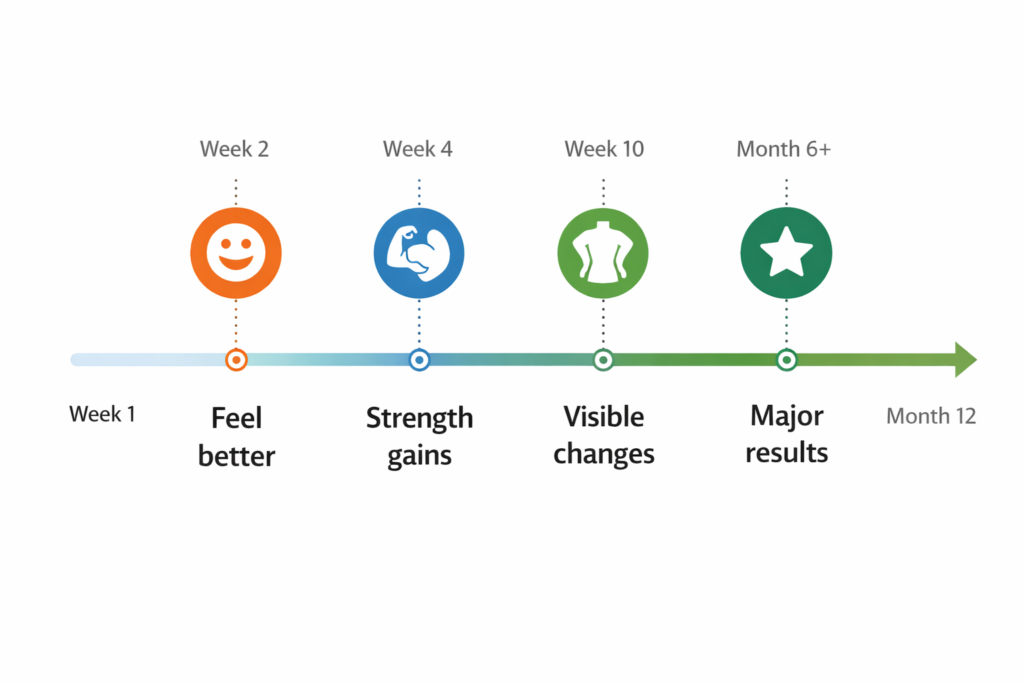
Here’s the part nobody tells you: weeks 3–6 often feel WORSE than week 1. Week 1 you have novelty. Week 3? You’re tired of the routine, you haven’t seen results yet, and the novelty has worn off. This is when most people quit. If you’re in this window and feeling discouraged, that’s not a sign you’re failing. It’s a sign you’re exactly where you’re supposed to be in the process.
Real talk: in the first month, the mirror lies. You’ll feel stronger (that’s real), workouts will feel easier (that’s real), but your body won’t look dramatically different yet. This is where people spiral because they think “it’s not working.” It IS working. You’re just measuring the wrong thing. Focus on performance wins: can you do more reps? Does the warm-up feel easier? Are you less sore? Those are your results. The mirror catches up later.
When your plan feels boring, don’t change everything. Rotate one knob.
Boredom kills routines… but chaos kills them faster.
So don’t restart your whole program every time you get a little bored. Keep the structure and rotate one small piece every 4–6 weeks: swap an accessory exercise, change your rep range slightly, or pick a different finisher. You get novelty without resetting your whole system.
If you’re deciding between popular splits, then you must read upper lower vs push pull legs.
Make showing up easier with a 5-minute pre-workout ritual
Your brain loves a starting line.
A tiny ritual is basically you telling your body, “Okay, we’re doing the thing now,” without needing a pep talk. Same playlist, water, short warm-up, first exercise. Five minutes to get momentum moving.
Need a simple warm-up plan? Check out this simple pre-workout routine for beginners.
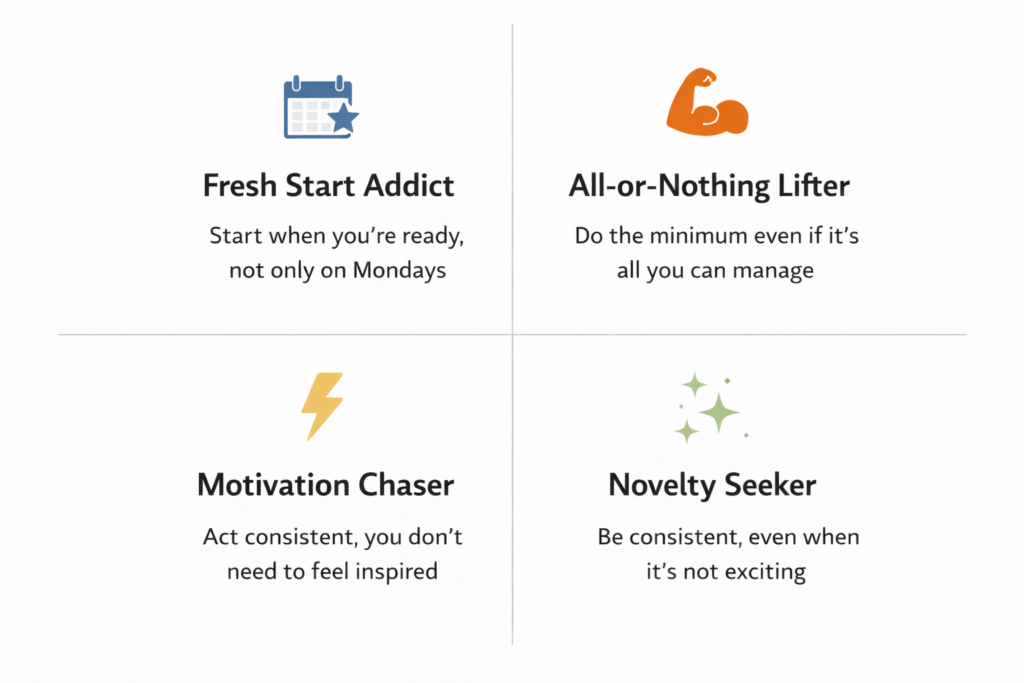
Why you’re really inconsistent (pick your trap)
This part is uncomfortable… and helpful.
Trap 1: The Fresh Start Addict. You restart every Monday.
Fix: Stop treating weeks as units. One missed day doesn’t reset anything.
Trap 2: The All-or-Nothing Lifter. If you can’t do the full workout, you skip entirely.
Fix: Reread the minimum workout section. Your minimum is your escape hatch.
Trap 3: The Motivation Chaser. You only work out when you “feel like it.”
Fix: Schedule workouts like dentist appointments. You don’t “feel like” the dentist either.
Trap 4: The Novelty Seeker. You change programs every 2 weeks.
Fix: Commit to boring for 8 weeks minimum. You’re not married to it. You’re just giving it a fair shot.
You don’t need to love working out (and that’s fine)
Most workout consistency advice tells you to “find something you love” or “make it fun.”
That’s nice, but it’s also bullshit for a lot of people.
Some people will never love working out. And that’s completely fine. You don’t love brushing your teeth either, but you do it. The goal isn’t joy. The goal is building a routine so solid that working out becomes as automatic as showering. You don’t need passion. You need a system that works when you’re indifferent.
Your next workout: the 10-minute consistency setup (do this right now)
☐ Add “Workout” to 3 days this week in your phone calendar (include the exact time)
☐ Write your minimum workout somewhere you’ll see it: “10 min = [specific exercises]”
☐ Pack your gym bag now (or lay out your workout clothes)
☐ Write down one backup plan: “If I can’t make my usual time, I’ll do [this] instead”
☐ Set a phone reminder for tomorrow: “Just do the minimum.”
Before you close this tab, do one thing: Open your calendar right now and add your first workout. Pick a day this week. Pick a time. Add a backup time. That’s it.
You don’t need to feel ready. You don’t need a perfect plan. You just need the appointment on the calendar.
Everything else follows from that.
References
- Lally P, van Jaarsveld CHM, Potts HWW, Wardle J. (2010). How are habits formed: Modelling habit formation in the real world. European Journal of Social Psychology, 40(6), 998-1009.
- Wood W, Rünger D. (2016). Psychology of Habit. Annual Review of Psychology, 67, 289-314.
- Gollwitzer PM, Sheeran P. (2006). Implementation intentions and goal achievement: A meta-analysis of effects and processes. Advances in Experimental Social Psychology, 38, 69-119.
- Vetrovsky T, Frybova T, Gant I, et al. (2021). The efficacy of wearable activity trackers and pedometers for physical activity promotion: A systematic review and meta-analysis. British Journal of Sports Medicine, 55(18), 1069-1077. (Note: The 2022 date was off—the major meta-analysis on wearables was published in 2021.)