
How to Start Going to the Gym Alone (First Time + First Week Plan)
You’ve probably already tried to go. Maybe you drove there, sat in the parking lot for five minutes, and left. Maybe you walked in, didn’t know where to stand, and spent 20 minutes pretending to use your phone near the treadmills before quietly slipping out the door.
That’s not a motivation problem. That’s what happens when your brain walks into a room full of decisions it hasn’t made yet.
The gym is just a building. But to someone who doesn’t have a default route, it’s a room where every minute requires a choice: where to go, what to do next, how long to stay, where to look, whether anyone is watching. That stack of tiny unknowns is what freezes people, not weakness, not laziness, not being out of shape.
The solution is simpler than you’d expect: a short, repeatable protocol that removes those decisions before you walk in. This guide on how to start going to the gym alone gives you exactly that for your first three visits. Follow it, and by visit three you won’t need it anymore.
Going to the Gym Alone for the First Time: What to Do (First 30 Minutes)
If you’re going to the gym alone for the first time, your goal isn’t a “real workout.” It’s a clean first win: walk in, follow a simple route, do a few easy sets, and leave while it still feels easy.
Here’s the first-time version:
- Cardio anchor (5 min): treadmill or bike, easy pace
- Machines anchor (15–20 min): one legs (leg press), one pull (seated cable row), one push (chest press), all for 2 sets each, light
- Between sets: timer set for 1-2 minutes, two deep breaths, one quick note logging your exercise
- Exit rule: leave while you still feel steady
Weight/reps rule (so you don’t overthink it): Pick a weight you could do for 12–15 reps, but only do 8–10 reps. You should finish each set thinking, “I could do 3 more.”
If a machine is taken: Do your timer/breath/note once, then swap to the closest similar machine (any row, press, or leg machine counts).
If you only do that once, you’ve already done the hardest part: a calm first solo visit.
Key mindset shift: Don’t try to “beat” the gym. Build a system that makes showing up normal and easy.
Here’s the first-time plan in a bit more detail (8 steps).
How to Start Going to the Gym Alone for the First Time (The Full Plan)
- Pick Two Anchor Zones: Choose predictable spots (cardio area and machines) you can always go to without thinking.
- Warm Up for 5 Minutes: Walk or bike while getting your bearings.
- Do Three Simple Exercises: One leg, one pull, one push movement with light weight (1-2 light warm-up sets, then 2 “working” sets each).
- Use a Between-Set Routine: Give your mind a job so you don’t feel exposed. (e.g., Timer, two breaths, one note).
- Leave While It Still Feels Easy: End thinking “I could do that again” to build the habit.
- Go During Off-Peak Hours: Late morning, early afternoon, or later evenings if possible.
- Repeat the Same Route: Use identical anchors and exercises for visits 2-3 to build familiarity.
- Track Sessions Per Week: Focus on showing up 2-3 times weekly, not perfect performance.
Quick Scripts for When You Feel Stuck:
- Car script (10 sec): “Protocol, not performance. 25 minutes.”
- If you feel watched: “My job is the next rep.”
- If a station is taken: “Timer. Swap. Continue.”
- Leaving script: “I’m leaving while it’s easy.”
Start Here
- If you have 30 minutes: do the Minimum Viable Session
- If you have 15 minutes: do “cardio anchor, 1 machine, then leave”
- If you’re panicky: do “5-minute entry win” (walk in, treadmill 3 minutes, leave)
Minimum Viable Session: The 30-Minute Plan
This routine is designed to be small enough to complete even when you feel anxious or “just not into it.”
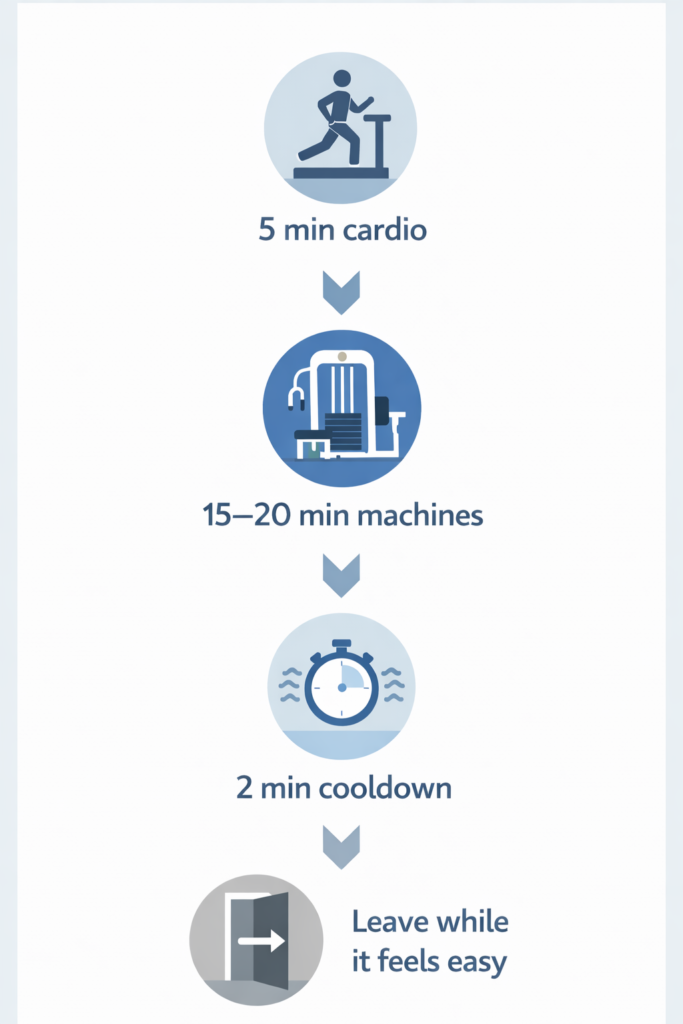
In plain steps: Warm up for about five minutes on a treadmill or bike. Do three exercises, two sets each, with easy weights. Cool down for a couple of minutes, jot down what you did, and leave.
If you can, go during slower hours the first week. Late morning, early afternoon, or later evenings on weekdays tend to feel calmer. Avoid 3-6 pm especially. But even if you can’t, the protocol still works because it assumes you are working out in a crowded gym.
The one rule: leave while it still feels easy. End the session thinking “I could do that again.” That feeling is how you come back.
Why Going Alone Feels Hard (and why that’s normal)
Going alone feels hard because you’re exposed to public uncertainty. Sometimes it’s just uncertainty. Sometimes it’s a real safety vibe. Either way, the plan is the same: reduce unknowns and give yourself exits.
There are lots of small unknowns: Where do I stand? What do I do with my body between sets? Am I using this right? Is someone waiting? Am I taking too long?
That stack of decisions creates decision fatigue. Decision fatigue feels like anxiety because your brain is running too many tabs at once. The fix isn’t to hype yourself up. The fix is to remove those tiny choices by deciding your route and your next action before you step foot in the gym.
How to Start Going to the Gym Alone (First 3 Visits)
This protocol is built around one idea: two anchor zones.
An anchor zone is a place you can always go without thinking. It’s your “safe area” that prevents aimless wandering. For most gyms, the easiest anchors are the cardio section, the warm-up area, or the machines or cable area. Those spots are predictable, easy to blend into, and they give you something obvious to do if you feel awkward. Sometimes gyms also have a sectioned off studio, which would be another great anchor spot.
You’ll use the same anchors for all three visits. Familiarity is the whole point.
Visit 1: Familiarity Session (25–35 minutes)
Goal: Learn the layout, do a tiny workout, leave on a win.
Before you even open the car door, use this script:
Pre-entry script (in the car): “I’m not here to crush a workout. I’m here to run the protocol. I only need 25 minutes inside. I already know my first move.”
An optional but powerful move is to ask at the front desk for a 5-minute walkthrough: “Hi, it’s my first time here. Would you be able to show me the different sections?”
The Warm-up:
Your first move in the gym is simple: walk to your cardio anchor and start.
- Pick a treadmill or bike. Keep it easy.
- While you warm up, look around casually. You’re collecting “map data” so the gym starts feeling familiar.
The Main Event (3 Exercises):
After five minutes, move to your machines anchor. Today you’ll do three exercises. Keep the weight light. The goal is competence, not intensity.
How to pick exercises without overthinking:
Choose:
- One leg-focused movement
- One pull
- One push
Most gyms have:
- Leg press (legs)
- Lat pulldown (pull)
- Chest press (push)
If your gym has those three, you’re set. If it doesn’t, just pick the closest machine versions available.
| Pattern | Easy default option | Also works if machines are busy |
|---|---|---|
| Legs | Leg press machine | Goblet squat (dumbbell squat) |
| Pull (back) | Lat pulldown machine | One-arm dumbbell row (light) |
| Push (chest/shoulders) | Chest press machine | Shoulder press machine |
- Do 1-2 extremely light warm-up sets for each exercise.
- Then do two working sets.
- Rest about 60-90 seconds between sets.
- Choose a weight that feels like you could do a few more reps at the end of every set.
What to do between sets:
This matters more than people admit. Run the same micro-routine every time, so you never have to stand there wondering what to do.
Between each set:
- Start a 60-90 second timer.
- Take two slow breaths.
- Type one line in your notes app: (exercise, weight, reps).
That gives your eyes and hands a job. It also makes you look like someone with a plan, because you are someone with a plan.
Finish and leave.
After your third exercise, do a two-minute walk to cool down. Then leave. Yes, even if you feel like you could do more. Especially then.
Leaving script: “I’m leaving while it’s easy. This is how I come back.”
You’re done when:
- You still feel like you could do one more set.
- You’ve completed your 3 exercises.
- You’ve logged them.
Summary: Warm up for five easy minutes, move to your machine anchor spot for one leg, one pull, and one push exercise (all light), use a timer, breathe, and log routine between sets, then take a short cool-down walk and leave while it still feels easy.
Visit 2: Repeat + Add One Free-Weight Pattern
Goal: Do the same route, then add one dumbbell move as a small skill upgrade.
Visit 2 starts exactly like Visit 1. That repetition isn’t boring. It’s teaching your nervous system that this place is safe and predictable.
- Same entry.
- Same warm-up.
- Same anchor zones.
- Same three exercises, in the same order.
If you want to “progress,” keep it tiny:
- Add 1-2 reps on one set, or
- Increase one machine by the smallest weight jump.
Don’t try to prove anything. Build a track record of calm completion.
After that, add one dumbbell move. Pick the least intimidating option and keep it light:
- Goblet squat: Feels stable (weight stays close, no complicated setup).
- Dumbbell bench press: Great if a bench is open and you like the “lying down” feeling.
- Incline dumbbell row: Simple and hard to mess up.
The dumbbell stress-free rule:
- Choose a weight you could lift for 12-15 reps.
- But only do 2 sets of 8-10.
- Stop while you still feel smooth and coordinated. Competence first.
Week 1 safety rule: Skip barbell squats and deadlifts unless someone shows you the setup and how to spot. Machines and dumbbells are plenty for now.
If the dumbbell area is crowded and your anxiety spikes, skip the dumbbell move and leave. You still succeeded, because you followed the protocol: repeat, stay calm, end on a win. You followed the protocol: repeat, stay calm, end on a win.
Summary: Repeat Visit 1 exactly (same entry, warm-up, anchors, and three exercises), make only a tiny progression if it feels easy, then add one light dumbbell move for two smooth sets and leave on a calm win even if you skip it because the area’s crowded.
Visit 3: Repeat + Add One “Confidence Rep”
Goal: Build evidence that you can feel discomfort and still finish.
Visit 3 is the same session again, with one addition: a “confidence rep.” This is not a heroic challenge. It’s a small step toward something you’ve been avoiding.
A confidence rep can be as tiny as:
- Walking into the free weights area, picking up the dumbbells you planned to use, doing one set, and leaving immediately.
- Asking the front desk, “Where’s the seated row machine?”
Both count. You’re practicing the skill of doing a slightly uncomfortable thing without bailing.
The structure stays the same:
- Warm up.
- Do the three exercises.
- Do your between-set micro-routine.
- Add one confidence rep.
- Leave while it still feels manageable.
When you walk out, you want one clear thought: “I did the plan even with discomfort.” That’s how your brain updates its expectations.
Important: This 3-visit protocol works for most gym anxiety. The other 20%? Sometimes you have a bad day. Sometimes the gym is weirdly crowded. Sometimes you get there and your brain says ‘absolutely not’ and you turn around. That’s also data. You showed up to the parking lot. That counts.
Summary: Repeat the same session again, add one tiny “confidence rep” toward something you’ve been avoiding, then leave with the win of finishing the plan even with discomfort.
What To Do Between Sets (so you don’t feel exposed)
That exposed feeling usually comes from a wandering mind. If your mind has nThat exposed feeling comes from a wandering mind. If it has nothing to do, it scans for danger. So give it a task.
Use one of these three between-set options for the next month:
- Default: Timer, two slow breaths, one line in your notes app. It’s boring, and that’s why it works.
- Purposeful loop: Sip water, quick wipe, a few steps away, then back. You’re not pacing. You’re resetting.
- One cue only: Pick one cue per exercise like “slow down,” “feet flat,” or “elbows back,” and repeat it mentally.
Between-set script: “Breathe. Timer. One note. Next set.”
Full disclosure: Occasionally I like to stand up and pace like a caged animal between sets, so feel free to get creative.
Crowded Gym Contingency Plan (no panic, no wandering)
Crowds are where people get stuck. They finish a set, their next station is taken, and suddenly they’re wandering with no plan. Wandering creates the feeling of being watched, and then anxiety spikes.
And I’ve been that guy plenty of times, wandering around like a lost child. You orbit the same three machines hoping one opens up, make eye contact with someone by accident, panic, and end up at a completely different section doing an exercise you didn’t plan for. It’s the worst!
So follow a tiny decision tree to avoid all that.
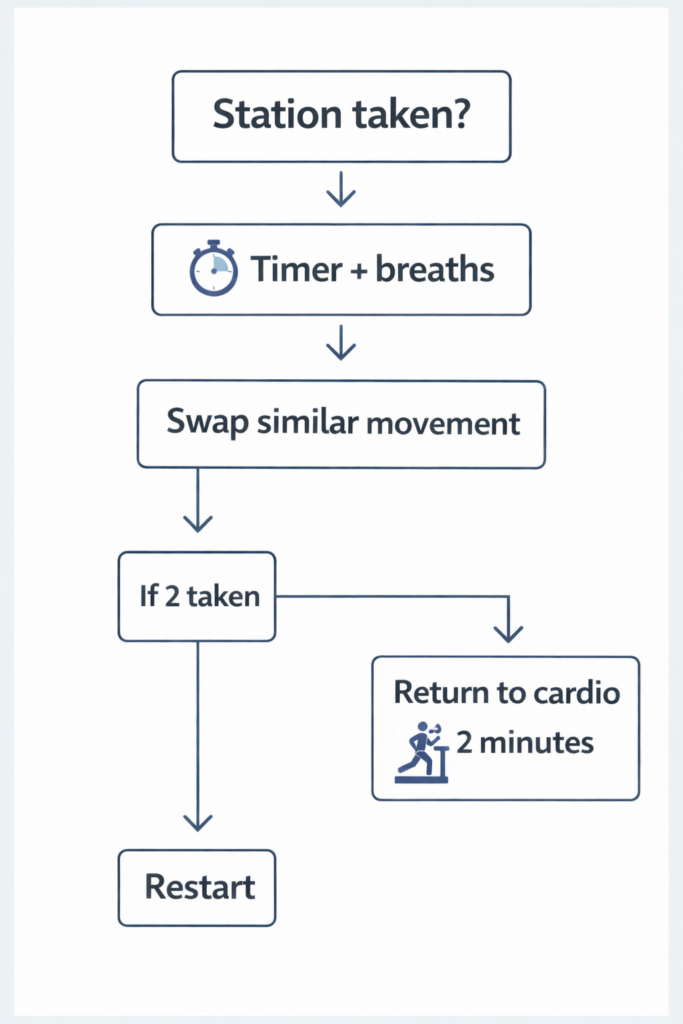
If your station is taken:
- Wait one minute while you run your between-set routine.
- If it’s still taken, swap to an alternative that matches the same movement pattern.
- If two stations in a row are taken, go back to your cardio anchor for two minutes, then re-enter the plan.
Here’s a clean swap table. It’s intentionally “good enough,” not perfect.
| If this is taken | Swap to this | If that’s taken too |
|---|---|---|
| Leg press | Goblet squat (light) | Box squat to bench |
| Leg extension | Step-ups (low bench) | Wall sit (short) |
| Lat pulldown | One-arm dumbbell row | Assisted pull-up machine (if available) |
| Seated cable row | Chest-supported dumbbell row | Another row machine you can find quickly |
| Chest press machine | Dumbbell bench | Push-ups using dumbbells |
| Shoulder press machine | Seated dumbbell press (very light) | Machine chest press again (close enough) |
The golden rule: Never wander for more than 20 seconds. If you don’t know your next move, walk to a cardio machine, reset for two minutes, then restart your plan.
If Anxiety Spikes Mid-Workout (60-second reset)
If anxiety spikes, you don’t need to “talk yourself out of it.” You need a next action that is small enough to do while anxious.
Here’s the 60-second reset.
- Plant your feet.
- Take three slow breaths, making the exhale longer than the inhale.
- Name your next action in plain language (in your head), like: “One more set of rows.”
If your brain wants to bolt, shorten the session on purpose. Cut an exercise. Cut a set. You’re not failing. You’re adjusting.
Use the “leave with a win” rule: Do one more set or one more exercise. Then go.
That rule matters because it changes the story. It’s not “I left because I panicked.” It becomes “I finished something even when I felt panicky.”
That’s a confidence builder, not a setback.
If anxiety is the main thing stopping you, I put together a free one-page toolkit you can print and bring with you. It covers exactly what to do when anxiety hits, before you walk in, when you’re inside, and if you need to bail early.
Gym Etiquette Without Overthinking It
Most etiquette is just: don’t create extra work for other people.
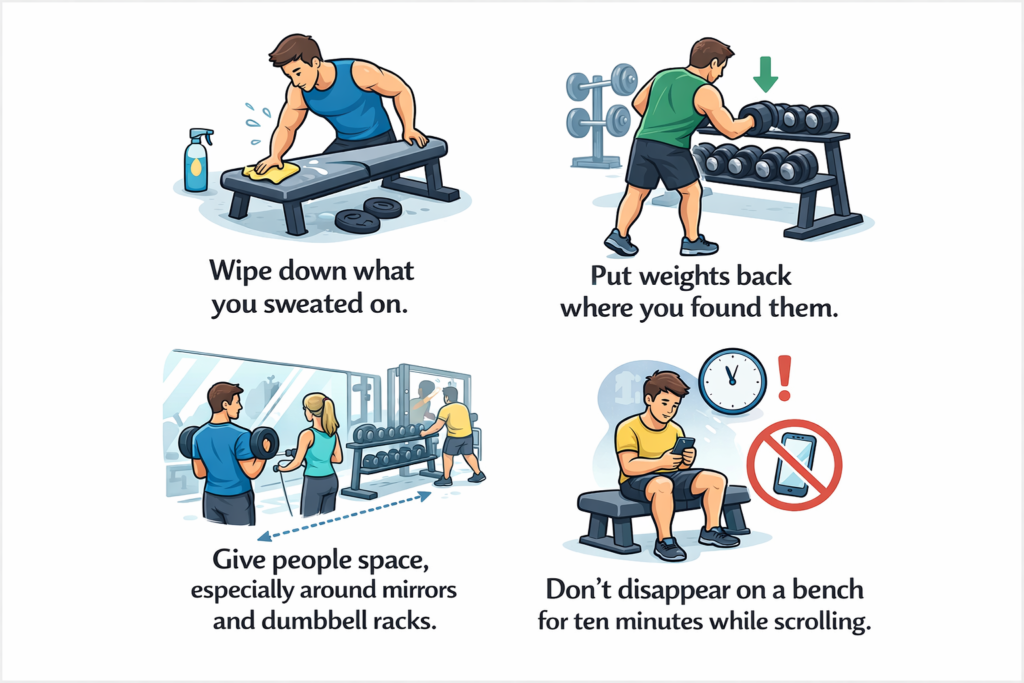
If you do these four things, you’re good:
- Wipe down what you sweated on.
- Put weights back where you found them.
- Give people space, especially around mirrors and dumbbell racks.
- Don’t disappear on a bench for ten minutes while scrolling.
If you’re not sure whether someone is using something, a quick “Are you using this?” solves it (and it’s a great way to challenge your anxiety).
Do these things, and you’ll be more considerate than half the room.
Headphones and Music (a useful tool, not a crutch)
Headphones help because they create a small bubble. They also give you a ritual: earbuds in means “protocol time.”
- If music calms you, use a short playlist you only play at the gym.
- If podcasts keep you from spiraling, that works too.
- If you’re nervous, one earbud out can make you feel more grounded.
The goal isn’t to block the world out forever. It’s to make the first few visits easier so you keep showing up long enough to gain familiarity.
A quick note: If you’re skinny / If you’re overweight
If you’re skinny, you might feel like you don’t “look like a gym person” yet. Your best move is to make sessions easy and consistent, then slowly build from there. Machines are a great start. So is keeping weights light enough that you stay coordinated and calm.
If you’re overweight, you might worry you’ll be judged, or that getting winded will feel embarrassing. That’s exactly why this protocol is short. Keep warm-ups gentle, pick stable movements, and rest as needed. You’re allowed to take breaks. You’re allowed to leave early. The win is the repeatable habit you are building.
Either way, the plan is designed to reduce uncertainty so you can focus on the one thing that matters: showing up again.
The 30-Day Rule (how you actually build confidence)
Confidence comes from repeated exposure and small competence wins, not from hyping yourself up. The gym stops feeling scary when your brain has enough data proving you can handle it.
For the next 30 days, track one thing: sessions per week. Not your weight lifted. Not your body changes. Just whether you showed up.
If you’ve been wondering how to get confident going to the gym alone, this is the boring answer that actually works.
- How many sessions per week? True beginner: start with 2 sessions/week. If that feels easy by week 3 or 4, move to 3 sessions/week.
- Keep one “minimum viable” session: Each week, make at least one session your minimum viable session: the short, easy version you can do even on a low-energy day. That session protects the habit.
- Keep progression simple: Stick with the same plan and add something small over time—a couple extra reps here and there, or the smallest weight increase on one machine. Small wins compound because they keep you consistent.
FAQ: Going to the Gym Alone
1) Is it embarrassing to go the gym alone?
No. Most people are there solo, and most of them are too focused on their own workout to track what you’re doing. The “embarrassing” feeling usually comes from uncertainty, not from you actually doing something wrong. If you follow a simple route (cardio anchor → machines anchor) and keep your between-set routine consistent, you’ll look like someone with a plan because you are.
2) Where should a beginner start in the gym?
If it’s your first time going to the gym alone, start in the most predictable, lowest-pressure spot: the cardio area. Walk or bike for five easy minutes while you look around and get your bearings. Then move to a simple machines area and do one legs, one pull, and one push movement with light weight. The goal isn’t intensity. It’s finishing a short session without wandering.
3) How do I motivate myself to go to the gym alone?
Don’t rely on motivation. Reduce the size and uncertainty of the task so it’s easier to start. Commit to the minimum viable session, pick an off-peak time if you can, and use the “leave while it still feels easy” rule. Motivation tends to show up after you’ve stacked a few calm wins, not before.
4) What if I can’t find the machines?
Use anchors and ask one simple question. If you can’t find something quickly, go back to the cardio area for two minutes, then re-enter the plan with the closest option you can locate. And if you’re genuinely stuck, ask staff or a trainer: “Quick question, where’s the lat pulldown (or chest press)?” You’re not bothering anyone. You’re doing what people do at gyms every day.
Do Visit 1 in the next 48 hours
You don’t need a perfect plan. You need a predictable one.
Pick two anchor zones, warm up, do three simple exercises for two sets each, run the between-set micro-routine, and leave while it still feels easy. That’s the protocol for your first visit, and it’s enough.
Schedule Visit 1 in the next 48 hours if you can. Even if it’s not perfect timing, getting it on the calendar makes it real. Make it small. Make it doable. Then go collect your first “normal gym visit.”
And after a few of those, you can check out the top weightlifting routines I recommend for beginners.