
Rest Day Guilt: When to Rest (Without Losing Progress)
I can’t tell you how much self-flagellation I’ve had to endure over my own rest day guilt throughout the years. My way of making up for the sin of resting was by reviewing every set from the week, planning the next session down to the minute, scrolling through lifting videos – anything to prove I was still ‘in it’ even though I wasn’t training.
Here’s the thing: you already know rest days matter. You’ve heard “muscles grow when you recover” a thousand times.
And yet… the minute you don’t go to the gym, your brain starts acting like you just deleted all your progress.
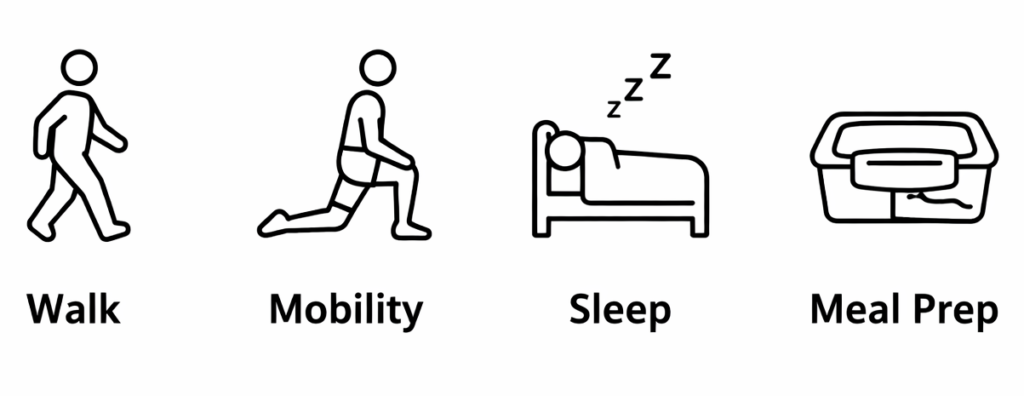
Rest day guilt is feeling anxious or lazy for skipping the gym on a planned day off. You won’t lose muscle in 24 hours. Rest reduces fatigue and improves your next session. If guilt hits: validate it, ask whether you’re chasing progress or calming anxiety, then do one recovery action (walk, mobility, meal prep, early sleep).
Rest day guilt is common with serious beginners and intermediates because you finally have momentum, structure, and identity tied to training. Training matters to you. Taking a day off can feel like you’re “being lazy” or “slipping” even when your body needs it.
For me, it shows up as this tightness in my chest and a low-grade hum of anxiety. Like I’m forgetting something important, except the ‘something’ is just… not training. My brain treats it like I left the stove on.
So, let’s fix that. You’ll get: (1) why this guilt shows up, (2) what rest actually does for strength and muscle, and (3) a simple plan to make days off feel like part of training instead of a mistake.
Start here: what to do when rest day guilt hits (5 minutes)
When that itch to ‘just do something’ hits, I’ve learned to sit with it for a minute or two. Just feel it. It sucks, but it helps. Then, after a minute or two of that, run this quick checklist:
- Validate (5 seconds): “I feel guilty. Makes sense. I care about this.” If you try to bury guilt with logic, it usually comes back louder. Accepting the feeling is often what lets it loosen so you can actually let it go later.
- Ask one question: “Am I trying to get better… or trying to calm anxiety?”
- Pick one recovery action (10–30 minutes): easy walk, light mobility, extra sleep, meal prep, or a deload-style pump session (details below).
- Do one non-gym win: errands, chores, social time, hobby, sunlight.
Before moving further, let’s distinguish between rest day guilt and missed workout guilt. Rest day guilt is when you feel guilty for not being in the gym on a planned day off. Missed workout guilt is when you feel guilty for missing a planned workout.
Since this post is about rest day guilt, let’s just make a quick comment about missed workout guilt. Sports psychologist Robin Hughes frames missed sessions as feedback, not failure, and recommends “minimum viable wins” (like a short walk) to maintain momentum without forcing a full workout. (1)
We don’t need a perfect mindset. We need a repeatable rest day routine that tells our brains: we’re still progressing.
Why do I feel guilty taking a rest day from the gym?
Because your routine/identity is tied to training, so the day feels “wrong” even when rest is part of the plan.
Rest day guilt usually comes from one (or more) of these:
You built an identity around “I don’t miss workouts”
Consistency is powerful. But when consistency turns into “I’m only doing well if I’m training,” a rest day feels like a threat.
Your brain confuses “routine disruption” with “danger”
A lot of lifters describe the guilt as routine anxiety, not training logic. It’s that jittery, off-kilter feeling – like your whole day is slightly wrong because you didn’t do the thing you always do. Your body expects the gym at 6pm, and when it doesn’t happen, you feel disoriented.
One person put it like: it’s not fear of losing gains, it’s the feeling of breaking the streak and spiraling. (2)
Toxic productivity leaks into fitness
There’s a culture-wide vibe that rest equals laziness and productivity equals worth. “Toxic productivity” is basically the urge to maximize every minute… even when it costs your wellbeing. (3)
The same “toxic productivity” that makes us feel guilty for taking a day off work can creep into fitness, making a rest day feel morally wrong instead of strategically necessary.
You’re using training to “earn” food or worth
This one’s sneaky. In one Reddit thread, a commenter said it plainly: “You don’t earn your food by working out.” (4)
If your thoughts sound like missed workout guilt plus “I don’t deserve to eat,” it’s not a scheduling problem. It’s a relationship-with-training problem.
You’re running on guilt-fueled motivation (and it works… until it doesn’t)
Psych researchers call this introjected regulation: you do the behavior to avoid guilt, shame, or anxiety, or to feel “good enough.” It can keep you consistent short-term, but it also makes rest feel emotionally unsafe. (2)
Bottom line: feeling guilty for not working out isn’t proof you’re doing something wrong. It’s proof you’ve formed an attachment to training which makes your safety, control, and self-worth dependent on it.
Rest isn’t “time off.” It’s where adaptation happens.
If your goal is strength and muscle, training is the stimulus. Recovery is where the stimulus turns into results.
- Hard lifting creates fatigue and tissue stress.
- Rest lets your body repair, restore performance, and come back ready to overload again.
- When you skip recovery, you’re not “outworking” people… you’re just accumulating fatigue.
Training frequency research backs up the big idea: what matters is high-quality, recoverable work over time, not some iron law of “never take a day off.” (5)
What actually happens if you take 1 rest day
I used to go to sleep with this fear that I would wake up and all my muscle would be gone. Sounds dramatic, but that’s genuinely what it felt like. Now, I’ve reverse engineered that fear; I know that the more sleep I get, the more muscle I will wake up with in the morning. Because recovery is the ground where the muscle grows.
Here’s what’s actually true:
- We don’t lose muscle in 24 hours. That’s just the brain being a bit over-dramatic.
- Performance often rebounds because fatigue drops.
- Your next session is higher quality, which is what drives progress long-term.
“But I feel bad if I don’t workout everyday.” Cool. Let’s redirect that energy.
You don’t have to go from “7 days a week” to “do nothing.” You just need a recovery menu so your brain still gets a win.
What to do on a rest day when you feel guilty
Quick picks (choose one):
If you feel: “I need a win.”
Do: 20-40 minute easy walk
Why: You get momentum without adding fatigue.
If you feel: “I want to touch weights so I don’t fall off.”
Do: 10-15 minute technique session (very light)
Example: 2 sets each of squat pattern + press + row, stop far from failure.
If you feel: “I’m anxious about losing progress.”
Do: Recovery admin + early bedtime
Example: Write tomorrow’s workout in 3 bullet points, prep your gym bag, lights out 30-60 min earlier.
If you feel: “I’m restless and wired.”
Do: 8-10 minutes slow mobility + nasal breathing
Example: hips/ankles/shoulders, easy pace.
If you feel: “I don’t deserve to eat unless I train.”
Do: Normal meals + hit protein + hydrate
Rule: You’re recovering today. Eating supports the next session.
If you feel: “I should make up for it.”
Do: Don’t double up. Just resume the plan next session.
Why: Punishment training creates the spiral.
If one of those matched, pick that action and you’re done.
If you’re still unsure, use the menu below. Start with Option A.
Option A: Active recovery (20–40 minutes)
Pick one:
- Easy walk (you can talk the whole time)
- Light biking
- Mobility flow
- Long warm-up and stretching
Goal: feel better leaving than when you started. For me, this often means a 25-minute walk around my neighborhood. No phone, no podcast. Just walking. It sounds boring, but it genuinely scratches the ‘I did something’ itch without negatively impacting my recovery.
Sometimes just doing something is enough to negate rest day guilt.
Option B: Technique day (20–35 minutes)
If you must touch the gym:
- 2–3 lifts
- 2–3 sets each
- Light weight, perfect reps, no grinding
Think “practice,” not “prove.”
Option C: “Recovery admin” (30–60 minutes)
This counts more than you think:
- Meal prep protein and carbs
- Do laundry, pack gym bag
- Plan your week’s sessions
- Watch technique videos
- Get to bed 45 minutes earlier
This is how real lifters stay consistent for years.
How many rest days do you actually need?
Most serious beginners and intermediates do great with 2–4 rest days per week, depending on:
- training age
- program intensity
- sleep/stress
- job and lifestyle
- how close to failure you train
If you’re following a structured plan (and I hope you are), the rest days are already built in. They’re not optional add-ons – they’re literally part of how the program works.
If you don’t have a plan yet, start with a simple routine that includes recovery on purpose:
- Use one of these 4 weightlifting routines for beginners (built-in rest, built-in progression, proven results).
- Lock in consistency with a pre workout routine for beginners so training days feel automatic (and rest days feel “earned,” not random).
The reframe that actually works: rest days are compliance days
A lot of advice says “stop calling it rest day, call it recovery day.” Helpful… but sometimes it still feels like a cheesy trick.
Here’s the version that sticks:
A rest day is a day you comply with the plan.
One lifter summed it up perfectly: recovery is as important as training and nutrition for progress. (6)
I’d go one step further: if your program says rest, and you don’t rest, you’re being undisciplined.
Not resting when you need it is the true emotional choice.
Red flags: when rest day guilt isn’t just “normal gym brain”
Look, I’m not trying to armchair diagnose anyone here. But if these show up often, don’t brush them off:
- You feel panicky or depressed when you can’t train
- You train through pain/injury because you “have to”
- You use workouts to “make up for eating”
- Rest days ruin your whole mood or relationships
This doesn’t make you broken. It means training became your main regulator. That’s fixable, and many people benefit from working with a qualified mental health pro, especially someone familiar with compulsive exercise patterns.
Here are three excellent resources for finding someone who can help you:
The next section explains why this happens in a way that usually clicks fast.
If you’re the “deep why” person: what rest day guilt is really doing
If you’re curious enough to chew on this, here’s the deeper answer.
1) Guilt is your brain’s attempt to control uncertainty
Progress in the gym is slow, messy, and not always visible. Guilt gives you a simple rule: “If I train today, I’m safe. If I don’t, I’m failing.”
That rule reduces uncertainty… but it also hijacks recovery and makes you dependent on the gym to feel safe.
This is why people can logically know rest matters and still feel weird vibes when they take days off from working out. Your logic is intact. Your nervous system is just using training as an emotional lever.
2) Introjected motivation turns the gym into an internal “judge”
Remember introjected regulation? It’s motivation powered by “I should,” “I have to,” and “If I don’t, I’m bad.” Researchers have even induced exercise-related guilt in experiments, and it reliably increases guilt in the moment. Those guilt increases are also linked with higher body anxiety. (2)
So when you rest, your internal judge doesn’t say: “Nice, you’re recovering.”
It says: “Prove you’re still that person.”
3) The gym can become an emotional regulator (so rest triggers anxiety loops)
For some lifters, workouts become emotional safety: structure, control, predictability, relief. Then a rest day doesn’t feel neutral… it feels like losing access to the thing that keeps you steady. YM Counseling describes this “control and safety” loop and how it can turn into cycles of guilt, overexertion, and rest-day anxiety. (8)
Not gonna lie: that’s also why it’s so hard to rest. You’re not just taking a day off lifting. You’re taking a day off your main coping tool.
That’s why your body can be tired while your brain is screaming “go anyway.”
What to do with this insight: don’t shame yourself for it. Just build other regulators so rest days don’t feel like free-falling: walking outside, calling a friend, journaling, a hobby, early bedtime, therapy if needed.
Say this exactly when the guilt spirals (30 seconds)
Word-for-word:
“If I don’t take this rest day, then I am being undisciplined. This is how I come back stronger.”
And if your exercise guilt feels personal, add:
“My worth isn’t measured in workouts. Consistency includes recovery.”
This kind of self-compassion isn’t “soft.” It’s a practical skill that’s been linked in research reviews to better mental health and resilience. (8)
FAQ
Q: Will I lose muscle if I take a rest day?
A: No. One day off won’t erase your progress. Rest reduces fatigue so you can train harder when you come back.
Q: Is it okay to take a rest day if I feel “lazy”?
A: Yes. Feeling lazy isn’t a reliable signal of anything. If the plan says rest, resting is part of the work.
Q: How many rest days per week do I need?
A: Most people do well with one to three, depending on training volume, sleep, and stress. If your performance is slipping or soreness never fully clears, you probably need more.
Q: What should I do on a rest day if I feel guilty?
A: Pick one small “win” from your recovery menu. A walk, a light mobility session, or even handling some recovery admin can give your brain the sense of closure it’s looking for.
Q: Should I do cardio on rest days?
A: Light cardio can work well if it genuinely helps you recover. Just keep it easy enough that you could hold a conversation the whole time.
Q: What’s the difference between rest day guilt and missed workout guilt?
A: Rest day guilt shows up even when you followed the plan perfectly. Missed workout guilt comes from skipping something you intended to do, and it usually just needs a simple make-up plan to resolve.
Q: Is rest day guilt a sign of overtraining or something deeper?
A: Sometimes it’s just habit and identity. But if the guilt is intense, constant, or tied to food, body image, or anxiety you can’t seem to switch off, that points to something worth exploring beyond your training routine.
Q: What if I feel guilty eating on a rest day?
A: You don’t have to earn food with workouts. Eating on rest days supports recovery and actually sets up your next session to be better, not worse.
Your next rest day game plan (print this)
10-minute prep (today):
- Put your rest day on the calendar (yes, literally).
- Decide: Active recovery OR Technique day OR Recovery admin.
- Write your one sentence: “This is how I come back stronger.”
20–40 minutes on rest day:
- Walk or mobility (easy)
- Protein and carbs meal
- Hydrate
- Early bedtime target
5 minutes the next day:
- Note how you feel in warm-ups and your first working set.
- That uptick in performance? That’s what you rested for.
References
- Harris-Fry, N. (2026, January 19). “Missed workouts aren’t failures, they’re feedback”: Sports psychologist shares 5 tips for managing “missed workout guilt.” Tom’s Guide.
- Hurst, M., Dittmar, H., Banerjee, R., & Bond, R. (2017). “I just feel so guilty”: The role of introjected regulation in linking appearance goals for exercise with women’s body image. Body Image, 20, 120–129. https://doi.org/10.1016/j.bodyim.2016.12.002
- Oostland, D. (2025, January 7). What is toxic productivity? Vogue.
- Reddit. (n.d.). Does anyone feel guilty when taking a rest day? r/GYM. Retrieved February 5, 2026.
- Schoenfeld, B. J., Ogborn, D., & Krieger, J. W. (2016). Effects of resistance training frequency on measures of muscle hypertrophy: A systematic review and meta-analysis. Sports Medicine, 46(11), 1689–1697. https://doi.org/10.1007/s40279-016-0543-8
- Reddit. (n.d.). Feeling guilty on rest days? r/Fitness. Retrieved February 5, 2026.
- Molina, Y. (2025, December 28). Why skipping workouts feels impossible: Understanding overexercising and guilt. YM Counseling Services.
- Neff, K. D. (2023). Self-compassion: Theory, method, research, and intervention. Annual Review of Psychology, 74, 193–218. https://doi.org/10.1146/annurev-psych-032420-031047