Pre Workout Routine for Beginners: What to Do When You Get to the Gym
If you’re new to lifting, the hardest part often isn’t the workout. It’s the 10 minutes before it, when you feel scattered, anxious, and unsure what to do with your body.
This pre workout routine for beginners is built for that exact moment. It doesn’t rely on supplements or hype. It gives you a repeatable script that settles your nervous system, warms your joints, and gets you confidently onto your first set.
You’ll get a 2-minute mental warm-up, a 5–8 minute physical warm-up, and an optional “don’t overthink it” quick guide. Then you’ll get simple versions for busy days, early mornings, and post-work sessions.
Let’s make the minutes before training feel easy.
If you feel scattered before the gym, this fixes it
Here’s what usually happens when you’re a beginner: you walk in, you scan the room, you second-guess your plan, and your brain starts negotiating with you.
So the goal of a pre-workout routine isn’t “rah rah motivation.” It’s reducing decision fatigue.
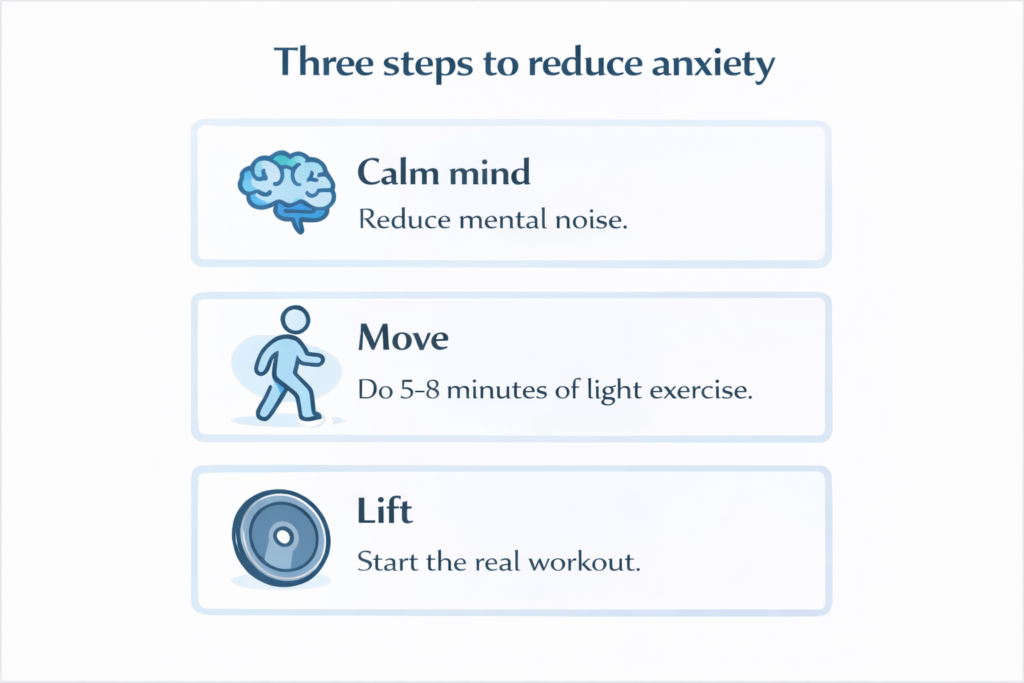
A good routine does three things, in order:
- Calms the mental noise
- Warms your body in a way that matches the workout
- Moves you into the first set without delay
That last part matters. Anxiety loves empty time.
What “pre workout routine” actually means for beginners
For a beginner, “pre workout” should mean a short bridge from normal life to training.
Not foam-rolling for 25 minutes.
Not a complicated mobility circus.
Not sipping a blood-pressure-raising pre workout supplement
Think of it like this:
- General warm-up: get your heart rate up a bit
- Dynamic mobility: move joints through comfortable ranges (not long static holds or stretches)
- Specific warm-up: do an easier version of the first lift you’re about to train
Dynamic warm-ups in the ~7–10 minute range show consistent performance benefits in research reviews, especially when they raise temperature and prep the movement patterns you’ll use. (1)
TL;DR Summary: A beginner pre-workout is a short ramp that calms your mind, warms your joints dynamically, and smoothly transitions into your first lift.
Part 1: the 2-minute mental warm-up (to stop the spiral)
You’re not trying to “think positive.” You’re trying to get your nervous system out of high alert so you feel in control of your body again.
The 2-minute script (do it in the car, locker room, or bathroom stall)
0:00–0:30 — Name the plan (one sentence).
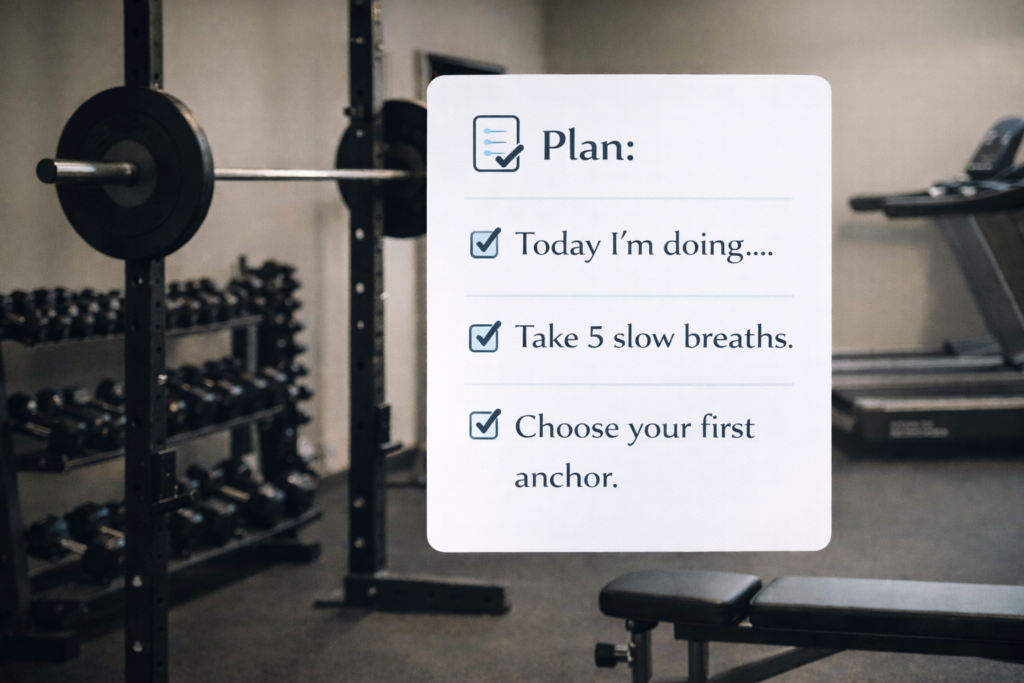
Say (quietly): “Today I’m doing: squat pattern, push, pull, leave.”
That’s it. Your brain wants a map.
0:30–1:30 — Breathe with a longer exhale.
Do 3-5 slow breaths where the exhale is longer than the inhale (example: inhale 4 seconds, exhale 6–8 seconds).
Breathwork studies show short daily practices can improve mood and reduce anxiety, and controlled breathing is a practical tool for downshifting stress in the moment. (2)
1:30–2:00 — Pick your “first anchor.”
Choose the first physical action you’ll do once you step onto the floor, like:
- “Treadmill walk 2 minutes,” or
- “Bodyweight squats x 8,” or
- “Cable row light set.”
Having an anchor helps you avoid aimless wandering.
Tiny rule that helps a lot
Keep your headphones off for these 2 minutes. Let your brain settle first, then add music if you want.
If walking in solo still spikes your nerves, you’ll like this guide on how to start going to the gym alone. And if the anxiety is more about being watched or judged, this breakdown of fear of the gym will help.
Part 2: the 5–8 minute physical warm-up (so you don’t feel stiff and awkward)
This is the part that makes you feel “in your body” instead of trapped in your head.
The easiest warm-up structure
You’ll do 2 minutes general + 3 minutes movement + 1–3 minutes specific.
Minute 0–2: General warm-up (pick one)
- Incline walk
- Easy bike
- Rowing at “I can talk” pace
Goal: warm skin, raise heart rate slightly, stop feeling stiff.
Minute 2–5: Move your joints with intent (dynamic)
Do one round, no rushing:
| Move | Reps | What it preps |
|---|---|---|
| Hip hinge (hands on thighs) | 8 | deadlift pattern, hamstrings |
| Bodyweight squat to comfortable depth | 8 | squat pattern, knees/ankles |
| Arm circles (small to medium) | 10 each | shoulders |
| “World’s greatest stretch” (gentle) | 3 each side | hips + upper back |
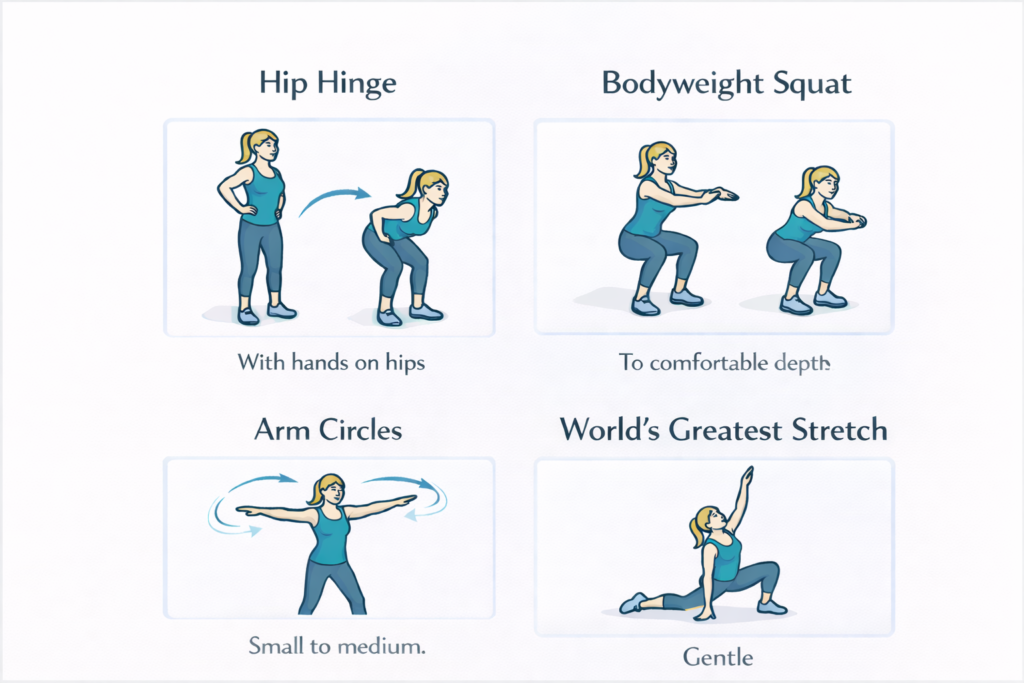
Dynamic warm-ups and dynamic stretching are commonly recommended because they increase temperature and range of motion without the performance drop that can show up with long static stretching right before training. Reviews generally favor dynamic prep for readiness. (1)
Minute 5–8: Specific warm-up sets (this is the secret sauce)
Do 2 lighter sets of your first main lift.
Example if you’re going to goblet squat:
- Set 1: very light x 8
- Set 2: moderate x 5
Then start your real sets.
This is where you stop feeling awkward because your body gets a rehearsal.
TL;DR Summary: Warm up by raising your temperature, moving dynamically through key joints, then doing 2 easy practice sets of your first lift.
The warm-up sets are your rehearsal, and the workout plan is the script. If you don’t have a routine yet, grab one of these workout routines for beginners.
Part 3: the “don’t overthink it” quick guide (optional)
You don’t need a supplement to have a good session. Most beginners do fine with normal food and water.
Use this simple decision tree:
- If you ate a normal meal in the last 2–3 hours: drink some water, you’re good.
- If you haven’t eaten in 3–5 hours and feel flat: have a small carb-forward snack, maybe some Gatorade.
- If you’re nauseous when you eat close to training: sip water, maybe a few bites, train anyway.
Sports nutrition position statements commonly suggest carbohydrate before higher-intensity or longer sessions to support performance, but the “right” amount depends on the person and the workout. (3)
Easy beginner snack ideas (30–60 minutes before)
- Banana + a few pretzels
- Toast + peanut butter
- Yogurt + berries
- A small bowl of cereal
If fat loss is your goal, don’t panic about this. A small snack doesn’t “ruin” anything. It just makes the session feel better.

The simplest version if you’re short on time
If you only have 5 minutes total, do this:
- 30 seconds: one-sentence plan
- 60 seconds: 5 slow breaths (longer exhale)
- 2 minutes: incline walk or easy bike
- 90 seconds: 1 light warm-up set + 1 moderate warm-up set of your first lift
That’s enough to get you steady and moving.
If you train early and feel wiped out
Morning training often fails for one reason: you try to go from zero to heavy immediately.
Make these tweaks:
- Extend general warm-up to 3–4 minutes
- Do one extra light warm-up set on the first lift
- Consider a small carb bite if you wake up hungry (half banana counts)
Also, lower the bar for “perfect.” Your job right now is to just show up and start.
If you train after work and feel drained
After-work fatigue is often mental, not physical. Your brain has been making decisions all day.
Try this:
- Do the 2-minute mental warm-up in your car before you walk in
- Keep your workout short (3–5 movements)
- Start with a machine if it helps you ease in (row, leg press, chest press)
You’re building consistency, not proving toughness.
The one rule that makes this routine work long-term
You do the same routine every time for 4 weeks.
Beginners usually change the routine too fast because they’re looking for the “best” warm-up. What you actually need is a familiar buildup that makes the gym feel predictable.
Predictable equals calmer. Calmer equals consistent. Consistent equals results.
How to know it’s working (what you should feel by minute 10)
By about minute 10 (including warm-up sets), you should notice:
- Your breathing feels steady, not shallow
- Your joints feel “oiled,” not stiff
- Your thoughts narrow to the next set, not the whole gym
- The first working set feels like effort, not shock
- You stop scanning the room for reassurance
If you still feel jittery, don’t add more stuff. Slow the exhale, and add one more light warm-up set.
TL;DR Summary: It’s working when your body feels coordinated and your brain stops negotiating.
FAQ
1) What should I drink 30 minutes before a workout?
Most beginners do best with water. If you sweat a lot, it’s hot, or your sessions run long, an electrolyte drink (or water plus a salty snack) can help you feel more steady. If you use caffeine, keep it modest and only if you already tolerate it well.
2) Is it good to take preworkout as a beginner?
No. As a beginner, you’ll get more consistent results from a repeatable warm-up, a simple plan, and decent sleep. Preworkout can also crank up jitters and anxiety, which is the opposite of what you want while you’re learning the gym.
3) What stretches should I do pre workout?
Do dynamic stretches (moving stretches) for 3–5 minutes, focused on the joints you’ll use. Try one round of:
- Leg swings (front/back and side/side) x 8 each
- Bodyweight squats x 8
- Hip hinges (hands on thighs) x 8
- Arm circles x 10 each direction
- Thoracic rotations (open books or standing rotations) x 6 each side
Save long, static holds for after training or separate mobility time.
Your next gym visit: copy-paste checklist
Save this in your notes app and follow it exactly for your next 10 sessions:
- Plan: “Today I’m doing: , , _.”
- Breathe: 5 slow breaths, longer exhale
- General: 2 minutes easy cardio
- Move: hinge 8, squat 8, arm circles 10/side, stretch 3/side
- Specific: 2 warm-up sets of first lift
- Start: begin your first working set immediately after
You now have a simple, drama-free path from intention to action. Now it’s time to execute.