
The Problem with Minimum Effective Dose Strength Training (The Easy Fix)
You start a new program on Monday. It’s solid. You hit a few great sessions. Then a hard week shows up, you miss one day, feel behind, and suddenly you’re “starting over” again next Monday.
That loop isn’t a motivation problem. It’s not even a program-quality problem. It’s a dose problem.
You might have heard of Minimum Effective Dose strength training: the idea of doing just enough to get results. It’s a great starting point. But to make real progress, you don’t just need a floor. You need to find your ceiling: your Maximum Sustainable Dose.
So, if you’re the person who’s run a bunch of decent workout plans and still keeps falling off, this is for you. Not day-one beginners. Not advanced lifters. This is for the frustrated intermediate who wants real progress without the constant reset button.
Before/After: What changes when you treat training as a dose problem
Before:
You run an aggressive plan that looks “optimal.” It’s well thought out and well-designed. Four days per week, lots of accessories, sessions that should take 60 minutes but somehow take 90. You miss one lower-body day, then the same day again two weeks later. Now you feel behind, so you switch programs. Over six months, you “trained for six months”… but you actually trained 11 total weeks.
Your squat: 225 for 5 is still 225 for 5. You’re not weak. You’re just never training long enough in a row to force adaptation.
After:
You keep a plan that sits near your sustainable ceiling. When life gets chaotic, you do a Minimum Dose Session instead of disappearing. Over the same six months, you train 23+ weeks (including simplified sessions). Your squat moves from 225×5 to 245×5. Your pulling strength climbs. Your shoulders look different in photos.
Same person. Same life. Different dose.
The Problem With “Optimal” Programs
Most “optimal” programs assume perfect weeks: stable energy, predictable schedule, consistent recovery. When a plan requires optimal conditions to work, it eventually breaks. The goal isn’t maximum theoretical stimulus and recovery. It’s maximum repeatable stimulus.
The simple truth is that the greatest factor in gaining significant strength and muscle is consistency over long stretches of time. (2)
So, the best program is the one that allows for repeatability + the largest training stimulus which conserves repeatability.
MED Is the Floor (Why “Minimum” Exists and When It’s Useful)
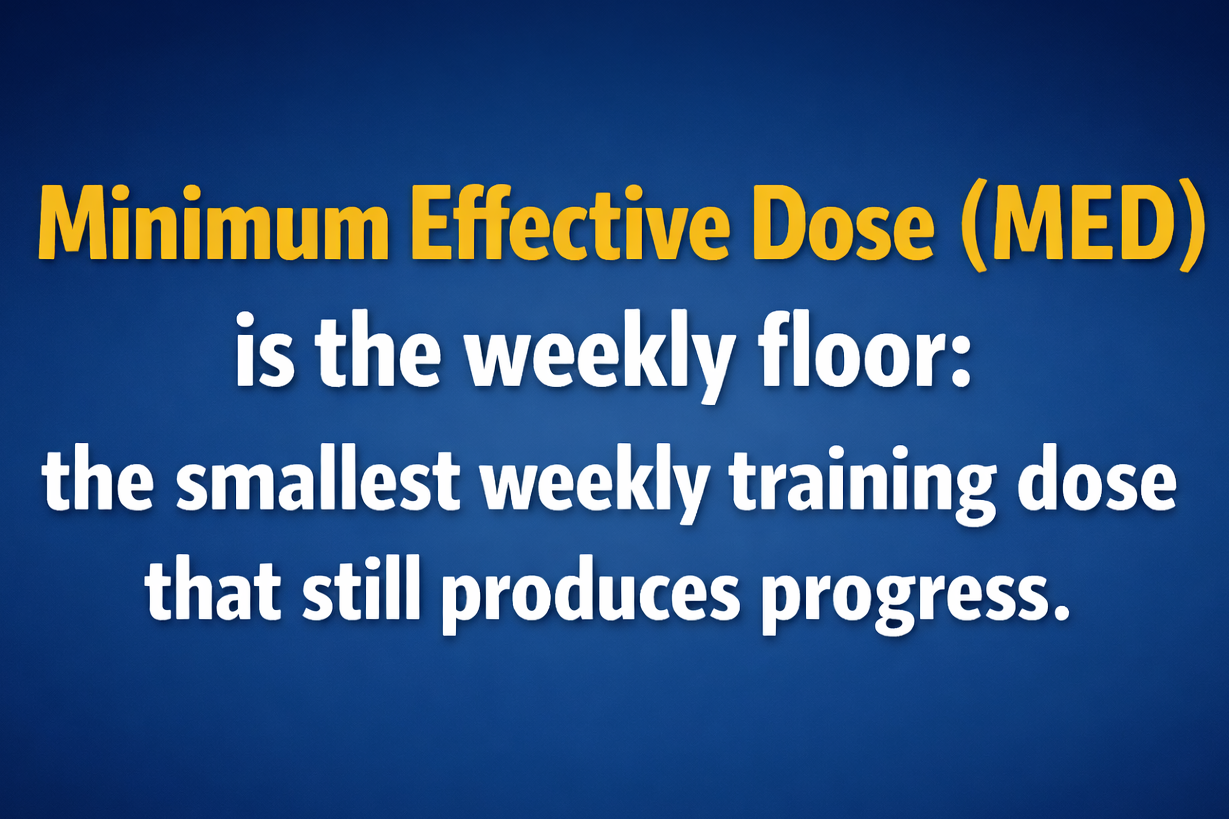
Minimum Effective Dose (MED) is the weekly floor: the smallest weekly training dose that still produces progress. It’s one of the most well-known (and well-studied) contingency plans for ensuring you hit the gym and get a minimally viable stimulus for growth. (1)
MED exists because life happens. Travel. Bad sleep. Heavy stress. Weeks where your best training skill is simply just showing up.
But MED is not the end goal. It’s the baseline that prevents the “I missed a week so I’m restarting” spiral. It keeps you training through rough patches so you don’t lose months rebuilding.
If you’re reading this and realizing you’re still figuring out the basics of programming or gym routine, these resources will serve you better right now:
MSD Is the Ceiling (Where “More” Starts Backfiring)
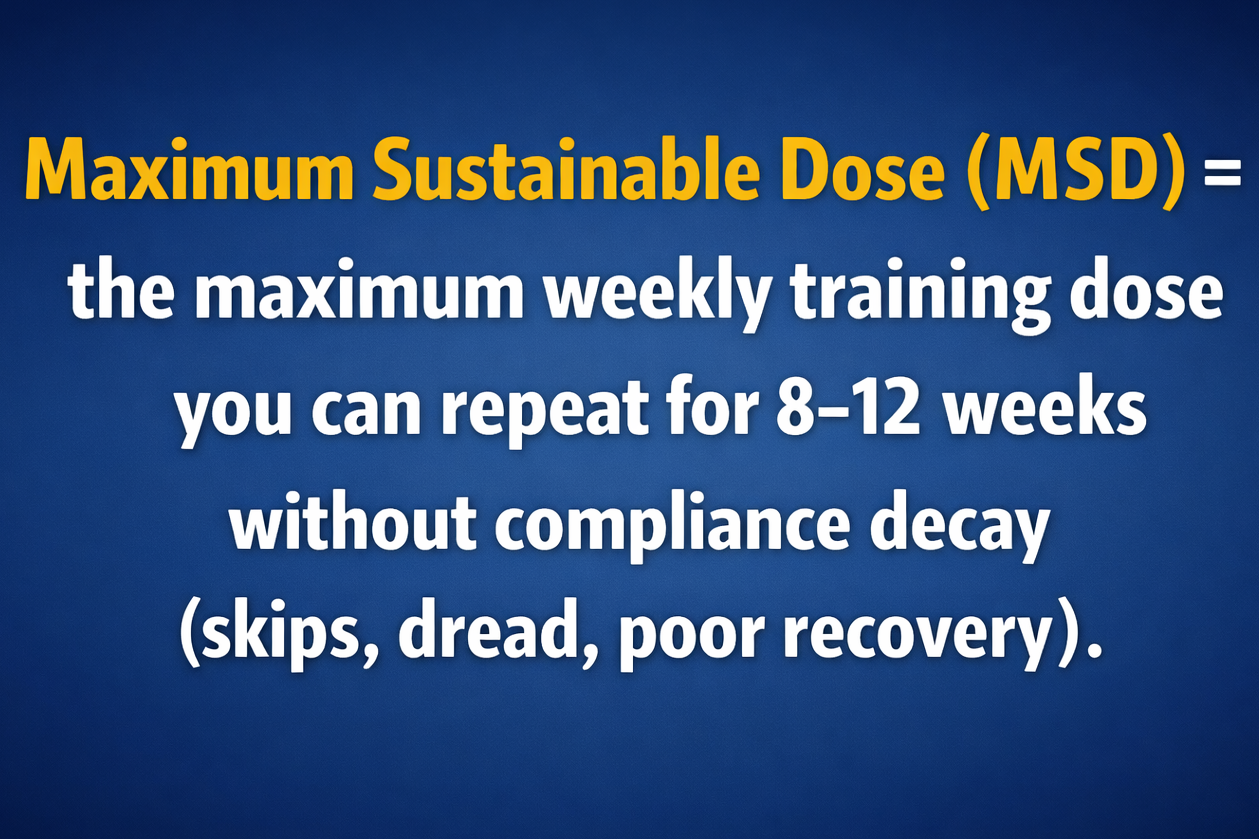
The real goal is to figure out what your Maximum Sustainable Dose (MSD) is. If the MED is the floor, then the MSD is your sustainable ceiling.
MSD = the maximum weekly training dose you can repeat for 8–12 weeks without compliance decay (skips, dread, poor recovery).
Quick transparency note: MED has research backing (you can make meaningful gains with surprisingly low volume when effort is appropriate). MSD is a practical coaching framework I generated through empirical observation: a pattern-based hypothesis about what breaks real-world training, not a lab-proven term.
I coined the term MSD after watching so many people (including myself) struggle through the same cycle of burnout. The pattern was too clear to ignore: the plan that looked optimal on paper was often the one that broke first in real life.
That 8–12 week horizon is the point. Anybody can brute-force a hard plan for two weeks. MSD is what you can actually run long enough for gains to build upon each other.
When you go above MSD, training starts charging interest: sessions run long, unnecessary soreness spills into your life, and one day becomes the avoided day (usually legs). Then the reset cycle begins.
Here’s the blunt truth: more stimulus on paper can create less progress in real life if it breaks adherence (even if it seems to account for recovery well).
The One Rule That Exposes Your Ceiling
This is the cleanest way to approximate your ceiling.
Same-Day Skip Rule (MSD detector):
If you miss the same scheduled day/session twice in a month, that day’s prescription is above your current MSD. Reduce dose for that day.
This is not a guilt rule. It’s not “try harder.” It’s a measurement tool.
Also important: you don’t have to shrink your entire program because one day is overdosed. Often it’s one session that’s too long, too sore, too complex, or too late in the week.
What Does Reducing the Dose Actually Look Like?
It’s pretty simple. There are generally five ways to reduce the dose:
- Reduce the amount of exercises performed (keeping all other variables such as weight, reps, rest period, etc. constant)
- Reduce the volume (less total sets)
- Reduce the intensity (lower weight used, further away from ‘failure’)
- Change the type of exercises performed (replace back squat with something easier like goblet squat, replace barbell rows with machine rows, etc.
- Set a hard limit on the amount of time in the gym (down from 60 to 45 mins)
The Sustainable Dose Zone (Where the Best Long-Term Gains Live)
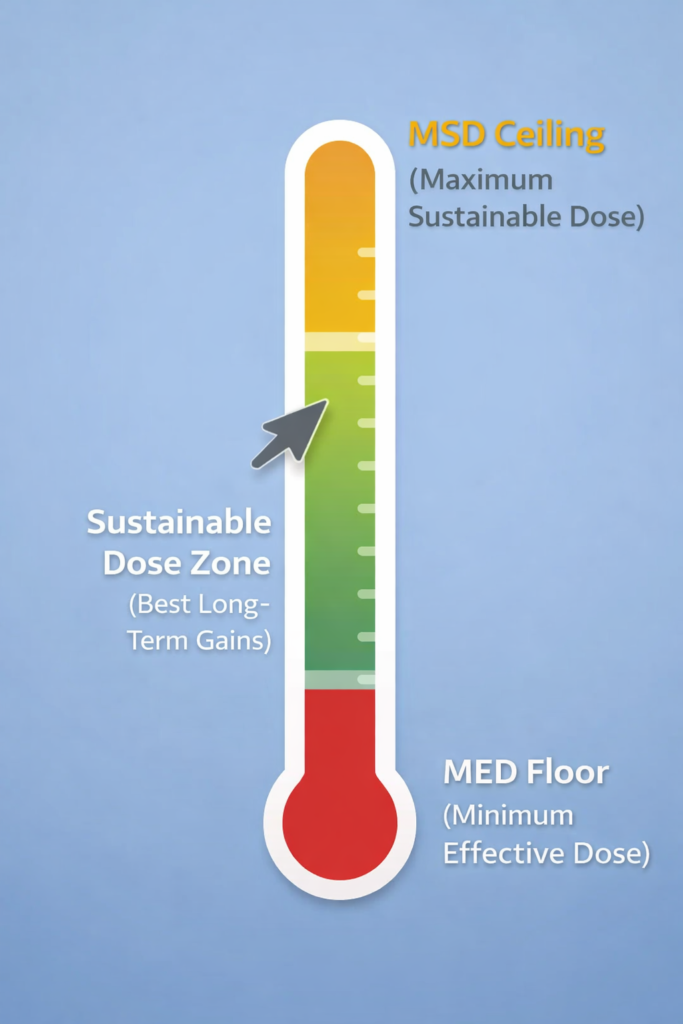
Between MED (floor) and MSD (ceiling) is the Sustainable Dose Zone.
This is where you get the best long-term return: enough work to grow, not so much that the plan collapses. The goal is productive weeks that build on one another, not heroic weeks that burn brightly and then flame out completely..
Keep this line:
MED keeps you afloat. MSD is where you grow fastest without falling off.
The point: MED is survival mode. It’s an excellent tool to keep you on track. High-volume/high intensity “optimal” training is often fragile (vulnerable to missed workouts). MSD is the upper edge you can live at. Train there, and gains compound over time.
But Won’t I Make Slower Progress Than Someone Doing More Volume?
In a perfect world with perfect adherence, yes, more volume can produce better results.
But you don’t live in that world. You live in the world where work runs late, sleep gets weird, and motivation is unreliable.
So the real equation looks like this: actual progress equals dose you can repeat, not a theoretically optimal dose you can describe.
Low-dose training can still produce meaningful gains. The minimum-dose research on strength outcomes suggests that even very small doses, done consistently and with sufficient effort, can move the needle. (1) Suboptimal can still be significant. That matters because four years of consistent training near your MSD beats four years of cycling through “optimal” plans you keep quitting.
How to Find Your MSD Without Tracking Anything
You don’t need spreadsheets to find your ceiling. You need signals.
Here’s a quick gut-check first.
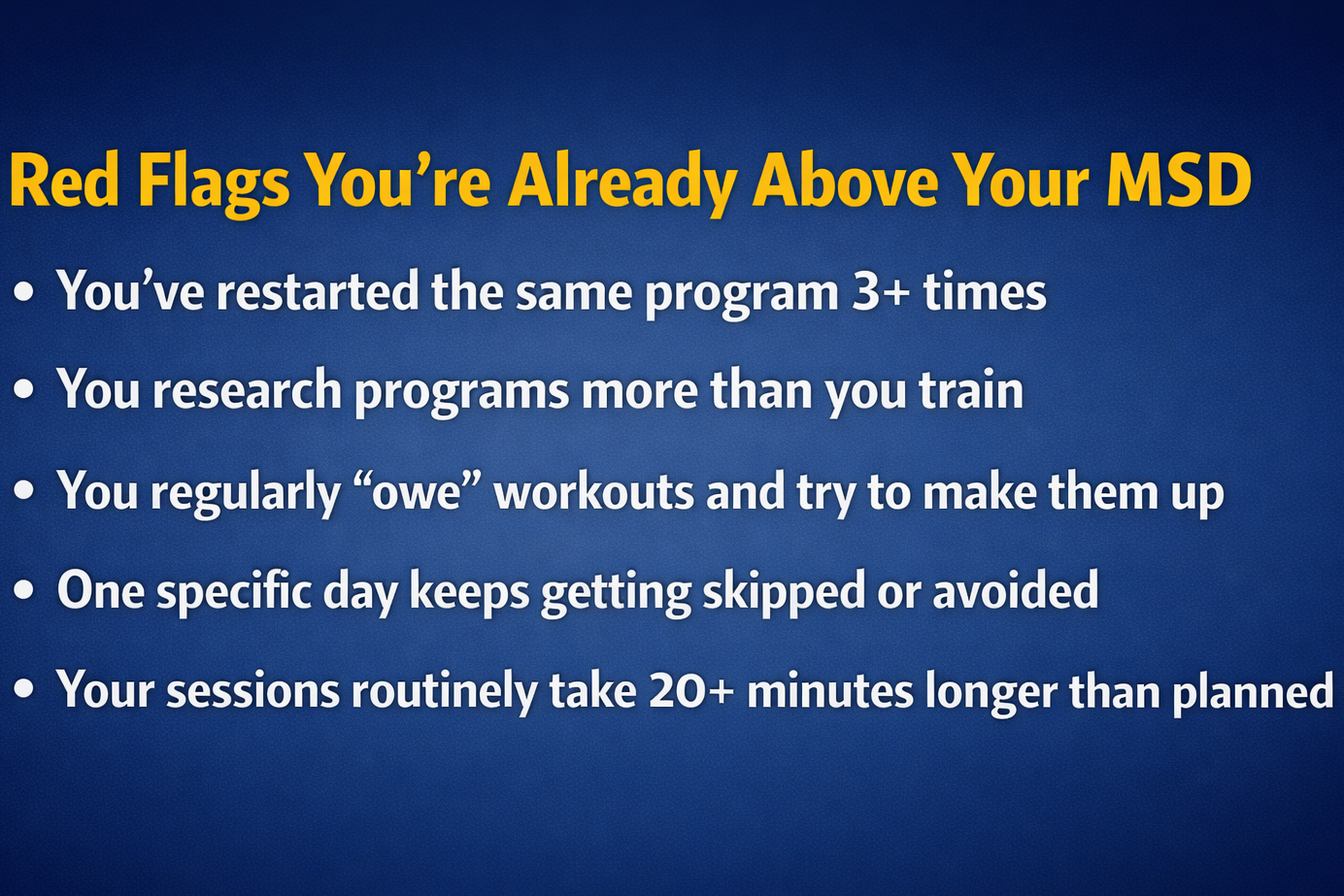
If you checked 2+, your current plan is above your MSD. The solution isn’t a better program. It’s finding your sustainable ceiling.
Dose signals cheat sheet
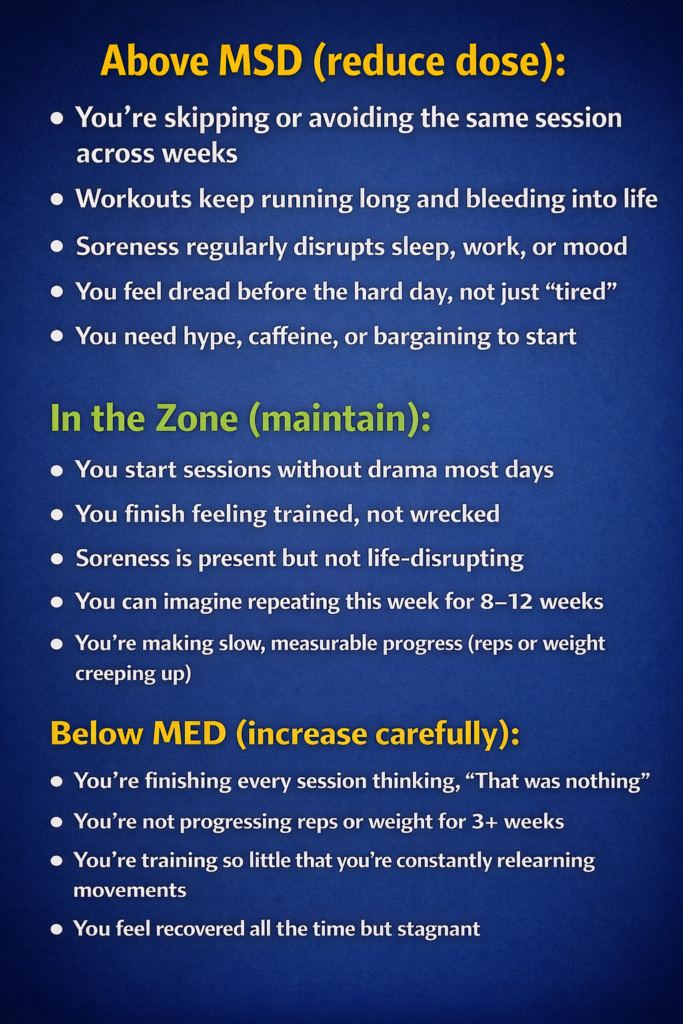
The Two Rules That Keep You in the Zone (Dose Control, Not Motivation)
These aren’t discipline rules. They’re dose control.
Rule 1: Never Miss Twice isn’t about discipline. It’s a ceiling detector.
Missing once is life. Missing the same session twice in a month means the prescription is above your current MSD. The fix is dose adjustment, not character improvement. The diagnosis isn’t moral. It’s analytical. Unless sick or injured, don’t let two misses become the new normal.
Rule 2: If You Skipped, Shrink the Next Workout. (Auto-downshift)
Skipping is feedback that the dose was too close to, or above, your ceiling for that week. Shrinking pulls you back under MSD so you can return, then rebuild.
(This applies to each skip, but if you’re skipping the same day repeatedly, that’s when Rule 1 kicks in and you adjust that day’s prescription permanently.)
The Three Session Types You Need
Use these terms consistently so your brain doesn’t have to conduct an internal debate.
1) MSD Plan (Full Session)
This is your normal training day when life is reasonably stable. You’re training at or near your sustainable ceiling.
It should feel challenging, but not like a death march. You finish feeling like you put work in, but also like you could come back and do it again.
2) Minimum Dose Session (Simplified Session)
This is what you do when the full MSD Plan is at risk, but you’re still safe to train.
This one line matters:
MED is the weekly floor; Minimum Dose Sessions are the day-level tool that lets you reach it without disappearing.
Choose one simple option:
- Two-move session (10–15 minutes): 2 exercises, 1–2 sets each, leave about 2 reps in the tank
- One-lift session (8–12 minutes): main lift of the day, 2–3 sets, done
- Sweat and reset (10–20 minutes): easy machines or incline walk, leave feeling better than you arrived
3) Stop Sign Rest (Intentional Rest)
This is for sick, injured, unsafe, or truly depleted days.
Stop Sign Rest isn’t “giving up.” It’s a strategic call that protects the next week. If rest guilt gets you, read this: https://appliedmuscle.com/rest-day-guilt/
What This Looks Like in Practice (A Real Week)
Here’s a normal week for someone training near their ceiling.
Monday: Full MSD Plan (45 minutes). Felt good. Hit the main lifts, left 2 reps in the tank, walked out normal-tired.
Wednesday: Chaos day. Work ran late, sleep was trash, brain felt foggy. Did a Minimum Dose Session (12 minutes): two moves, two sets each.
Friday: Full MSD Plan (45 minutes). Back on track.
Result: 102 minutes of training instead of zero.
And more importantly: you stayed above the weekly floor without needing a restart. No guilt. No “I’m behind” spiral. Just training.
First 2 Weeks Protocol (So You Don’t Overthink It)
Weeks 1–2: Find your MSD baseline
Run the MSD Plan as written for your split. Don’t change anything yet.
Just observe:
- How long did sessions actually take?
- Did you avoid any day?
- Did soreness disrupt your life?
- Did you feel like you could repeat this week for 8–12 weeks?
Weeks 3–4: First adjustments
- If you skipped a day: Use the MSD Adjustment Ladder below
- If sessions ran long: Set a hard time cap
- If you’re crushing it: Maintain (don’t add volume yet)
3-Day Program Templates (Examples, Not Doctrine)
These templates are examples. Your personal MSD might require different exercises, splits, or volumes. Use these as a concrete starting point to learn your own dose, not as a rigid doctrine.
Progression (simple): add 1 rep per set until you hit the top of the range. When it feels smooth, add a little weight next time.
Day A: Squat pattern + Push + Pull (Full Session ~45 min)
✓ Full Session (MSD Plan):
- Squat or Leg Press: 3 × 5–10
- Bench Press or DB Bench: 3 × 6–12
- Row (cable/DB/chest-supported): 3 × 8–12
Optional: arms 1 × 10–15
✓ Simplified (Minimum Dose Session, ~10–15 min):
- Squat/Leg Press: 1–2 × 6–10
- Bench/DB Bench: 1–2 × 6–12
Day B: Hinge + Push + Pull (Full Session ~45 min)
✓ Full Session (MSD Plan):
- RDL or hinge machine: 3 × 6–10
- Overhead Press or Incline DB Press: 3 × 6–12
- Pulldown or Assisted Pull-up: 3 × 8–12
Optional: abs 1 set
✓ Simplified (Minimum Dose Session, ~10–15 min):
- RDL/Hinge: 1–2 × 6–10
- Pulldown (or Row): 1–2 × 8–12
Day C: Squat-lite/Single-leg + Push + Pull (Full Session ~45 min)
✓ Full Session (MSD Plan):
- Split Squat, Hack Squat, or Goblet Squat: 3 × 8–12
- Incline DB Press or Machine Press: 3 × 6–12
- Row (any style): 3 × 8–12
Optional: lateral raises 1 set
✓ Simplified (Minimum Dose Session, ~10–15 min):
Pick the option that balances your week:
- Lower + Push: squat-lite 1–2 × 8–12, incline press 1–2 × 6–12
- Lower + Pull: squat-lite 1–2 × 8–12, row/pulldown 1–2 × 8–12
If you keep restarting, pair this with: https://appliedmuscle.com/stay-consistent-with-working-out/
4-Day Program Templates (Examples, Not Doctrine)
These templates are also examples. The goal is to show how a repeatable split near your ceiling can coexist with Minimum Dose Sessions.
If you don’t know which split to choose, read this: https://appliedmuscle.com/upper-lower-vs-push-pull-legs/
Schedule example: Mon Upper 1, Tue Lower 1, Thu Upper 2, Fri Lower 2
Progression: add reps smoothly, then add a little weight.
Upper 1 (Full Session ~45 min)
✓ Full Session (MSD Plan):
- Row: 3 × 6–12
- Bench or DB Bench: 3 × 6–12
- Pulldown: 2 × 8–12
Optional: lateral raises 1 set
✓ Simplified (Minimum Dose Session, ~10–15 min):
- 1 push: bench/DB bench 1–2 × 6–12
- 1 pull: row/pulldown 1–2 × 8–12
Lower 1 (Full Session ~45 min)
✓ Full Session (MSD Plan):
- Squat or Leg Press: 3 × 5–10
- RDL/Hinge: 3 × 6–10
Optional: calves or abs 1 set
✓ Simplified (Minimum Dose Session, ~10–15 min):
- 1 squat pattern: squat/leg press 1–2 × 6–10
- 1 hinge pattern: RDL/hinge 1–2 × 6–10
Upper 2 (Full Session ~45 min)
✓ Full Session (MSD Plan):
- Overhead Press: 3 × 6–12
- Pulldown (different grip): 3 × 8–12
- Incline DB Press: 2 × 6–12
Optional: arms 1 set
✓ Simplified (Minimum Dose Session, ~10–15 min):
- 1 push: overhead or incline press 1–2 × 6–12
- 1 pull: pulldown/row 1–2 × 8–12
Lower 2 (Full Session ~45 min)
✓ Full Session (MSD Plan):
- Hinge (RDL or trap bar deadlift): 3 × 5–8
- Split Squat/Lunge: 2–3 × 8–12
Optional: abs 1 set
✓ Simplified (Minimum Dose Session, ~10–15 min):
- 1 squat pattern: split squat or leg press 1–2 × 8–12
- 1 hinge pattern: RDL/hinge 1–2 × 6–10
How to Fix the Overdosed Day (MSD Adjustment Ladder)
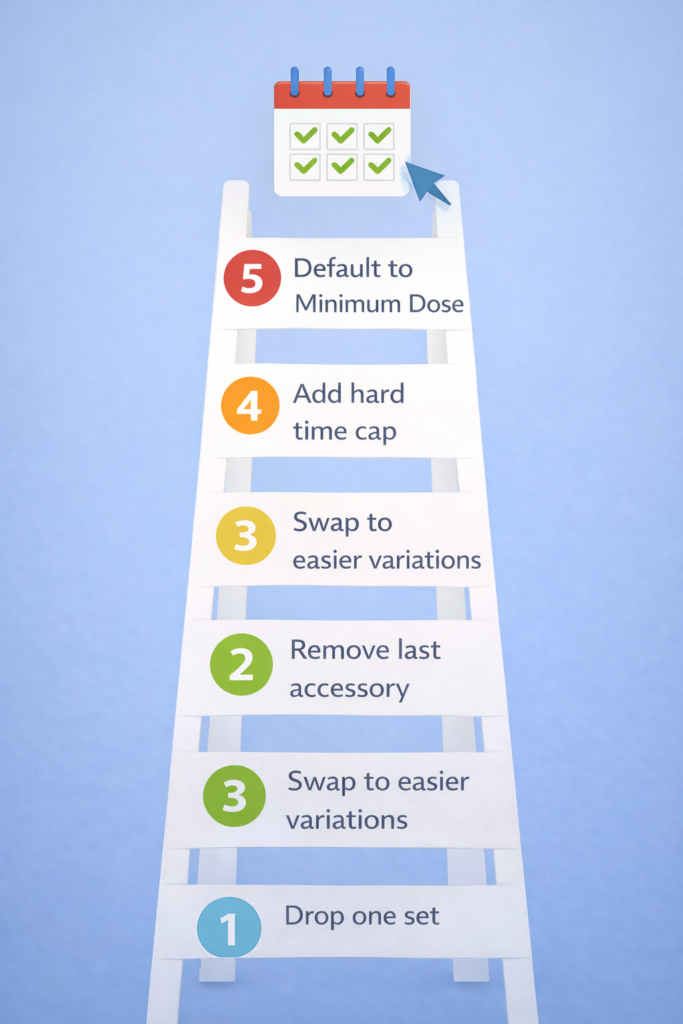
This is the other big takeaway.
When a day keeps getting missed, treat it like dose feedback. Adjust that day.
- Drop one set from each lift
- Remove the last accessory
- Swap to lower-setup variations (machines/DBs)
- Add a hard time limit
- Default that day to a Minimum Dose Session until it stops getting skipped
The goal is to return to your MSD Plan over time. You’re not reducing the dose forever. You want to get back up to just below (or at) that Maximum Sustainable Dose. So that means you’re calibrating.
Progression That Doesn’t Break Consistency
Progress should feel like a controlled climb, not a scramble. Remember: you’re not just progressing weight or reps. You’re also progressing your sustainable ceiling. Both matter.
Only increase dose after 2–3 consistent weeks. Then change one thing: add a rep, add a little weight, or rarely add a set. If skipping returns, you exceeded MSD. Revert one step and stabilize.
FAQ
Q: But isn’t this just doing the minimum?
No. MED is the floor. The goal is to train near (or at) your MSD for the best gains you can repeat. Minimum Dose Sessions are how you keep weekly dose from collapsing when full sessions are at risk.
Q: Will I still gain muscle and strength?
Yes, especially if you’ve been inconsistent. Consistent training near your sustainable ceiling compounds over time. Low-dose research suggests meaningful gains can happen with surprisingly small doses when effort is appropriate. (1) The big win is training long enough in a row for adaptation to show up.
Q: What if I’m traveling 2 plus weeks per month?
Then those travel weeks, Minimum Dose Sessions are your MSD Plan. When you’re home, run the full plan. You’re still training 52 weeks per year, which beats training 20 weeks and restarting forever.
Q: What about progressive overload?
Progressive overload means adding stress over time. You can do that by adding reps, adding weight, or adding dose. In this framework, there’s a sneaky form of overload that matters most: adding consistent weeks without falling off. That counts.
Q: What if my life is just always chaotic?
Then chaos is your baseline, not the exception. Design your MSD Plan for that reality. If you’re consistently only hitting 2 full sessions per week plus a Minimum Dose Session, that might be your actual MSD right now. The framework still works. You’re just working with a different ceiling than someone with a stable schedule.
Q: Won’t this be too easy?
Your MSD Plan isn’t supposed to be easy. It’s near your sustainable ceiling. You should feel challenged without getting wrecked. If it feels genuinely easy for 3+ weeks, that’s a signal you’re below your ceiling and can dose up carefully.
Q: What if I’m always doing Minimum Dose Sessions?
Then your current life season sets a lower ceiling. Stabilize for 2–3 weeks, then nudge upward with one small change. If full sessions keep breaking, your ceiling isn’t where you want it yet. That’s fine. Train at the ceiling you actually have. A low ceiling that you train at consistently beats a high ceiling you can’t reach.
Q: What about sickness or injury?
Stop Sign Rest. Then return with Minimum Dose Sessions and rebuild. No make-up workouts. Just go to your next scheduled session.
Decision Tree (Keep This Simple)
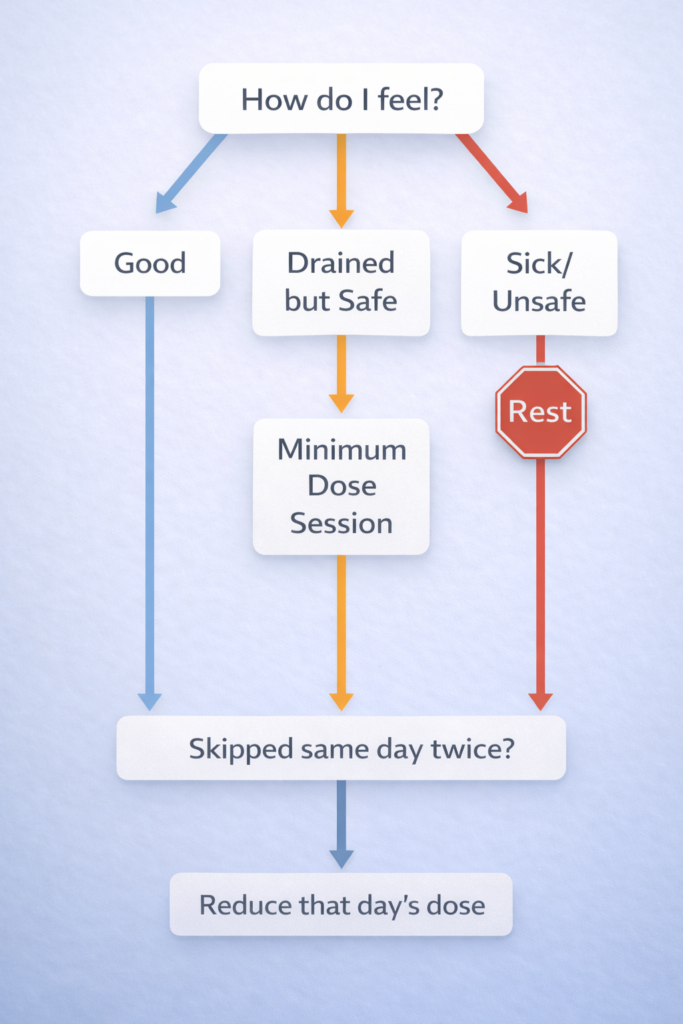
Feeling good? Use the MSD Plan.
Feeling drained but safe? Do a Minimum Dose Session.
Feeling unsafe or sick? Take Stop Sign Rest.
Skipped the same day twice? Reduce that day’s dose.
Three consistent weeks? Consider adding 1 rep per set.
This isn’t about finding the perfect program. It’s about building a training practice that fits you, wherever you’re at.
Your next move (so you know what to do Monday)
MED is the floor. MSD is the ceiling. The Sustainable Dose Zone is the goal: more gains than MED without breaking adherence.
Start today: Pick the 3-day or 4-day example structure and schedule your first session. If the full MSD plan is at risk, do a Minimum Dose Session. If it’s a stop-sign day, take Stop Sign Rest. Never miss twice.
And if you realize you actually need the fundamentals first, read this:
https://appliedmuscle.com/how-to-start-going-to-gym/
References
- Androulakis-Korakakis P, et al. The Minimum Effective Training Dose Required to Increase 1RM Strength in Resistance-Trained Men: A Systematic Review and Meta-Analysis. Sports Med. 2020.
- Rhodes RE, et al. Promoting Physical Activity: Development and Testing of Self-Determination Theory-Based Interventions. Int J Behav Nutr Phys Act. 2021.