
What to Expect Joining a Gym for the First Time (And How to Handle All of It)
You’re probably not reading this from the gym. You’re reading it from your couch, or your car, or your phone at 11pm, doing the thing where you prepare to prepare. The gym bag is somewhere nearby. You’ve driven past the building a few times.
This is the part nobody talks about: the moment before you go in, when your brain starts flooding you with scenarios. What do I say at the desk? What if I don’t know how to use anything? What if everyone notices I have no idea what I’m doing?
This post is a walk-through for exactly that moment. You’ll know what to say, what to ask, what to bring, and exactly what to do when you walk onto the floor for the first time. By the time you finish reading, you’ll have already done a version of this in your head. That matters.
Core point: Most first-gym anxiety isn’t about fitness. It’s about not knowing what to expect. Once you know, the whole thing gets easier.
What Actually Happens When You Walk In
The front desk looks like any other reception area. Someone will greet you, usually with something like “Welcome in, have you been here before?” Say no. They’ll take it from there.
At most gyms one of two things happens next: they hand you a day pass and let you look around, or they sit you down with someone to talk about membership options. Either way, you’re not committed to anything yet. Going to a gym for the first time is just about getting a feel for the place.
If they try to move you straight into signing paperwork before you’ve seen the place, slow it down. Say: “I’d like to take a look around first before I sign anything.” They should absolutely give you a tour of the gym first. If they push back on it, that tells you something about how the gym operates.
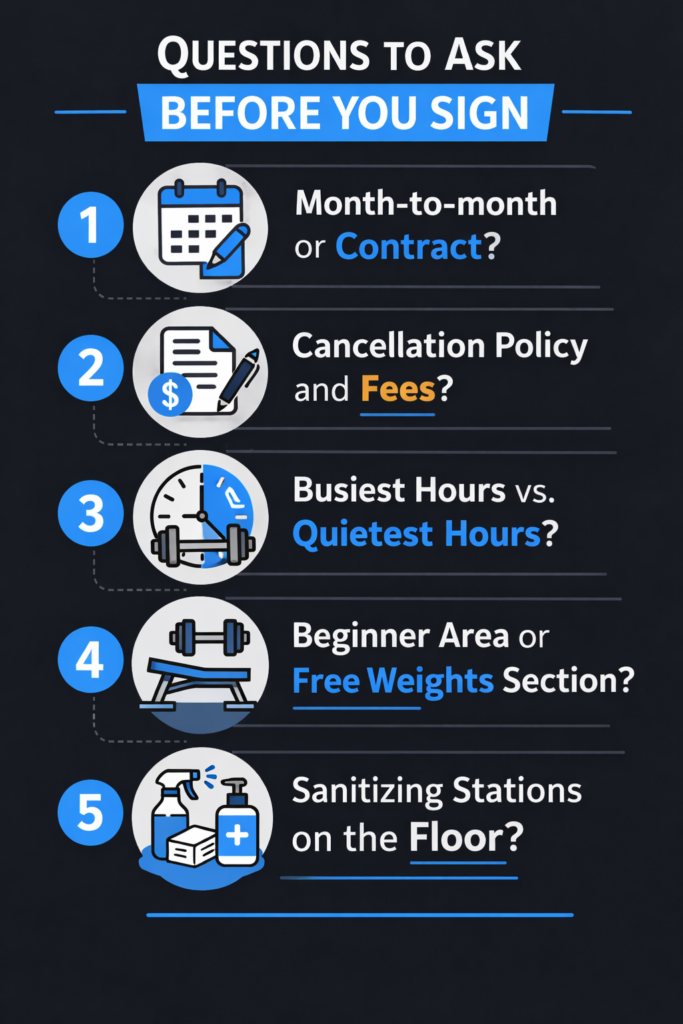
Once you decide to join, you’ll get a brief tour, set up billing, and sign a contract. Before any of that happens, ask these questions:
- Is there a month-to-month option, or is this a contract?
- What’s the cancellation policy, and is there a fee to cancel early?
- What are the busiest hours, and when is it quietest?
- Is there a beginner-friendly area or a designated free weights section?
- Are there sanitizing stations provided on the floor?
A gym with nothing to hide answers all of these without hesitation. One that deflects or rushes you past them is worth reconsidering. A gym that won’t show you the cancellation terms in writing before you sign is telling you something specific about what comes later.
While you’re on the tour, also look at the floor itself. Look for:
- Broken equipment that’s been sitting out of order,
- A shortage of cleaning stations, or
- A space that’s genuinely packed wall to wall at the time you’d normally train.
Making sure the temperature is controlled well is another factor to notice. If it’s a hot day and the a/c is broken or not turned up, that’s a red flag.
The Personal Training Upsell (And How to Decline It)
At most commercial gyms, someone will offer you a complimentary personal training session. Sometimes this is genuinely helpful. Often it’s a sales funnel.
You don’t have to take it. You don’t have to explain yourself either.
Say this: “Thanks, I’m going to get settled in first and revisit that later.”
That’s the whole script. No apology, no long story about your schedule. If they come back a second time, use the same line again, word for word. If they push past that, it’s a red flag.
The Locker Room
This is a real sticking point for a lot of people and most guides skip it entirely.
Yes, you should bring your own padlock. Most gyms have day-use lockers but don’t supply locks. And if you’re in a large gym in a metropolitan area, you may even want to just carry your bag with you (as annoying as that is). Unfortunately, I’ve had my locks broken and personal items stolen before in exactly these sorts of situations, so I tend to carry my gym equipment on my person.
Most locker rooms also have private changing stalls, so you’re not forced to change in the open if that’s not comfortable. And the general atmosphere in a gym locker room is one of total mutual indifference. Everyone is in their own head. Nobody is paying attention to you.
If you’re going to a gym close to home, you can also just change before you leave the house. That sidesteps the whole thing on day one.
What to Take to the Gym for the First Time
Keep the bag simple. Overloading it is one more reason to talk yourself out of going.
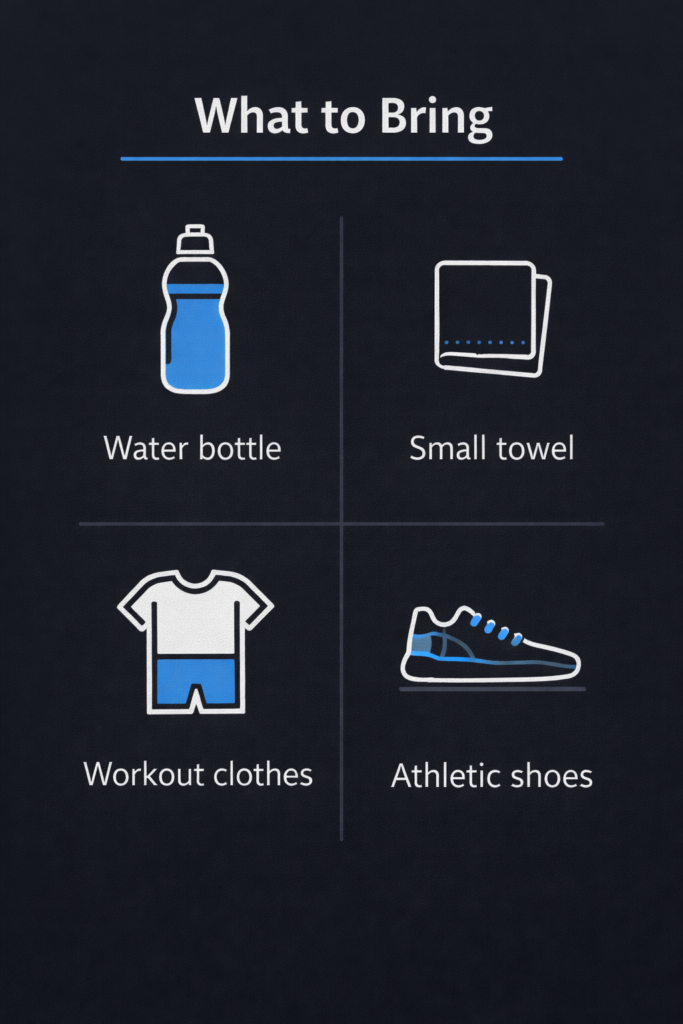
Here is the equipment you actually need:
- Water bottle
- Small towel
- Comfortable clothes you can move in
- Supportive athletic shoes
For shoes, supportive athletic shoes matter more than most people expect. Running shoes or cross-trainers work fine. Flat-soled shoes work for lifting. What doesn’t work: anything with a raised heel, worn soles, or no lateral support.
We already talked about a padlock. Have your membership card or app ready for check-in. Headphones are optional but useful if you want to stay focused (and music just makes everything better anyway).
One thing worth having before you walk in: a loose plan for what you’ll do on the floor. Not a full program. Just a rough idea, so you’re not standing in the middle of the gym trying to figure it out with people around. More on this next.
What to Do on Your First Day at the Gym
Here’s a nugget you won’t hear anywhere else: The smartest first visit isn’t a workout. It’s a walkthrough.
Walk in. Get your bearings. Find the bathrooms, the water fountain, the locker room. Figure out where the cardio machines are versus the free weights versus the resistance machines. Then leave. That’s it. Knowing the physical layout of the building removes a layer of uncertainty that’s responsible for a lot of the “I don’t want to go” feeling. Familiarity breeds comfort. Use the first visit for that if you need to.
If you’re ready to train, keep it to twenty or thirty minutes. Here’s a structure that works:
First, start with five to ten minutes of light cardio on the treadmill or stationary bike at a pace where you could hold a conversation. The goal isn’t effort. It’s getting warm and letting your nervous system settle.
If you want a more structured warm-up before you start touching weights, this pre-workout routine for beginners is worth a look.
Second, pick three machines and do two or three sets of each. Leg press, chest press, and a seated cable row cover most of your body and are straightforward to figure out. Set the weight at a level where the last couple of reps of your second set feel mildly challenging, not grinding. If you finish a set and felt nothing, add a little weight. If you were struggling to control the movement, drop it.
For reps, aim for eight to twelve per set. Don’t rush them. Slow and controlled beats fast and sloppy, especially early.
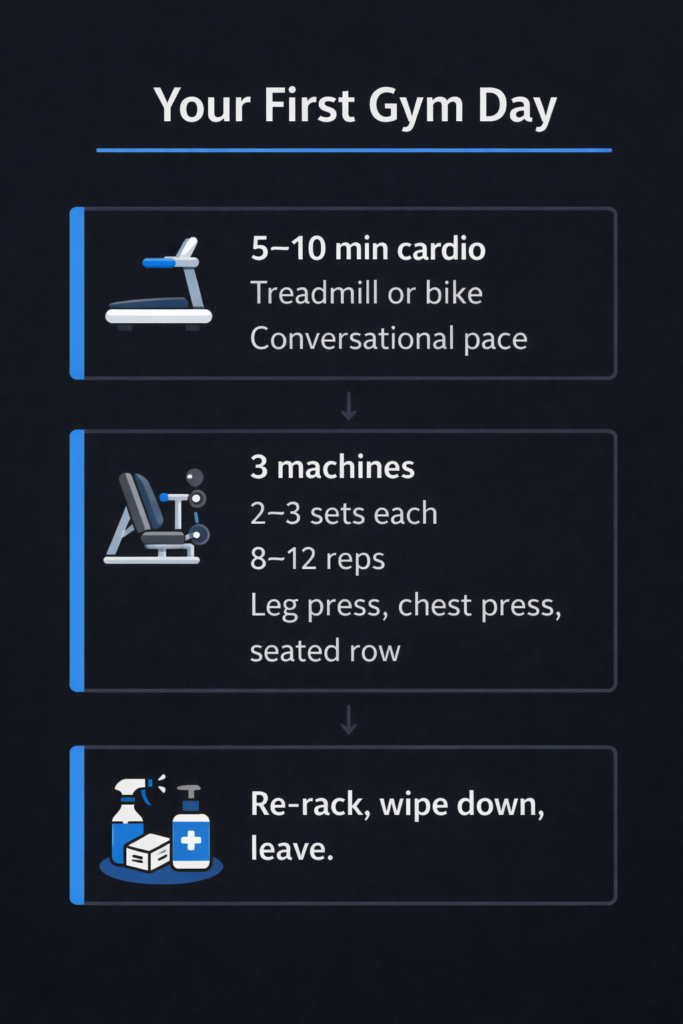
Before you leave, re-rack your weights, wipe down the machine, and if someone asked to work in between your sets, the courteous answer is always yes. That’s the full etiquette guide. It takes about five seconds. From here, do two to three sessions per week, thirty minutes each, at a consistent time. That’s the whole target.
What to Say When You Don’t Know How a Machine Works
You will hit this moment. Some machine will have an adjustment you can’t figure out, or a starting position that looks completely wrong for your body.
Most beginners would rather wander around confused for ten minutes than admit they don’t know something. Don’t do that. Walk up to anyone on staff and say: “Hey, quick question. How do I adjust this one?”
That’s the whole line. Staff answer this question fifteen times a day. It’s not embarrassing. It’s exactly what they’re there for.
One Thing to Know About Being Watched
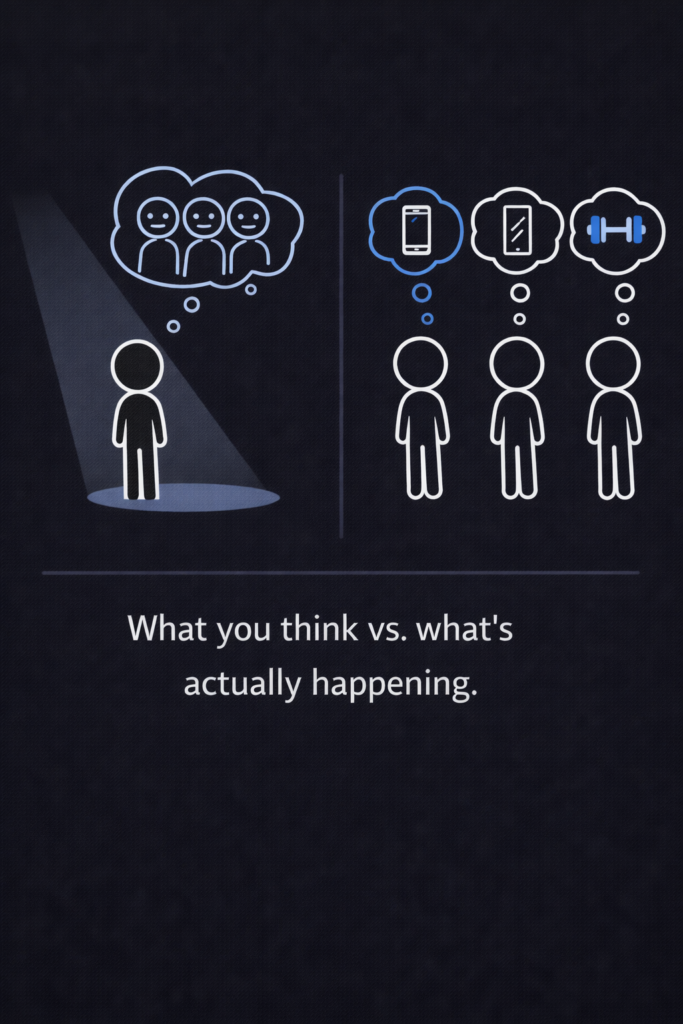
You will feel like everyone is looking at you. They are not.
There’s a well-documented phenomenon called the spotlight effect: people consistently overestimate how much others notice them. In a gym, this is amplified. But the reality is that the person doing bicep curls in front of the mirror is thinking about their biceps. The person on the treadmill is staring at the TV or their phone. The person adjusting the cable machine is thinking about the cable machine.
The gym floor is genuinely less judgmental than the parking lot makes it feel. Everyone was new once. Most of them remember it.
Go This Week, Not Next Monday
The first visit is reconnaissance. You’re not there to prove anything, perform for anyone, or figure it all out. You’re going to walk in, look around, do a little something, and leave. That’s the whole job.
Next Monday is a made-up construct. This week is real.
If you’re going alone and want a structure that holds up past the first few visits, this guide to going to the gym alone covers how to build a routine that actually sticks. And if anxiety is the main thing keeping you in the parking lot, this goes much deeper on that.
The bag is already packed. That’s the hard part.