
How to Start Going to the Gym: A Beginner Plan That Doesn’t Overwhelm You
If the thought of walking into a gym makes you sweat more than an actual workout… yeah, that’s normal.
Most people don’t “lack motivation.” They lack a plan, feel awkward, and don’t want to look clueless while holding a dumbbell like it’s some cursed relic from a museum.
This guide is the opposite of overwhelming. It’s a beginner plan for how to start going to the gym that tells you exactly what to do on Day 1, what to do once you’re inside, and how to build a routine you can actually stick with.
You’ll get a simple 2–3 day schedule, and some beginner workouts that don’t require summoning confidence you don’t have yet.
Here’s how to do it in 8 short steps. Read this briefly, then decide if you want the detailed version below:
How to Start Going to the Gym as a Beginner:
- Pick 2–3 gym days per week (example: Monday, Wednesday, Friday)
- Save a simple workout plan to your phone (prevents wandering and decision fatigue)
- Visit 1: Orient yourself – Walk in, do a 5-minute warm-up, try 2–3 machines, leave after 20–30 minutes
- Visit 2–3: Repeat the same workout – Same machines, same order, build familiarity
- Start with machines, not free weights – They’re stable, guided, and less intimidating
- Use 2–3 reps in reserve rule – Stop each set before failure to avoid burnout
- Repeat the same plan for 4 weeks – Consistency beats variety when you’re learning movement patterns
- Progress when you hit 12 reps easily – Add small weight increases, keep good form
Your only goal Week 1: prove to your brain the gym is safe and navigable. You can leave after 20 minutes and it still counts.
Start Here: Your First Week Is a “Just Show Up” Week
Before we talk workouts, let’s handle the real problem: getting through the door.
Your goal for Week 1 isn’t to crush a workout. It’s to prove to your brain that the gym is safe, navigable, and not a test you can fail.
Here’s the simplest way to do it:
Visit 1 (20–30 minutes): Walk in, do a short warm-up, learn where things are, do a tiny workout, leave.
Visit 2 (30–45 minutes): Repeat the same workout. Same machines. Same flow.
Visit 3 (30–45 minutes): Repeat again. Add one small exercise.
That’s it. Consistency beats intensity, especially at the beginning. And beginners don’t need daily workouts to improve. Training 2–3 days per week is a widely recommended starting point for novices. (1)
Bottom line: You can leave after 20 minutes and it still counts.
How to Start Going to the Gym Without Feeling Lost
The biggest rookie mistake is walking in with a vague idea like “I’ll do some machines” and then doomscrolling your phone while trying to use equipment you don’t understand.
Instead, do this 10-minute prep at home.
The 10-Minute Prep
Pick your days (2–3 per week). Example: Mon/Wed/Fri or Tue/Thu.
Pick your time. If crowds stress you out, aim for off-peak hours.
Choose one plan for 4 weeks. No swapping workouts every session.
Save the workout to your phone. Notes app is fine.
Decide your “minimum workout.” If you’re anxious, your minimum might be: warm-up, do 3 exercises, then leave.
If your gym anxiety is high, you’ll like this: fear of the gym and how to start going to the gym alone. Read those once, then stop overthinking.
What to Do at the Gym the First Time (A Step-by-Step Script)
This is the part most guides skip. So let’s make it ridiculously simple.
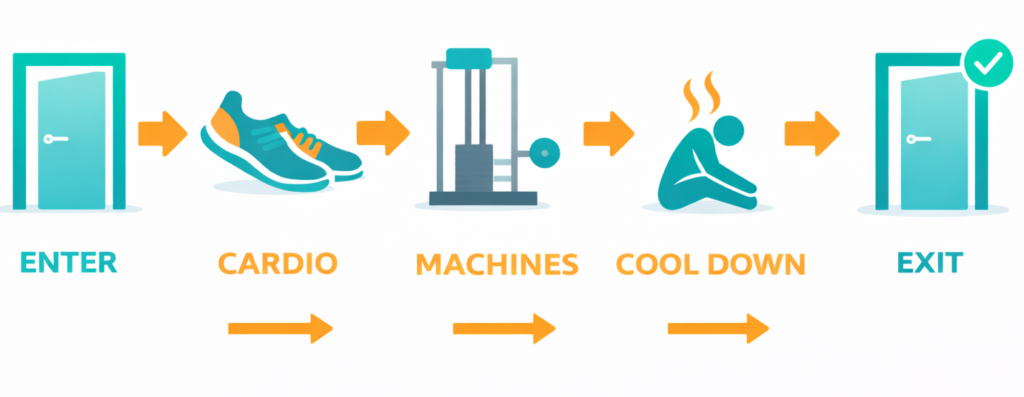
Your First Visit “Flow” (30–40 Minutes Total)
1) Walk in and orient (2–3 minutes).
Look for: bathrooms, water fountain, wipes, cardio area, machines, free weights, stretching space.
2) Warm up (5–8 minutes).
Treadmill walk, bike, elliptical… anything easy. Warm-ups matter because they help your body transition into training and reduce that “I feel stiff and weird” feeling. (2)
3) Do this beginner workout (15–20 minutes).
Pick machines. Machines are stable, guided, and way less mentally taxing than free weights. 2 exercises. That’s it.
4) Cool down (2–5 minutes).
Easy walking and a couple light stretches.
5) Leave.
Yes, really. Leave while it still feels manageable. This is how you build the habit.
The Beginner Rule That Changes Everything: Do the Same Workout for 4 Weeks
Not gonna lie: “variety” is overrated when you’re new.
Beginners improve fast from repeating the basics because your body is learning movement patterns and building coordination. Early strength gains are strongly linked to nervous system learning (your body getting better at using what you already have). (3)
So here’s the deal:
- Same workout
- Same order
- Same machines
- For 4 weeks
Then you can tweak.
A 2–3 Day Beginner Gym Plan (Simple, Full-Body, Easy)
This is the plan you came for: what to do at the gym when you’re a total beginner.
It’s full-body because it’s efficient, beginner-friendly, and fits well with a 2–3 day schedule. Training major muscle groups at least twice weekly is a common strength-training guideline. (4)
Your Schedule Options
Option A (2 days/week): Tuesday and Friday
Option B (3 days/week): Monday, Wednesday, and Friday
Each workout is the same “A” workout for your first 2 weeks, then you’ll alternate A/B in Weeks 3–4 (still simple, just a tiny upgrade).
Your Warm-Up (5–10 Minutes) and Quick Setup (2 Minutes)
Warm-up (choose one):
- Treadmill walk (slight incline if comfortable)
- Bike
- Elliptical
- Row machine (easy pace)
Quick setup (2 minutes):
Do 1 light set of your first exercise (very easy weight) before you start your “working” sets. It makes you feel stronger and smoother.
If you want a full pre-lift routine, here’s a helpful guide: pre-workout routine for beginners.
Weeks 1–2: Workout A (30–45 Minutes)
How hard should it feel?
Use this super simple rule: Stop each set with 2–3 reps left in the tank. That’s enough to progress without wrecking you.
Workout A (machines-first):
Do 2 sets of each exercise in Week 1.
Do 3 sets of each exercise in Week 2 if you feel up for it.
- Leg Press: 8–12 reps
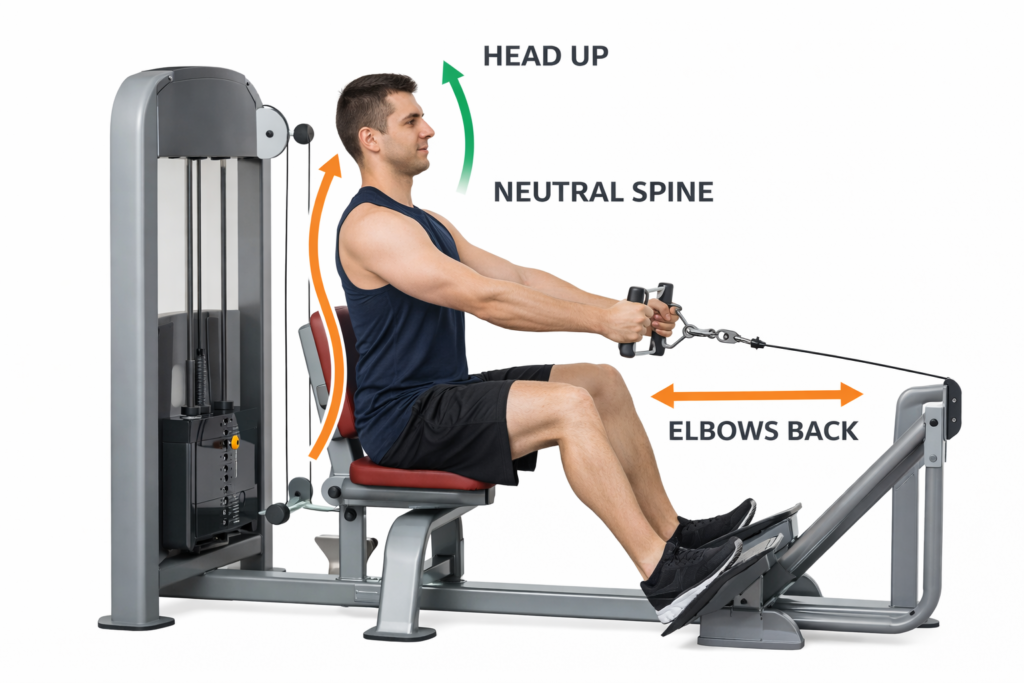
- Seated Row: 8–12 reps
- Chest Press: 8–12 reps
- Hamstring Curl: 10–15 reps
- Lat Pulldown: 8–12 reps
- Plank: 2 rounds of 20–40 seconds
Rest: 60–90 seconds between sets.
Time estimate: 5–10 min warm-up + 20–30 min lifting + 2–5 min cool down
Exactly How to Pick Your Starting Weight (No Guessing Spiral)
Start with an extremely light warm-up set you can easily do for 12 reps.
Then pick a slightly heavier weight you’re confident you can do for 12 reps with solid form.
Do your set.
If you could’ve done 5 more reps, go heavier next set.
If form gets sloppy before 8 reps, go lighter.
Your form matters more than the number on the stack. This is standard beginner advice for a reason. Strength will come. But you need to set the foundation (form) first. (1)
Weeks 3–4: Alternate Workout A and Workout B (Still Beginner-Friendly)
In Weeks 3–4, you’ll keep Workout A and add a Workout B. Same structure, same vibe.
Workout B:
- Goblet Squat (one dumbbell) or Leg Press: 8–12 reps
- Incline Dumbbell Press or Chest Press machine: 8–12 reps
- Cable Row or Seated Row machine: 8–12 reps
- Glute Bridge (bodyweight or light weight): 10–15 reps
- Dumbbell Romanian Deadlift (light): 8–12 reps
- Decline Sit-ups: 12-15 reps
If free weights feel intimidating, keep using machines. You’re not “behind.” You’re building a base.
For more options, this guide can help you expand later: weightlifting routines for beginners.
Progression: How to Get Stronger Without Overthinking
Here’s the simplest progression method on Earth:
The “Double Progression” Method
- Stay in a rep range (example: 8–12 reps)
- When you can hit 12 reps with good form for all your sets, increase the weight next time (small jump)
That’s it. This approach lines up well with beginner strength training recommendations (gradual increases, controlled form). (1)
What to Do at the Gym When It’s Crowded and You Feel Weird
Crowds add weird pressure. Your brain starts saying, “Everyone’s watching.”
They’re not. They’re very likely thinking about their own stuff, their own playlist, and whether they left the stove on.
Still, here’s how to adapt fast:
The 3 Backup Rules
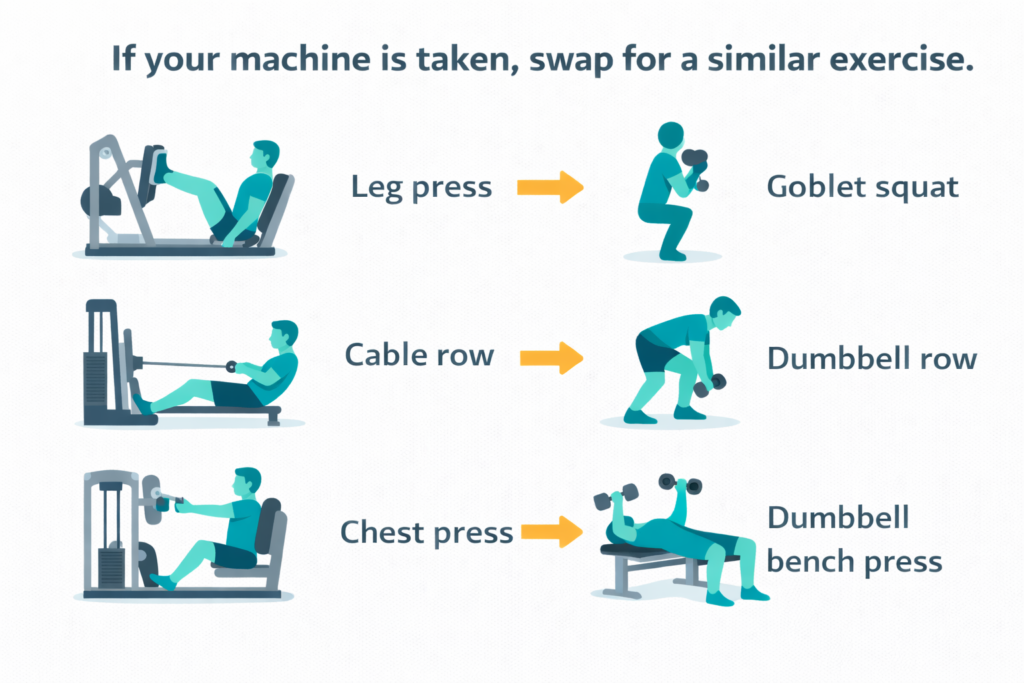
1) If your machine is taken, swap for a similar exercise.
- Leg press → goblet squat
- Cable row → dumbbell row
- Chest press → dumbbell bench press
2) If everything feels taken, do a “two-station workout.”
Pick one lower-body machine and one upper-body machine and alternate for 20 minutes.
3) If you’re overwhelmed, do the minimum workout.
Warm-up, 3 exercises, then leave. Habit secured.
If You Feel Awkward Being Alone
It can be weird going to the gym alone your first time. This guide on how to start going to the gym alone can help a lot.
If you’re a woman dealing with the extra layer of “I don’t want to be bothered,” this guide can help you navigate these awkward situations: going to the gym alone as a woman.
Common Beginner Mistakes That Make the Gym Suck (And How to Avoid Them)
Let’s save you a month of frustration in about 90 seconds.
1) Doing Too Much Too Soon
If you go from zero to five days per week, you might feel inspired at first, but eventually it will be too much. Your body will feel wrecked and your motivation will evaporate.
Starting with 2 days and building up is not “soft.” It’s smart. It also matches public health guidelines that recommend muscle-strengthening work at least 2 days per week for adults. (4)
Real muscle, strength, and fitness are attained through long-term consistency and follow-through. So, make the process easy on yourself.
2) Treating Soreness Like a Scoreboard
Soreness doesn’t equal effectiveness. Real progress equals consistency.
3) Skipping Recovery Basics
You don’t need a perfect diet. But try this:
- Protein and carbs within a few hours after training
- Water
- Sleep
4) Changing Your Routine Every Session
Confidence comes from familiarity. Repeat the plan.
Pick 2–3 days, repeat the same simple full-body workouts, add small weight when reps feel easy, and leave before you feel overwhelmed.
What If You Still Feel Like You Don’t Belong?
Here’s the thing: gyms are full of beginners. You just can’t always spot them because they’re wearing normal clothes and trying to look casual like everyone else.
Also, a lot of the “confident” people you see? They earned that by showing up while they still felt awkward.
If your brain is loud on the way in, use a tiny commitment:
“I’m going for 10 minutes. If I hate it, I can leave.”
Most of the time, once you start moving, the anxiety drops a notch.
And if you want a deeper breakdown of the mental side, learn to overcome your fear of the gym.
If anxiety is the main thing stopping you, I put together a free one-page toolkit you can print and bring with you. It covers exactly what to do when anxiety hits, before you walk in, when you’re inside, and if you need to bail early.
Your Next Step: The Beginner Checklist You Can Do Today
Here’s your 10-minute action plan:
- Pick 2–3 gym days for the next 2 weeks
- Save Workout A in your phone
- Pack your bag now (water, headphones, comfy clothes)
- On your first visit, do: warm-up, 2 machines, then leave
- Repeat the same flow for 2 weeks before changing anything
If you want a slightly more detailed routine library after you’ve built momentum, check out these proven weightlifting routines for beginners.
References
- NSCA. “Determination of Resistance Training Frequency.” National Strength and Conditioning Association. https://www.nsca.com/education/articles/kinetic-select/determination-of-resistance-training-frequency/
- McGowan, C. J., et al. (2015). “Warm-Up Strategies for Sport and Exercise: Mechanisms and Applications.” Sports Medicine. https://pubmed.ncbi.nlm.nih.gov/26400696/
- Sale, D. G. (1988). “Neural adaptation to resistance training.” Medicine and Science in Sports and Exercise. https://pubmed.ncbi.nlm.nih.gov/3057313/
- CDC. “Physical Activity Guidelines for Americans.” Centers for Disease Control and Prevention. https://www.cdc.gov/physical-activity-basics/guidelines/adults.html