How to Not Feel Awkward at the Gym: A Practical Guide
You walk in, scan the room, and your feet stop moving. Just for a second. Nobody notices, but you notice. Bag still on your shoulder. Brain running through seventeen different scenarios.
That three-second freeze near the entrance is what this post is about.
Not the exercises. Not the program. The weird, low-grade discomfort of not knowing where to stand, what to do between sets, or how to act without feeling watched. That’s the real barrier for most beginners, and nobody talks about it directly. If you’re still in the planning stage and haven’t taken that first solo trip yet, the guide to going to the gym alone for the first time has the logistics covered. This post handles everything that happens once you’re inside.
By the end, you’ll have the right words, behaviors, and a simple way to shut the awkward loop down before it spirals.
Core point: The awkward feeling is not a sign you don’t belong. It’s your brain flagging an unfamiliar environment as uncertain territory. That fades the moment you have a default behavior to fall back on.
The Pre-Game Rehearsal (Do This Before You Leave)
Close your eyes for 60 seconds. Picture yourself walking through the door. See yourself heading directly to the dumbbell rack without stopping. Feel your hand grabbing the weight. Hear the clank of the metal. See yourself doing your first rep.
This isn’t motivational fluff. It’s mental rehearsal, and the research behind it is legitimate. A 2025 peer-reviewed study in Frontiers in Psychology found that guided imagery reinforces neuromuscular pathways, helps regulate anxiety, and improves performance specifically by helping athletes mentally simulate the environment before they enter it. (3)
Your brain doesn’t fully distinguish between a vividly imagined experience and a real one. By simulating the entrance in your mind, you’ve already been there. When you walk in for real, your brain thinks “I’ve done this before” and the stress response drops. One minute. Do it in the car before you go in.
The Real Reason the Gym Feels Awkward
The gym has unspoken rules and you’re expected to already know them. Nobody hands you a map. Nobody says “stand here.” There’s no etiquette guidebook. You’re just supposed to walk in, pick something, and start moving.
What most people are experiencing in those early sessions has a name in the research: social physique anxiety. It’s the fear of being negatively evaluated because of how you look or perform in a physical setting. Certain studies show it’s one of the primary mechanisms that quietly reduces how often people exercise, often without them realizing it’s happening. Research published in PMC found that when people rated their gym environment as uncomfortable or judgmental, higher social physique anxiety was strongly tied to exercising less per week. (1) Other research on social exercise avoidance also links this specifically to fear of scrutiny in public fitness settings. (2)
Here’s the honest part.
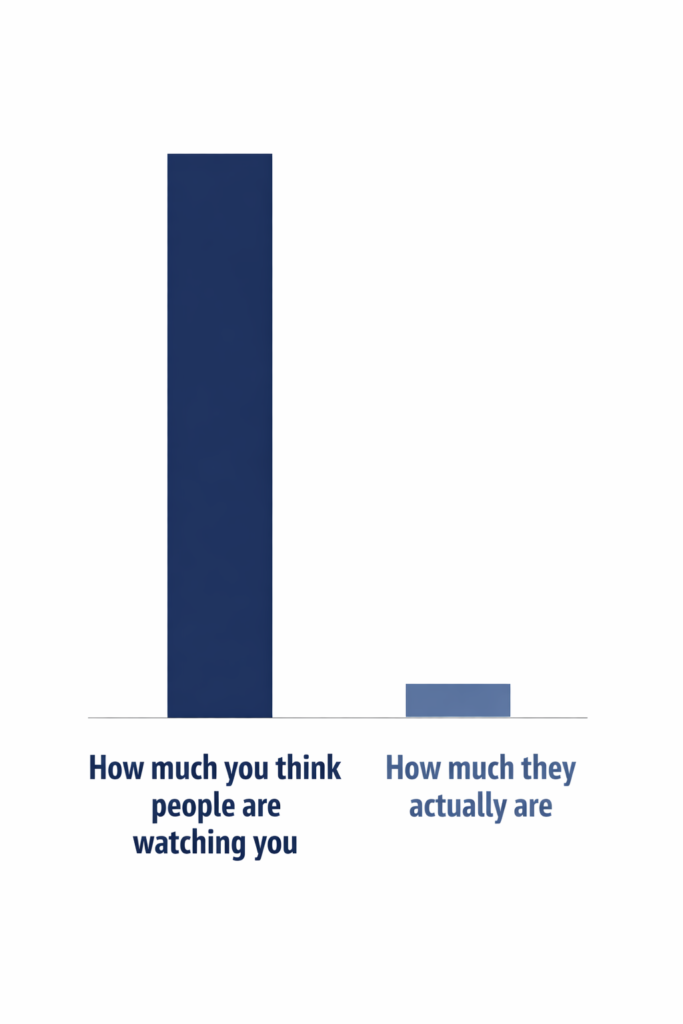
Most people in the gym are not watching you. Psychologists call this the Spotlight Effect, the tendency to believe we are being noticed far more than we really are. Everyone around you is counting their own reps, adjusting their playlist, or staring at themselves in the mirror. The spotlight you feel is largely invented. That doesn’t make it feel less real, but it does mean the solution is practical. Look like you have a plan, even on the days you’re improvising.
How Can I Feel Comfortable at the Gym Alone?
The reframe that works: you don’t need to look perfect. You need to look intentional.
Two people can be doing the exact same beginner workout. One looks like they own the room. The other looks like they’re about to apologize for existing. The difference is not weight lifted or skill level. It’s whether they move with a next step in mind. And I’ve been both people. The shy, unsure beginner who actually preemptively apologized once for being too “loud” while lifting. And now I feel like a man on a mission, because I am.
Purposeful people walk to something and just begin. Lost people hover near the entrance and hope the room figures itself out.
Feeling comfortable going to the gym alone starts with this: pick one thing before you walk in and go straight to it. One exercise, one area, one machine. That’s enough of a plan to look like you have one.
Being confident going to the gym alone isn’t a mindset you manufacture from nothing. It’s something you build with repetition and small wins. Get through today’s session with one completed thing, and confidence follows. It works backwards from action, not forwards from motivation.
If what you’re dealing with runs deeper than general awkwardness, the post on gym anxiety covers the more serious version. But for most beginners, the fix is purely behavioral.
The Only Three Things You Need to Control
When you feel awkward, your brain tries to solve a million problems at once. It’s overwhelming. Let’s shrink the problem down to three things. If you control these, you win the session regardless of the weight on the bar.
Your feet. Are they moving toward something, or stuck? Plant them or move them. No shifting weight from foot to foot.
Your hands. Are they holding something useful: phone, water bottle, dumbbell? If they’re fidgeting with your clothes or hanging limp at your sides, give them a job.
Your eyes. Are they looking at something specific: your notebook, the floor in front of you, the wall during a rep? If you’re scanning the room, you’re inviting anxiety.
That’s the whole checklist. When a session starts to go sideways, come back to those three. Feet moving, hands occupied, eyes fixed.
Your Default Behavior When You Do Not Know What to Do
The highest-anxiety moments in any gym session are the in-between ones. Between sets, when equipment is taken, when the plan breaks. You need a default behavior ready for each.
Where to Stand (So You Stop Hovering)
Pick a spot and commit. If you’re waiting for a machine, stand back far enough that you’re not in the way, but close enough that your intent is clear. One to two meters works. Look at your phone or your notebook. You are not lurking. You are waiting. Most people can tell the difference.
If you genuinely don’t know where to start, head to the dumbbell area or a cable machine. They’re almost always available, flexible enough for dozens of exercises, and give you something to do within thirty seconds of arriving.
What to Do with Your Hands (So You Stop Fidgeting)
This one seems small. It isn’t. Tugging at your shirt, adjusting straps repeatedly, or nervously flipping your phone signals discomfort, and it amplifies the feeling for you more than for anyone watching. Between sets, hold your phone with both hands like you’re reviewing notes. Drink water slowly. Wipe down the equipment. Any of these gives your hands a job.
What to Look At (So You Stop Scanning the Room)
Scanning the room is the fast track to a bad session. It invites comparison, feeds the sense of being watched, and breaks your focus at exactly the moment you need it. During sets, pick a focal point straight ahead or slightly upward. Between sets, look at your phone or at the floor directly in front of you. You don’t need to stare at the wall like a statue. You just need a go-to when your eyes start drifting.
An Important Note
Some people may roll their eyes at this sort of practical advice about how to not feel awkward at the gym. I mean, isn’t the best advice to just not care what other people think of you? Sure, maybe, in a perfect world. But, we’re flawed humans. And, here at Applied Muscle, we’re honest and practical humans. The simple fact is that most people do care what others think and it affects their behavior (and this is totally normal for a civilized member of society).
So, given that fact, we’d rather deal with it practically and give you tools that actually work in the real world.
The Awkward Moments Playbook
Every beginner runs into the same situations. Here is the difference between letting it spiral and shutting it down.
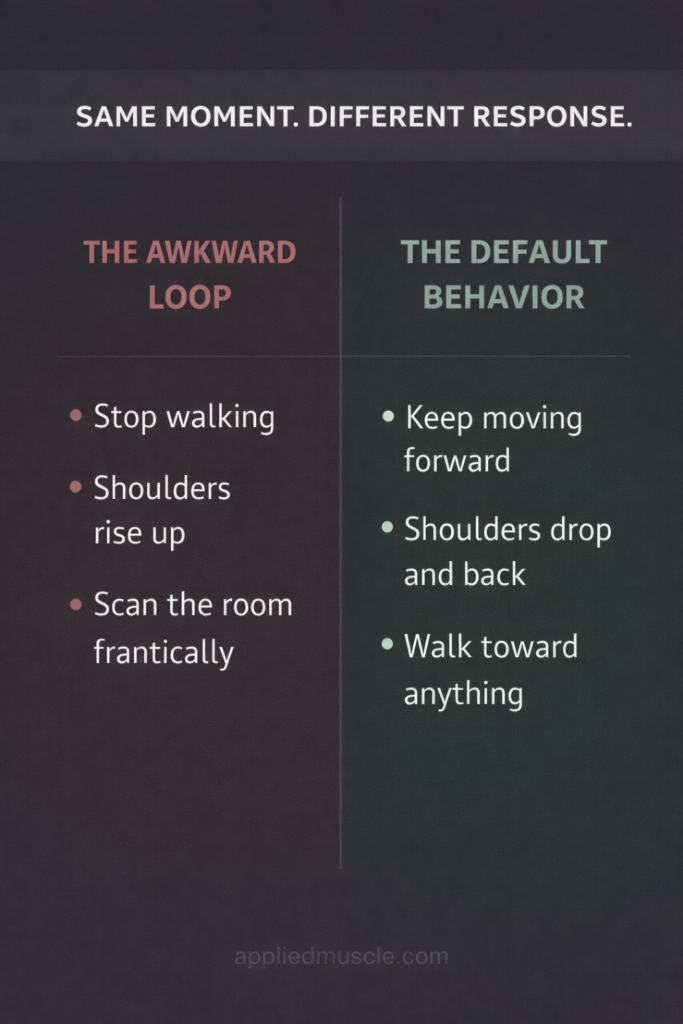
You Walk In and Instantly Feel Exposed
The awkward loop: Stop walking, shoulders rise toward your ears, scan the room desperately for a familiar face or an empty machine, feel your face get hot.
The default behavior: Don’t stop walking. Keep your feet moving toward anything: the lockers, the water fountain, the leg press. Forward motion kills the freeze response. Pause after you’ve arrived somewhere, not in the middle of the floor.
You Forgot What You Were Doing Mid-Workout
The awkward loop: Freeze, look around blankly, start wandering, feel like everyone can see you’re lost.
The default behavior: Stand still exactly where you are. Pull out your phone or notebook. Stare at it for ten seconds. Find your place. The act of looking at a device signals “I am reviewing my plan,” not “I am lost.” If you still can’t find your place, repeat the last set you’re confident you completed and move forward.
You Cannot Find a Machine or an Attachment
Walk to the nearest staff member and ask. Say: “Hey, quick question: where do I find the rope attachment for the cables?” It takes fifteen seconds. Nobody thinks less of you. Everyone has asked this at some point, including people who have been going for years.
The Equipment You Need Is Taken
Move to the next item on your list and come back. If your whole plan depends on one piece of equipment, that’s a good reason to have a fallback plan ready in advance. Most sessions can flex by ten to fifteen minutes without any real problem.
You Think Someone Is Waiting for Your Station
Glance over. If they’re hovering close, make brief eye contact and say: “One more set.” Now you’ve acknowledged them and you control the timeline. If they walk off, they either weren’t waiting or they found something else. Either way, you’re done.
You Need to Ask a Person for Something
Walk up, make eye contact, and start talking. Don’t apologize before asking. Don’t preface the question with five sentences of context. Ask the question. Most people in a gym respond normally to a direct, brief ask.
How to Look Like You Own the Place (Even When You’re Guessing)
Confidence is communicated through your body before your brain feels it. These aren’t tricks. They’re signals your nervous system actually responds to.
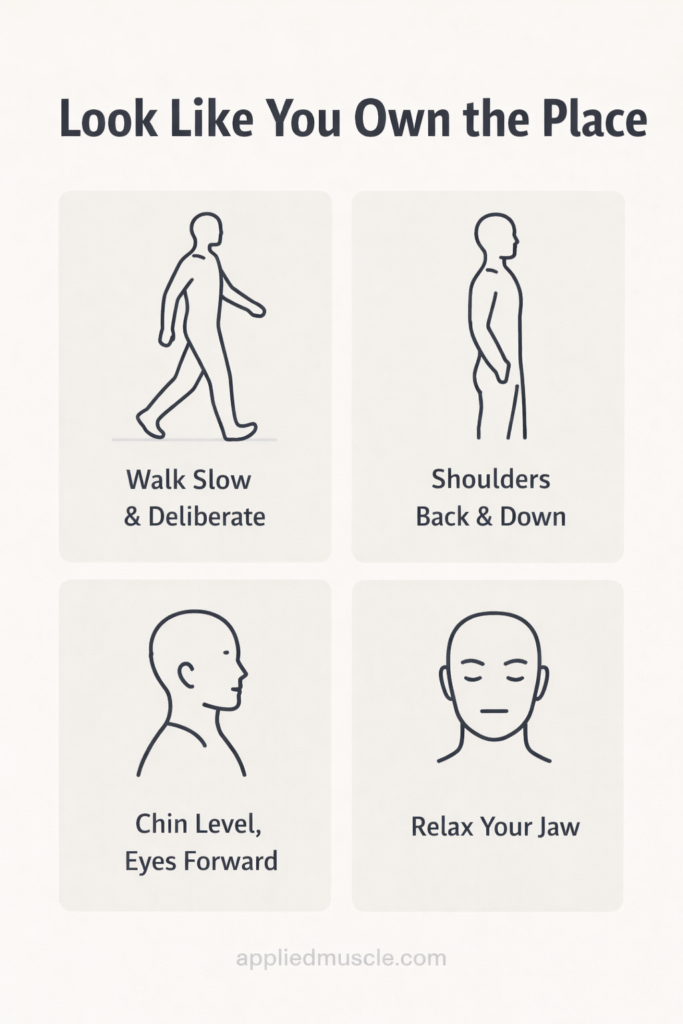
The walk. Move slowly. Not rushed, not shuffling. Purposeful strides from the hip. Fast, jerky movements signal nervousness. Slow is smooth, and smooth reads as confident.
The shoulders. Pull them back and down. When we feel awkward, we turtle, shoulders up by the ears. Consciously drop them. It opens your chest immediately and signals calm to everyone, including you.
The chin. Keep it parallel to the floor. Looking down as you walk signals “I don’t want to be seen.” Chin level doesn’t mean staring at people. It means looking at your path.
The resting face. You don’t need to smile. You don’t need to look intense. Just relax your jaw. A neutral, relaxed face reads as approachable and settled. A tight, tense one reads as anxious to everyone in the room and feeds the feeling back to you.
What to Say When You Go Blank
These are short one-liners for the moments that trip people up most. Memorize one or two of them. You’ll likely use them.
Someone is using the equipment you need: Say this exactly: “Hey, can I ask how many more sets you have left?” If they say one, you can stay close by and wait. If it’s more than one, move on to the next exercise and circle back. Clean interaction.
You want to work in with someone: Say this exactly: “Mind if I work in between your sets?” Almost everyone says yes. If they don’t, no worries. Move on.
You have no idea how to use a machine: Say this exactly: “Hi, do you know how this machine works?” They’ll show you in about twenty seconds. You’re no longer stuck.
You accidentally interrupted someone’s set: Say this exactly: “My bad.” Nothing else required.
Someone walks up while you’re resting at your machine: Say this exactly: “One more set” or “All yours, go ahead.” You looked up, you answered clearly, the interaction is over in three seconds. No ambiguity for either of you.
The Exit Rule That Prevents the Spiral
Here’s the rule: finish one thing before you leave. One full set. One complete exercise. Something with a checkmark.
Bad sessions happen. You’ll show up some days and nothing clicks: the equipment is taken, the energy is off, the place is crowded. If you leave without doing anything, the story your brain files away is “I quit.” If you finish one set of anything, the story becomes “I showed up and trained.” That distinction shapes how you feel about going back more than any program design will.
The goal isn’t to never feel awkward again. Even veterans say something awkward, grab the wrong machine, or drop a plate. The goal is to make those moments boring.
You don’t panic when you stub your toe at home. You say “ow,” shake it off, and keep walking. That’s the relationship you want with gym awkwardness. You’ll have the moment, you’ll use one of the lines above (or your own), and you’ll move on to your next set.
If you’re scared to go to the gym to the point where the exit rule doesn’t feel reachable, that’s worth addressing separately. For everyone else, once you’ve got the awkward moments handled, the next step is knowing what to do with your first few weeks. The full guide on how to start going to the gym covers the structure, the habits, and how to make it stick.
You belong here as much as anyone. Now go pick a spot and start.
References
- Ames, G. E., et al. “The soulless cycle: Social physique anxiety as a mediator of the relation between body mass index and exercise frequency.” PMC. pmc.ncbi.nlm.nih.gov/articles/PMC8963126
- Heeren, A., et al. “Validation of the Social Exercise and Anxiety Measure (SEAM).” PMC. pmc.ncbi.nlm.nih.gov/articles/PMC3827729
- Volgemute K, Vazne Z, Malinauskas R. “The benefits of guided imagery on athletic performance: a mixed-methods approach.” Front Psychol. 2025 Apr 11;16:1500194. doi:10.3389/fpsyg.2025.1500194. PMID: 40290535; PMCID: PMC12021890. https://pmc.ncbi.nlm.nih.gov/articles/PMC12021890/