
How to Get Motivated to Workout When You Keep Putting It Off
If you’re Googling or asking ChatGPT how to get motivated to workout, you’re not lazy.
You already want to train. You know why it matters. You’re just stuck in that dumb gap between intention and action.
And yeah. Your brain will offer you the same bad deal: ‘Just go home. Start fresh tomorrow.’
First, let’s define the key word here. Motivation comes from the Latin word movere: “to move.” Not to plan. Not to think about moving. To move.
That’s the hook: you don’t need a stronger feeling. You need a smaller start.
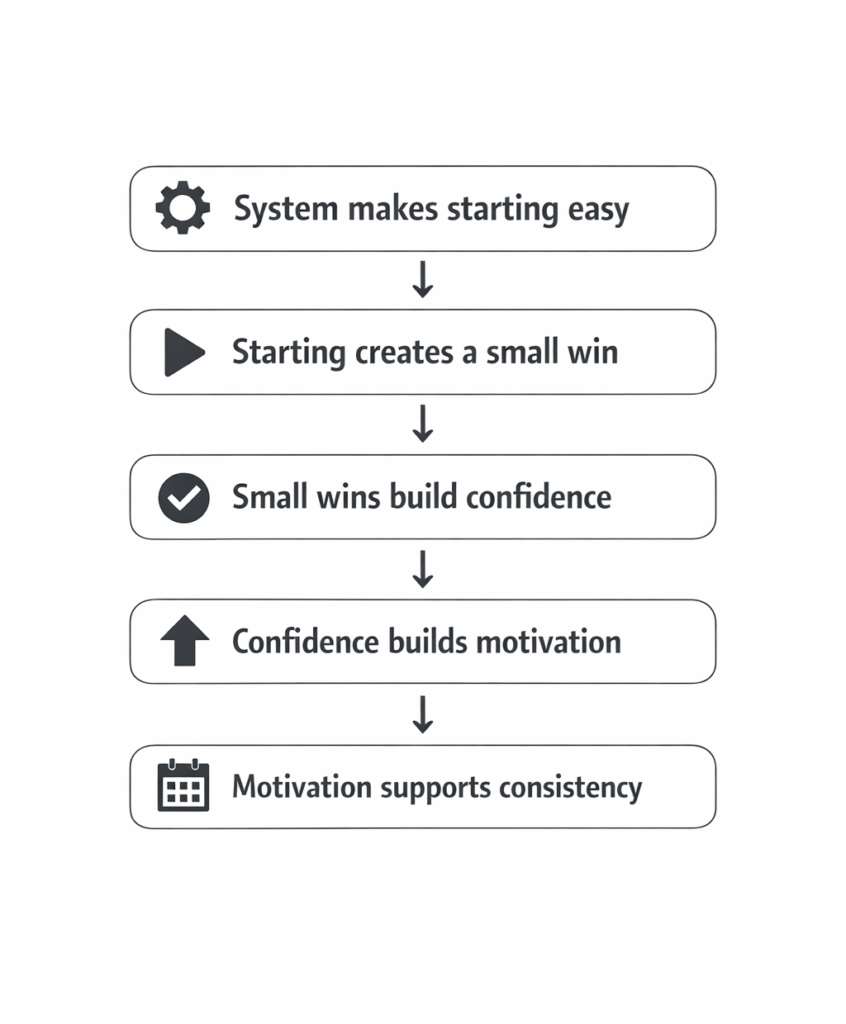
Core point: Hype-style motivation is a short-term stimulant. Systems are what guarantee consistency, and consistency is what changes your body.
Why most “motivation for working out” advice fails you
Most advice tries to pump you up.
It’s basically pre-workout for the brain.
Sometimes it works. For a day. Maybe a week. Then you hit a normal Tuesday and suddenly your motivation to go to the gym has fallen into a storm drain and your couch is feeling weirdly comfortable.
The logistics procrastinator doesn’t need inspiration. You need fewer decisions at the exact moment you’re tired.
Because you know that moment.
The internal debate in the parking lot.
It’s 6:12 pm. You’re in the car. Keys still in your hand. You stare at the gym entrance like it’s going to start a conversation first.
And your brain does this little 47-second courtroom drama:
“Let’s go in.”
“Or we could go tomorrow.”
“Tomorrow is busy.”
“Then Wednesday.”
“Wednesday is also busy, but I’ll figure it out.”
You know how this ends. You drive home and promise you’ll make up for it later with a harder workout. Monday. The made-up holiday.
So we’re not doing that anymore.
We’re building a system that makes it hard to even start that internal debate.
How to get motivated to workout when motivation = 0
This is the play I give people when they’re stuck on the couch, staring at the clock, waiting to feel ready.
You’re going to hate how simple it is.
Shrink the task (10 seconds)
Your job is not “do a great workout.”
Your job is “start the workout.”
That’s it. Starting is the hardest part, and you already know it. Once you’re moving, everything gets easier.
Do the first tiny action (60 seconds)
Pick one small action you can do even when you don’t feel like it.
Put on your gym shirt. Fill the water bottle. Tie your shoes. Grab your keys. Open your workout note.
One action is enough to break the freeze.
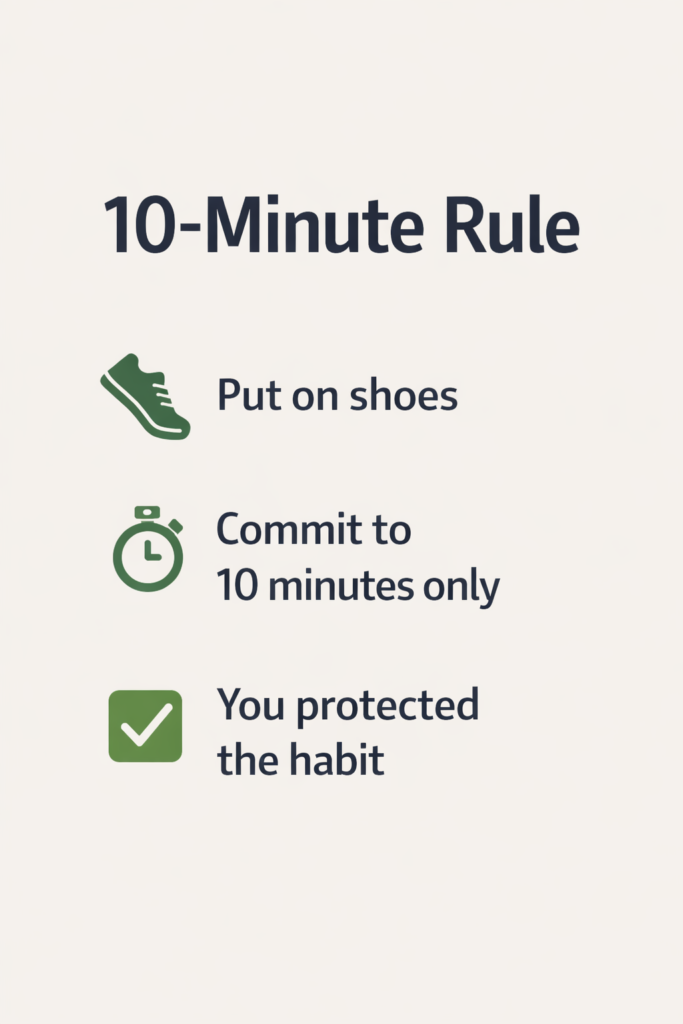
Use the 10-minute rule (10 minutes)
Commit to 10 minutes only.
After 10 minutes, you’re allowed to stop. No guilt. No “I should’ve done more.” You did the thing.
Most days, you’ll keep going once you’re warm. But even if you leave, you protected the habit. That is the win.
Say this exactly: “I only have to do the minimum. Anything extra is a bonus.”
If you want one thing to remember from this entire guide, it’s that sentence.
Systems beat hype, and you already know it
You’ve had motivated weeks before.
Maybe you crushed three workouts in a row. You felt unstoppable. You started picturing yourself in some fitness transformation story
Then life happened. Work got heavy. Sleep got weird. Your relationships stole your attention. You missed one day, then two, and suddenly you’re “starting over.”
That’s not a character flaw. It’s a design flaw.
A system is what keeps your motor running when your feelings don’t cooperate.
The people who get results long-term aren’t the most fired up. They’re the most consistent, and their consistency comes from boring, repeatable structure.
Same days most weeks. Same starting ritual. Same plan you don’t have to reinvent. A fallback for low-energy days.
Not sexy. Very effective.
Habit research backs this up: repeated behavior in a stable context builds automaticity over time. It doesn’t flip on overnight, but it does build. (1) And once a behavior becomes more automatic, you spend less mental energy deciding. (2)
Translation: you stop needing motivation to go to the gym because going becomes the default.
The minimum workout that saves your week
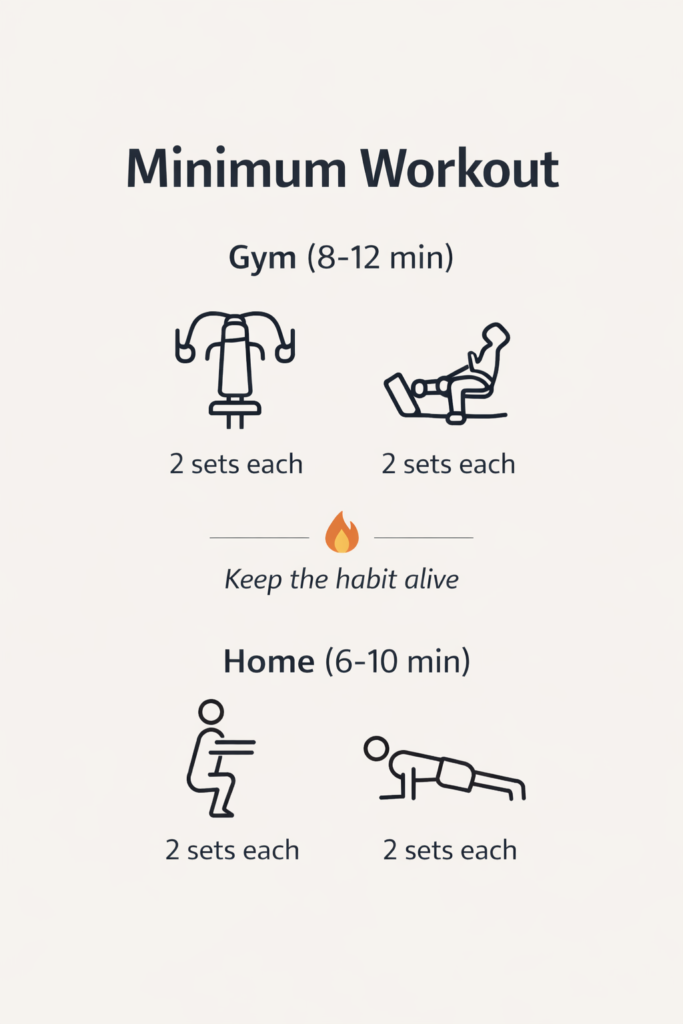
A minimum workout is the smallest version of training that still counts (otherwise known as ‘Minimum Effective Dose’, or MED training).
It exists for one reason: to protect consistency on the days you’re most likely to quit.
You are not using it to chase progress. You’re using it to keep the habit alive so progress becomes easier to earn later.
Think of it like keeping a campfire lit. You don’t need a bonfire every day. You need a flame.
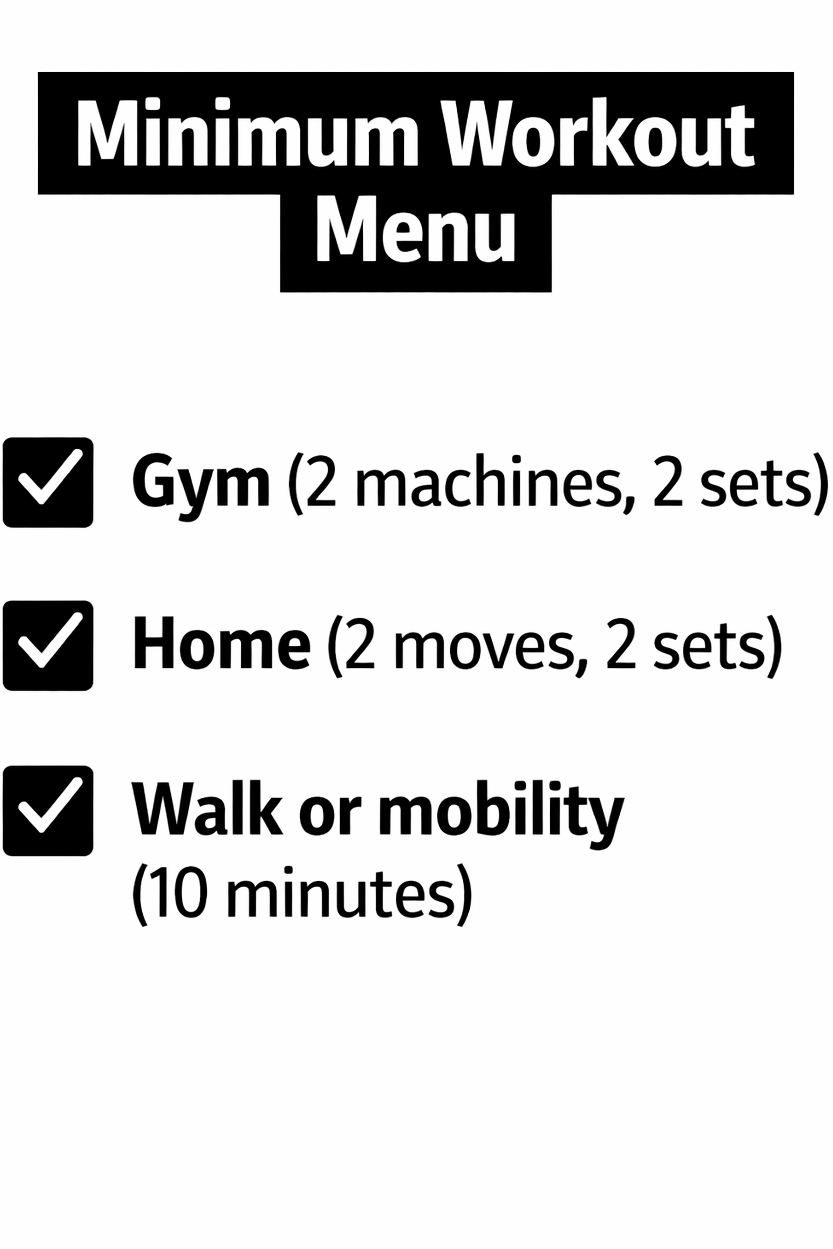
Gym minimum (8 to 12 minutes)
Walk in. Pick two simple machines. Do two challenging sets at each. Leave.
Example:
Chest Press 2 x 10-12
Machine Row 2 x 12-15
Machines are perfect for this because setup is fast and you don’t need to psych yourself up.
Home minimum (6 to 10 minutes)
Pick two exercises. Do two sets each. Done.
Example:
Bodyweight Squats: 2 sets as many reps as you can
Push-ups: 2 sets as many reps as you can
No warm-up drama. No “I should do a full program.” Just move.
Here’s when to deploy the minimum workout, and this is the key:
Anytime you catch yourself negotiating or debating.
The moment you hear “maybe tomorrow,” that is your signal to do the minimum today.
Remove decisions before you’re tired enough to lie to yourself
Decision fatigue is the real villain for the logistics procrastinator.
It’s not that you don’t want to train. It’s that at 5:30 pm your brain is out of battery and it starts prioritizing comfort like it’s a life-or-death situation. (Because evolutionarily, that’s what it was built to do: conserve energy when resources felt scarce.)
So you pre-decide while you’re still sane.
Pick two or three workout days you can repeat for a month. Pick a time. Pick a backup time.
Now the calendar is the trigger, not your mood.
Then you add one if-then plan for the moment that usually derails you. This matters because implementation intentions, those “if X happens, I do Y” plans, have been shown to reliably improve follow-through. (3)
Here’s a concrete example that actually matches real life:
If I leave work after 5:30, then I do my home minimum before I sit down.
Not after dinner. Not after I “just check something” on my phone. Before I sit.
Because sitting is a trap.
Habit stacking that makes workouts automatic
This is the part that feels almost too easy, but it’s how you stop relying on willpower.
You attach training to something you already do.
Coffee finishes, shoes go on, you leave.
Work laptop closes, gym bag goes in hand, you walk out the door.
Morning bathroom routine ends, you do your 10-minute warm-up.
It’s boring on purpose. Boring means repeatable. The key is making it feel routine.
Make the gym feel less awful (so you’ll actually come back)
You don’t need to love the gym.
You don’t love brushing your teeth either.
The goal isn’t joy. The goal is a routine so solid that workouts happen even when you’re feeling indifferent.
A big part of motivation for working out is simply this: you start associating training with feeling better, not worse. How you feel during exercise influences whether you come back. (4)
So we keep it sustainable.
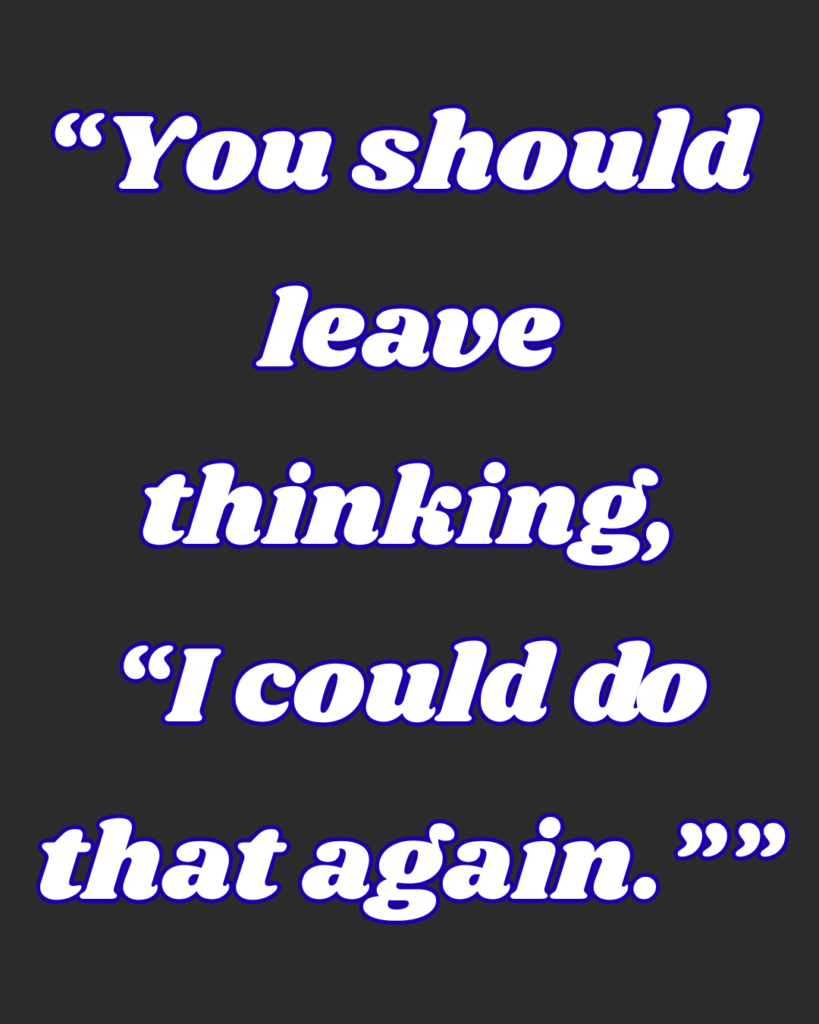
Most sets should end with one to three reps left in the tank. Most sessions should land in the 20 to 45 minute range. You should leave thinking, “I could do that again.”
That’s how you build competence and momentum without burning out.
What to do when you walk in the door (so you don’t wander)
Wandering is where workouts go to die.
Here’s a simple “walk-in script” that removes the museum tour energy.
Minute 0 to 2: Put your stuff down. Fill water. Bathroom if needed. No scrolling.
Minute 2 to 7: Warm-up. Keep it the same every time. Quick walk, a couple of simple mobility moves. Nothing fancy.
Minute 7 to 10: Start your first lift immediately.
If you don’t know what to do first, pick one of these beginner-friendly starters:
A leg press machine, a chest press machine, a lat pulldown, or a machine row.
They’re simple, stable, and you can load them safely without a bunch of setup.
Machine etiquette, quick version: wipe the bench when you’re done, don’t sit on a machine for ten minutes scrolling, and if someone is waiting you can alternate sets. That’s it. You’re now a functioning member of society.
And if you feel the urge to overthink your program in the middle of the gym, congratulations, you are having a normal human moment. Do the next set anyway.
How to motivate yourself to workout alone (without needing accountability)
If you train alone, you need a ritual.
Not a spiritual ritual. A logistics ritual.
A repeatable five-part sequence that signals “we’re doing the thing” before your brain starts doubting.
The solo session ritual
1) Same arrival cue (30 seconds).
Same parking spot if possible. Same entrance. Same check-in. The point is familiarity.
2) Same corner (30 seconds).
Pick a home base. One spot you always start. It keeps you from drifting.
3) Same warm-up (5 minutes).
Same playlist, same water, same first few movements. Your body likes a starting line.
4) Same first lift (10 minutes).
Not always the same exercise forever, but the same category. Example: you always start with a lower-body move, then push, then pull. Balanced, repeatable, hard to mess up.
5) Same exit routine (2 minutes).
Log what you did in 30 seconds. One line. Then you leave. No lingering, no “maybe I should add more.”
This turns solo training into something you own. It’s your system. Not a social event you have to coordinate.
And here’s the sneaky benefit: the more predictable the session feels, the less motivation you need to start it.
Morning workout motivation when you feel like a zombie
Morning workout motivation is mostly a night-before problem.
If you wake up and have to decide, you’ll decide no. Morning-you is not a reliable friend.
Night before setup (3 minutes)
Put clothes and shoes where you’ll see them. Set out water and headphones. Decide the exact workout you’re doing.
You are removing morning decisions.
Morning start (10 minutes)
Drink water. Start the warm-up. Commit to the 10-minute rule.
That’s it.
Say this exactly: “I’m not trying to crush a workout. I’m becoming someone who trains in the morning.”
When you’re truly too tired: sleep-first vs train-through
This is where people either get honest or get clever.
If you slept four hours, feel wrecked, and your body feels heavy in a way that screams “recovery,” you don’t need discipline. You need sleep.
If you slept decent but you’re mentally tired, cranky, or just sluggish, that’s usually a “start anyway” day.
Here’s the simple test:
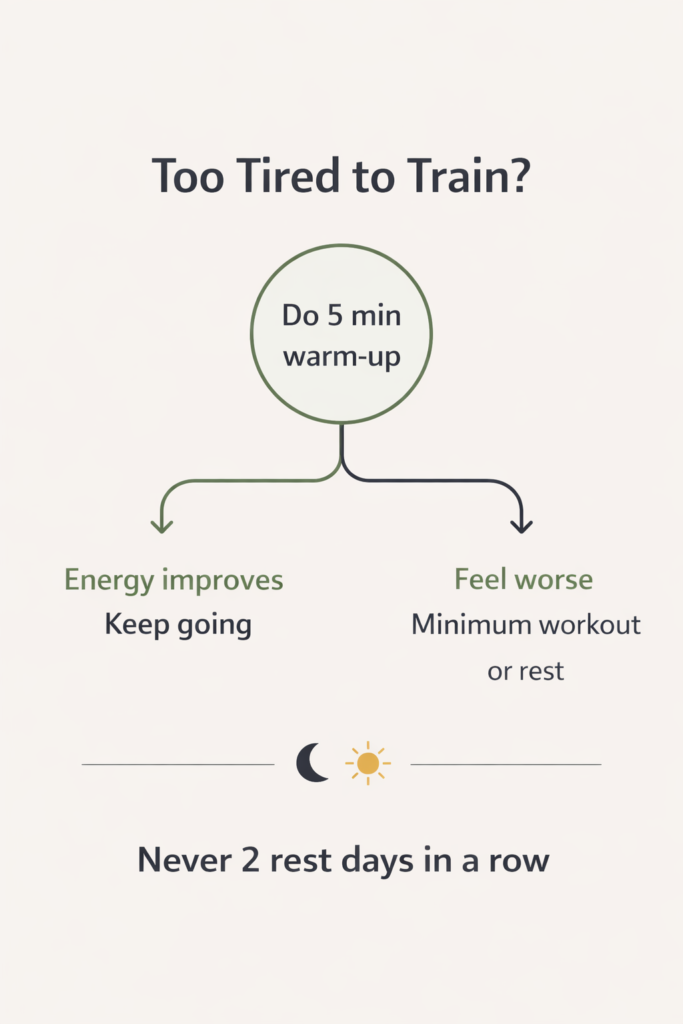
If you can do five minutes of warm-up and your energy improves even a little, keep going.
If five minutes makes you feel worse, scale to the minimum workout or call it a recovery day and go to bed earlier tonight.
No guilt. No heroics. Just smart consistency.
Just never take two recovery days in a row. If you feel the same next workout, then you do the minimum.
How to motivate yourself to workout at home when the couch is right there
Home workouts fail for one reason: it’s too easy to delay.
So you make the start obvious and the end guaranteed.
Put your equipment where you can see it. Use a timer so the session has an end. Use one consistent start cue.
Coffee ends, timer starts.
That’s the system.
Here’s a quick table you can screenshot. It’s simple. It works.
| Situation | What to do |
|---|---|
| “I don’t feel like it” | 10-minute rule, then decide |
| “Too tired” | Minimum workout only |
| “Keep getting distracted” | Timer, same spot, phone away |
| “Feels pointless” | Track one metric (reps or weight) |
Motivation traps that catch the logistics procrastinator
This is the part where I stop being polite for your own good.
Trap: waiting to feel ready
Feeling ready is a mood. Moods change like the weather.
If you wait for readiness, you’ll keep restarting.
Readiness usually shows up after you’ve started moving. The warm-up is where “ugh” turns into “okay.”
So your rule is: start first. Let your feelings catch up.
Trap: planning for your best week
You plan like you’re a superhero.
Then you have a normal week and the plan collapses.
Plan for the tired version of you. The version who gets home late and wants to eat cereal for dinner.
If your plan only works when everything goes right, it’s not a plan. It’s a fantasy.
Trap: the one-miss spiral
Missing one workout is a scheduling problem.
Missing two in a row is where the habit starts to wither.
So you live by the simplest rule in strength training consistency:
Don’t skip twice.
If you miss Monday, you hit Wednesday. Not because Wednesday is magical, but because you’re protecting the identity of someone who trains.
And if you miss a workout, don’t wait around for the next “perfect” day. Shrink the gap fast. The next day, do the minimum. Same day if you can. Your job is to return to the pattern, not punish yourself.
Trap: going too hard too often
If every workout feels like a battle, your brain will resist.
Hard sessions are great. Even necessary. But not as your default when you’re still building the habit.
Make it repeatable first. Then make it intense.
Trap: week 3 to week 6 impatience
Here’s a weird truth: weeks 3 to 6 often feel worse than week 1.
Week 1 has novelty. Week 3 has reality. You’re not seeing dramatic results yet, and your brain starts whispering, “Is this even working?”
It is. You’re just measuring the wrong thing.
Early wins are performance wins. More reps. Cleaner form. Less soreness. Faster warm-up. Those count.
The mirror catches up later.
The 10-minute motivation reset (do this today)
This is the whole system, compressed.
It’s the version you do when you’re sick of thinking about it.
Take 10 minutes. Actually do it.
- Put “Workout” on your calendar for 2 or 3 days this week. Include the exact time.
- Write your minimum workout in your Notes app. Make it stupid simple.
- Pick a backup time for each workout.
- Write one if-then plan for your most common obstacle. (Example: “If I’m still at work at 5:30, then I go straight to the gym before going home.”)
- Prep tonight: bag by the door, shoes out, headphones charged.
Then set one reminder for tomorrow that says: “Just do the minimum.”
That’s it.
Everything else follows from that.
Related reading (only if you want the deep dive)
- How to Stay Consistent With Working Out (When Motivation Tanks)
- Too Tired to Go to the Gym? Use This Simple Rule
Small footnote for home gym gear nerds: Are Adjustable Dumbbells Worth It? The Straight Answer for Home Lifters
References
- Lally, P., van Jaarsveld, C. H. M., Potts, H. W. W., & Wardle, J. (2010). How are habits formed: Modelling habit formation in the real world. European Journal of Social Psychology, 40(6), 998–1009. https://doi.org/10.1002/ejsp.674
- Wood, W., & Rünger, D. (2016). Psychology of habit. Annual Review of Psychology, 67, 289–314. https://doi.org/10.1146/annurev-psych-122414-033417
- Gollwitzer, P. M., & Sheeran, P. (2006). Implementation intentions and goal achievement: A meta-analysis of effects and processes. In M. P. Zanna (Ed.), Advances in Experimental Social Psychology (Vol. 38, pp. 69–119). Elsevier Academic Press. https://doi.org/10.1016/S0065-2601(06)38002-1
- Williams, D. M. (2008). Exercise, affect, and adherence: An integrated model and a case for self-paced exercise. Journal of Sport and Exercise Psychology, 30(5), 471–496. https://doi.org/10.1123/jsep.30.5.471