

Going to the Gym Alone as a Woman: How to Feel Safe, Not Scared
You’ve probably already thought about going to the gym alone as a woman. Maybe you even planned it. And then the list started.
What if I don’t know how to use the equipment. What if someone watches me struggle. What if a guy doesn’t take the hint. What if I freeze in the middle of the floor with nowhere obvious to go and everyone notices.
That’s not the same anxiety men feel at the gym. It’s heavier. You’re not just navigating an unfamiliar room. You’re navigating an unfamiliar room while being perceived, while staying alert, while carrying the mental load of what could go wrong socially and physically. That’s a lot to manage before you’ve even walked through the door.
Here’s what actually helps: not confidence, not hype, not a pep talk. A system. A short, repeatable plan that removes most of those decisions before you walk in, so your brain isn’t running threat assessments and logistics at the same time.
This guide gives you that plan, including how to pick your spots, what to do when something feels off, and how to go from “I have to survive this” to “I just go to the gym now.”
Why It All Feels So Big (Even If You “Know” It Shouldn’t)
Two kinds of stress show up when you’re new:
1. Everything-is-new stress.
The space, the machines, the unspoken rules. It’s a lot. The equipment might as well be spaceship tech.
2. Safety and social stress.
Many women aren’t just worried about form. There’s the very real fear of being stared at, bothered, or not taken seriously if they speak up.
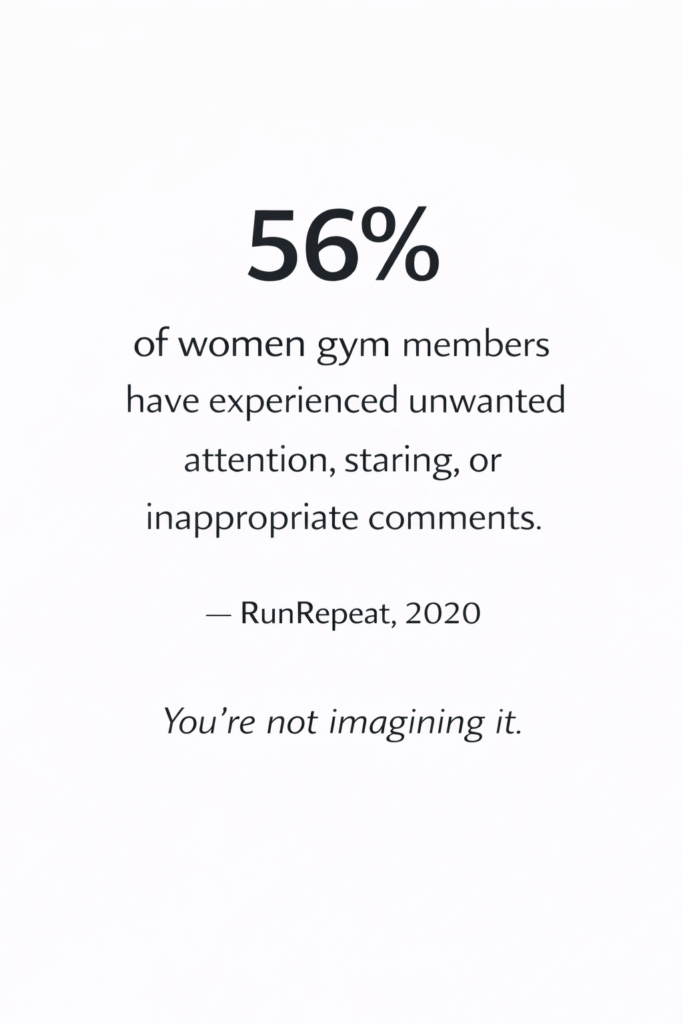
You’re not imagining it. Gym harassment does happen. One widely-circulated RunRepeat survey found that 56% of female gym members have experienced harassment—nearly three times the rate for men. Of those, 26% stopped going to that gym entirely, and 30% changed their schedule to avoid certain times or areas. [1]
Now, most gym-goers are focused on their own workout and won’t bother you. But because stuff does happen, this guide treats confidence and safety as one thing: have a plan, know your lines, keep a quick exit strategy in your pocket.
You’re not “too sensitive.” You’re adapting to a new environment and staying aware. That’s smart, not dramatic.
First, Choose a Gym That Makes This Easier
You can’t control who else is in the gym. You can choose a setup that lowers the mental load.
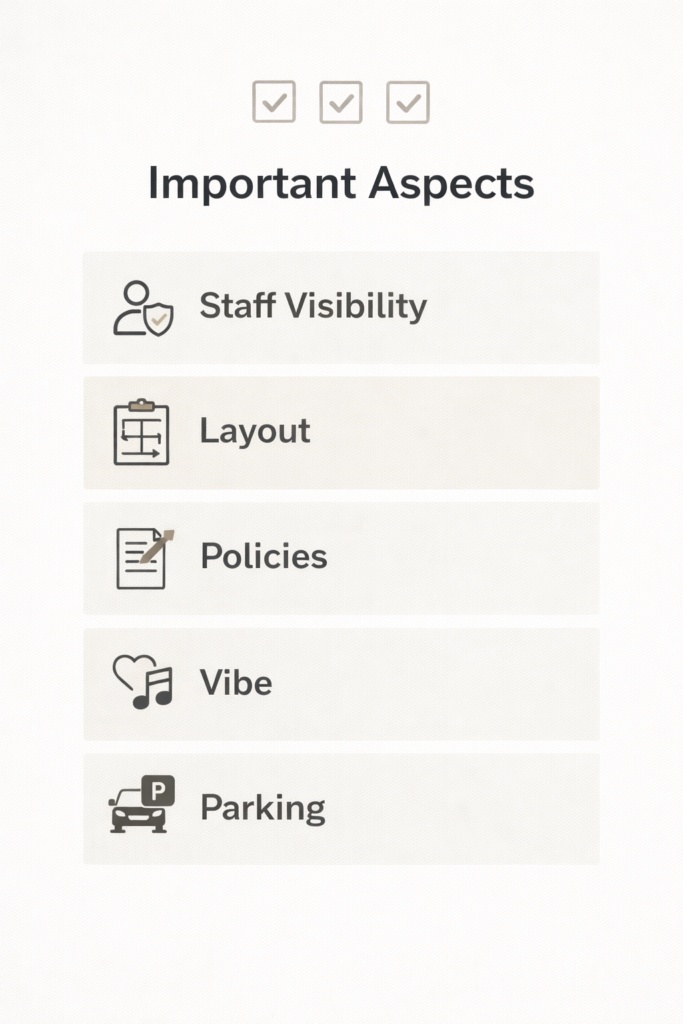
Gym choice checklist (take 5 minutes on a tour):
- Visible staff: You can see the front desk from the floor, and staff aren’t hidden in an office.
- Open layout: No weird back corners where you feel boxed in.
- Clear policies: Signs about filming, harassment, and member conduct (or staff can clearly explain them).
- Visible security cameras in the weight area, not just at entrances.
- Parking and entry: Well-lit, close to the door.
- Vibe at your likely time: Visit when you’d actually go. If it feels off then, it’ll feel off later.
One more thing that costs nothing: just listen. Notice how staff talk to members, especially women. Do they seem present? Dismissive? Actually looking up from the screen? You don’t need to rehearse anything. Your gut will pick up on it.
How to Test a Gym Without Committing
- Ask for a day pass or short trial.
- Do a “no workout” walkthrough.
- If you can, ask this exact question at the desk: “If someone is bothering me, what’s the process for getting help quickly?”
It’s a hard question to ask. But you’re not overreacting. You’re checking if the gym deserves your membership.
Your First 3 Visits: Orientation, Not Workouts
These visits are not “real workouts.” They’re orientation sessions with weights.
Your only job is to collect boring proof: I can walk in, do a plan, and leave.
And one more thing, because this matters: if part of your hesitation is unwanted attention, you don’t need to earn the right to take that seriously. You’re allowed to want a calm workout. You’re allowed to take up space. You’re allowed to have boundaries.
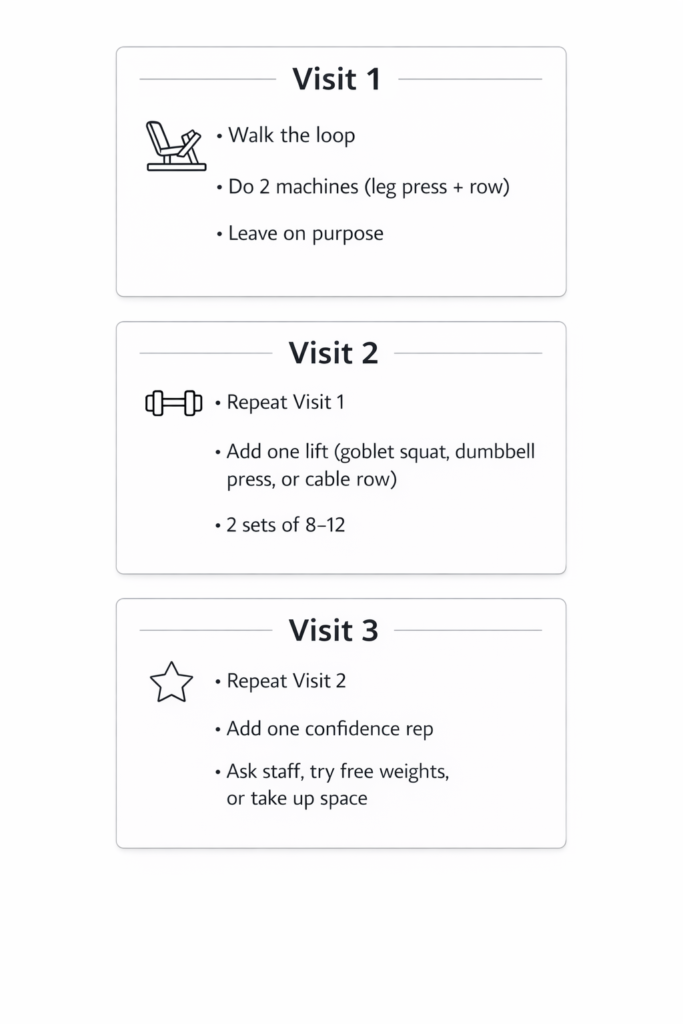
Visit 1 (20–30 minutes): Learn the layout + do two machines
Goal: Learn the flow and touch two easy pieces of equipment.
Time: 20–30 minutes (or 15 if you’re doing minimum dose).
Step 1: Walk the loop (3–5 minutes).
Locate: front desk, bathrooms, water fountain, the two machines you’ll use, the main exit.
Step 2: Do these two machines (12–18 minutes).
- Leg press: 2 sets of 8–12 reps
- Lat pulldown or machine row: 2 sets of 8–12 reps
Keep the weight light enough that you could do 2–3 more reps if you had to.
If a machine is taken: swap to the other machine first, then come back. Or pick a similar machine nearby.
Say this exactly (if you want to ask for the machine):
“Excuse me, how many sets do you have left?”
After you finish on the two machines, you leave. On purpose. Before your brain starts spiraling.
Bottom line: Visit 1 is a win if you walk in, do two things, and walk out.
Visit 2 (25–35 minutes): Repeat + add one simple lift
Goal: Same plan, less novelty. Add one movement that makes you feel more “normal” in the room.
Time: 25–35 minutes (or 15 minimum).
Warm-up (5 minutes): Treadmill walk or bike. Just warm. Not tired.
Repeat the two machines from Visit 1:
- Leg press: 2 sets of 8–12
- Pulldown or row: 2 sets of 8–12
Add one simple lift (pick one):
- Goblet squat (holding one dumbbell)
- Dumbbell bench press (flat bench)
- Seated cable row (if it felt good in Visit 1)
Do 2 sets of 8–12.
If you want help and you see staff nearby:
“Can you show me how to set this up quickly? I’m new to this machine.”
You can always load up an instructional YouTube video, but staff are generally better for “where is the pin?” questions.
Visit 3 (30–40 minutes): Repeat + add one “confidence rep”
Goal: Same workout again, plus one tiny action that widens your comfort zone.
Time: 30–40 minutes (or 15 minimum).
Repeat Visit 2 exactly.
Then choose one confidence rep:
- Ask staff where a machine is.
- Do one set in the free weights area (even if it’s just dumbbell rows).
- Try one new machine you’ve been eyeing.
- Take up space intentionally for 60 seconds
If you freeze up, no big deal. Just go back to your Visit 2 plan. Following through beats pushing too far.
This is the part people don’t say out loud: your first few visits are emotionally expensive. Not because you’re fragile. Because you’re paying attention, learning a new environment, and doing it without a buddy buffer. That takes grit.
What If You Feel Watched or Judged?
Most people are busy thinking about themselves. That’s true. But it doesn’t magically erase the feeling of being perceived.
Try these:
- Face a wall or the edge of a mirror.
- Stick to machines near staff.
- Keep your plan on your phone to avoid pacing.
- Choose one “home base” machine to return to between sets.
- Headphones help block the world out.
And seriously, give yourself permission to be new. Being new isn’t embarrassing. It’s just part of learning.
What to Say If Someone Won’t Leave You Alone
People don’t always respect unspoken signals. You don’t need to be friendly. You just need to be clear.
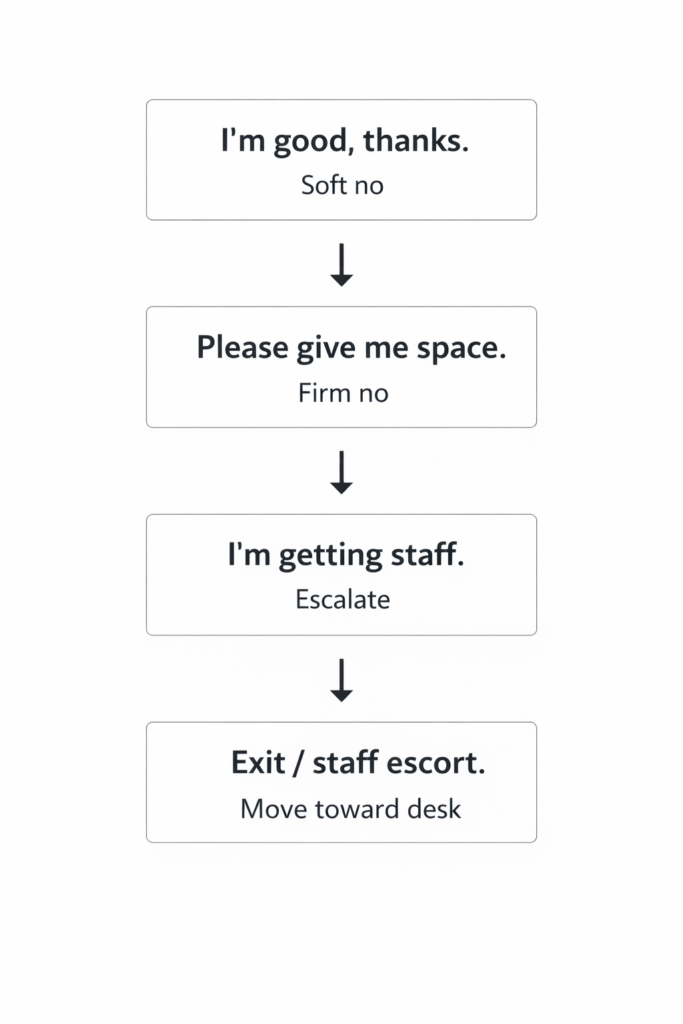
You don’t need to go from zero to confrontation. Start polite, escalate only if needed. Most people will back off after one clear signal. The ones who don’t are exactly why you need the firmer scripts ready.
Boundary scripts (three is enough)
Your goal is not to win anything. Your goal is to end the interaction.
Say this exactly (first try):
“I’m good, thanks.”
Say this exactly (if they continue):
“Please give me space.”
Say this exactly (if they still don’t stop):
“I’m getting staff.”
Then move toward the desk. Immediately. Motion matters here.
If anyone touches you:
“Don’t touch me.” (Loud, firm.)
No extra explanation required.
Staff support scripts
You don’t need a speech. You need one clear sentence.
Say this exactly:
“Hi, I need help. Someone is bothering me and won’t stop. Can you help me right now?”
If you want an escort out:
“Someone is bothering me and I want to leave. Can someone walk me out?”
If something serious happened and you want it recorded:
“Can you document this incident for me?”
You’re allowed to ask for what you need without making it pretty.
Exit plan (use if you feel unsafe)
This is not paranoia. It’s a fire drill.
- Move toward staff and the main exit.
- Don’t go to the far bathroom or a back corner.
- If you leave, go to a well-lit area.
- Once you’re safe, write a quick note: date, time, description.
You don’t owe anyone your comfort. You don’t owe anyone your attention. You don’t owe anyone “nice.”
Your First Month: Make It Boring
The first three visits are your bridge to creating a repeatable routine.
Now the goal is to turn that into a month where you stop the internal debate about every session.
And if you’re thinking, “Okay, but will I actually do this?” That doubt isn’t a character flaw. It’s your brain trying to protect you from the threatening fear of failure. Our system is going to make it easy to do.
Your Month 1 Schedule (simple on purpose)
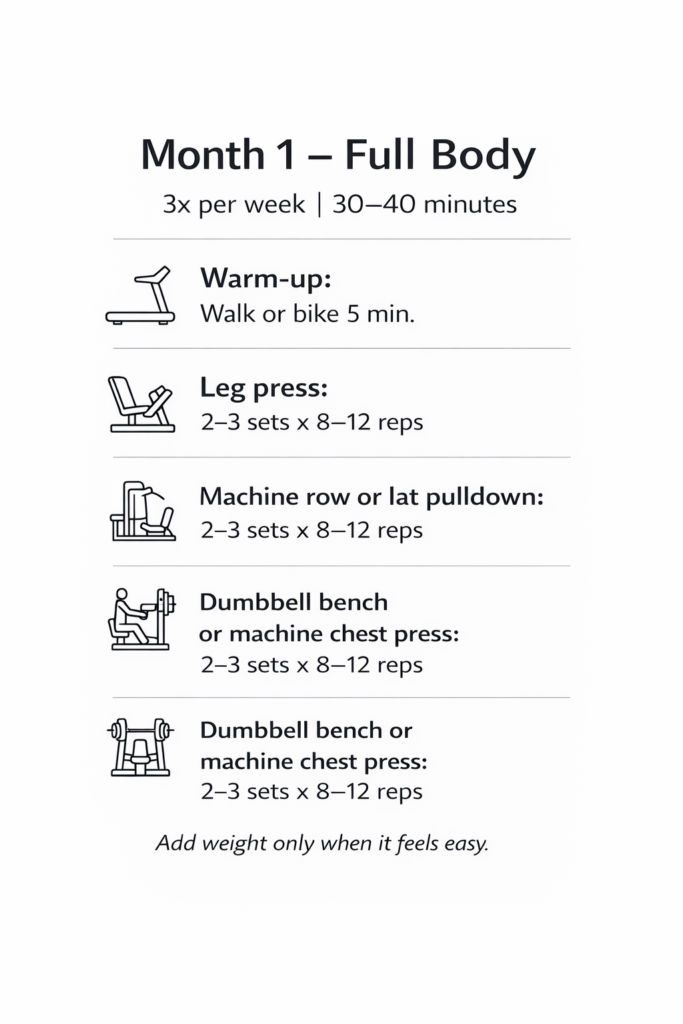
Pick 3 days per week for four weeks. Same days most weeks.
Example: Monday, Wednesday, Saturday or Tuesday, Thursday, Sunday.
Keep sessions 30–40 minutes. Short enough to repeat. Long enough to matter.
Your Month 1 Workout (simple, full-body, repeatable)
Do this three times per week. Same three movements. The goal is comfort and steady progress, not variety.
Warm-up (5 minutes): walk or bike.
Workout (25–30 minutes):
- Leg press: 2–3 sets of 8–12
- Machine row or lat pulldown: 2–3 sets of 8–12
- Dumbbell bench press or machine chest press: 2–3 sets of 8–12
That’s it.
When it feels easy, you add a little weight or a rep. Nothing big. Just small bits at a time.
Here’s the permission slip you didn’t know you needed: you don’t have to love the gym. You don’t have to feel strong every time. You just have to show up and move your body a little.
That’s it. That’s the whole month.
Tracking Your Workouts Without Turning it Into a Hobby
Your brain likes receipts. Give it receipts.
Open your phone Notes app and create this:
Workout Log (copy/paste):
Date:
Leg press:
Row or pulldown:
Press:
One sentence: “Today felt _.”
That’s enough.
The Rule That Protects Your Identity
Don’t skip twice.
Miss once, fine. Life happens.
Miss twice in a row and your brain starts practicing a new identity: “someone who used to go.”
So if you miss a planned day, your next move is tiny and immediate:
Minimum dose recovery plan (15 minutes, same day or next day):
- 1–2 sets leg press
- 1–2 sets row or pulldown
- Then leave.
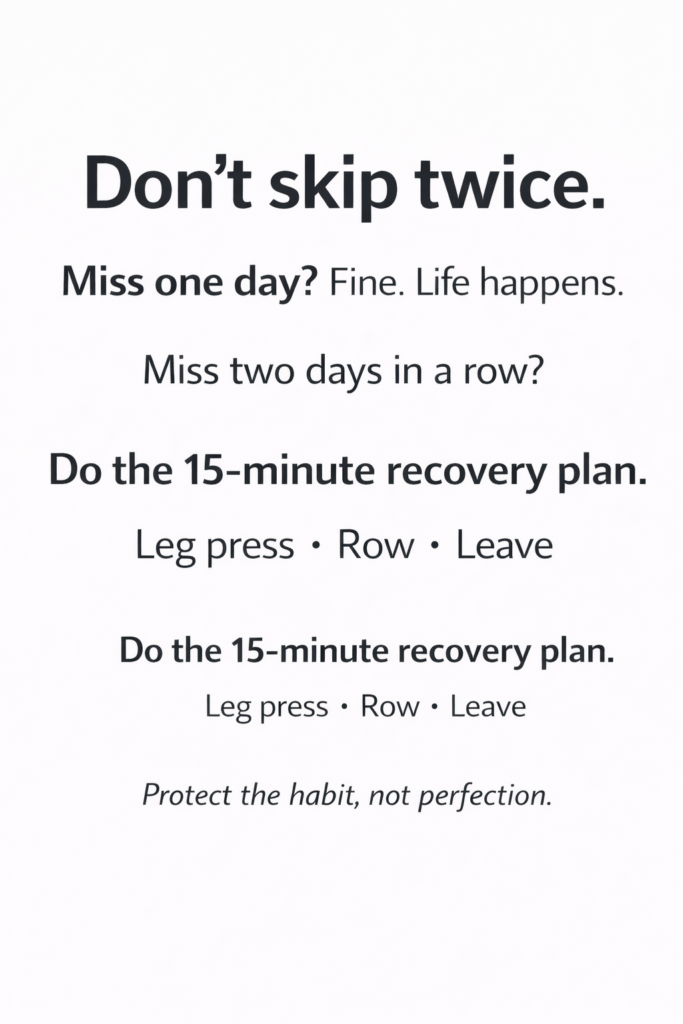
Bottom line: You’re not chasing perfect weeks. You’re protecting the habit.
If you can’t get to the gym, then you can do this at home:
- 2 sets bodyweight squats
- 2 sets push-ups
- 2 sets of crunches
Boom. On days you just can’t make it to the gym, this still counts.
FAQ
Q: Is it okay to go to the gym alone?
Yes. Absolutely. Solo workouts are completely normal. Most gym-goers go by themselves.
Q: Is it embarrassing to go alone?
It can feel that way. But most people are locked into their own workout. The feeling fades as your routine settles in.
Q: How do I start?
Start with the three-visit plan above. Pre-write the plan in your notes app, go at a time with visible staff, and give yourself permission to leave early.
If you want a full beginner program once you’ve done your first three visits, this beginner gym plan keeps the setup simple.
And if your biggest issue becomes consistency (not nerves), this consistency system helps you stop renegotiating every week.
If this resonated and you want to go deeper: How to Overcome the Fear of the Gym
If anxiety is the main thing stopping you, I put together a free one-page toolkit you can print and bring with you. It covers exactly what to do when anxiety hits, before you walk in, when you’re inside, and if you need to bail early.
Your Next 3 Tiny Actions (Do These Today)
- Copy the Visit 1 plan into your phone.
- Choose a time to go when staff are present.
- Save 2–3 boundary phrases to your notes app. (“I’m good, thanks.” / “Please give me space.” / “I’m getting staff.”)
You’re not someone who’s “trying” to go to the gym anymore.
You’re someone who has a system.