Fear of the Gym: Overcome Gym Anxiety and Start Working Out
Let’s be clear from the start: my goal isn’t to tell you to ‘just get over it.’ I haven’t personally battled with a fear of the gym, but I’ve made it my mission to understand it, to listen to the people who have, to dissect the psychology behind it, and to build real, gentle strategies that work.
If you’re dealing with this fear, you’re facing something very real. And it’s rarely about the weights. It’s about the uncertainty, the exposure, and the nagging thought that everyone else knows what they’re doing and you don’t…
Turns out, science has a name for this exact feeling: “gym avoidance”. And it’s incredibly common. It’s not in your head; it’s a documented and well-understood response to a new social environment. (1)
This post will allow you to understand what’s happening, explain why the anxiety spikes right at the entrance, and give you a simple plan to overcome this pesky fear.
If the gym scares you, it’s not because you’re weak
Fear is a protective system, not a character flaw.
The gym has bright lights, mirrors, unfamiliar equipment, and people who look like they know what they’re doing. Your brain reads that as: “I might mess up in public.” So it tries to keep you safe by pushing you toward avoidance. It’s another example of our tendency to float towards the path of least resistance.
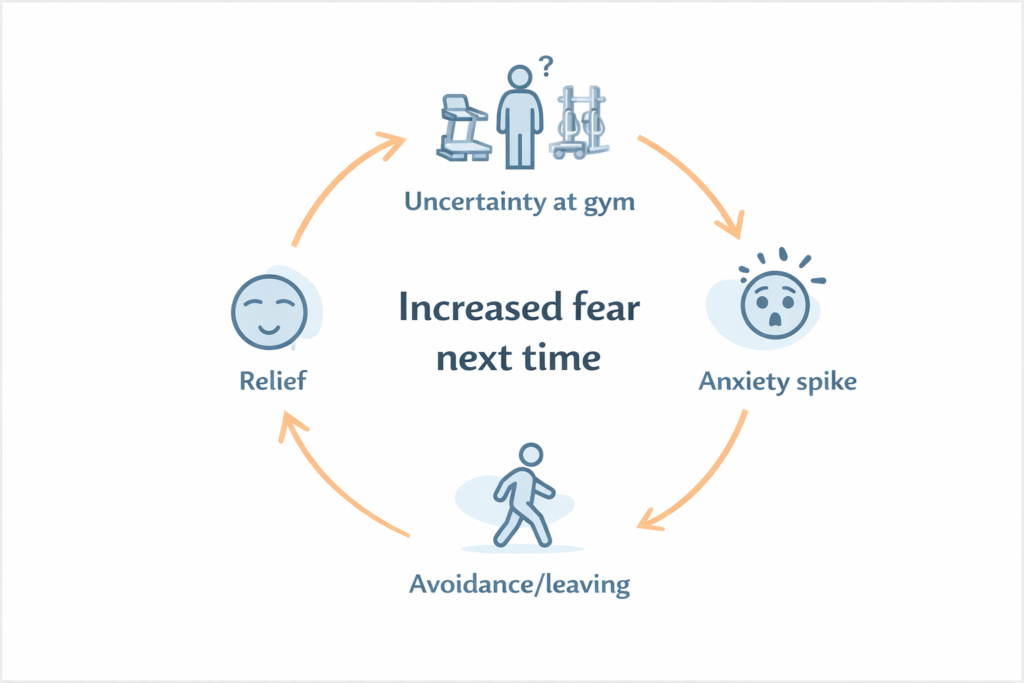
And avoidance does work in the short term. You leave, the anxiety drops, and your brain learns: “Good call. Leaving fixed it.”
And just like that, a sneaky habit is born: avoiding the gym to avoid the dread. It makes perfect sense in the moment, but it keeps you stuck in the same limiting patterns.
What you’re really afraid of (and why it spikes the moment you walk in)
Most beginners aren’t afraid of treadmills or weights. They’re afraid of what treadmills and weights represent in that moment.
Common fears that hide underneath “I’m scared of the gym”:
- Looking clueless (not knowing where to stand, what to do next)
- Doing something “wrong” (bad form, using a machine incorrectly)
- Being watched or judged (especially in free-weight areas)
- Taking up space you don’t “deserve” yet
- Getting trapped (joining a class, starting something you can’t finish)
- Being there alone (not having a “buffer person” to make you feel safer)
There’s a reason the fear hits hardest at the door: the door is where uncertainty peaks. Once you’re inside and doing something familiar, your brain finally gets data that you’re safe.
That idea shows up in research on anticipatory anxiety and familiarity: repeated exposure and familiarization can reduce anxiety because you’re no longer walking into the unknown. (2)
TL;DR Summary: Your fear isn’t random. It’s your brain reacting to uncertainty and social exposure, and it calms down when you build familiarity.
The “uncertainty + exposure” problem: why you freeze or wander
When uncertainty and exposure combine forces, your brain goes into “scan mode.”
You know that feeling when you walk into a party where you don’t know anyone? You might grab a drink just to have something to do with your hands, or check your phone obsessively. That’s ‘scan mode.’ At the gym, it looks like:
- wandering between machines
- rereading your notes 10 times
- pretending to stretch so you look busy
- leaving early because “it’s too crowded”
Ever had this happen?
It’s not laziness. Your brain is basically buffering, like a spinning wheel on a computer screen. It’s not laziness; it’s overload.
So the fix is not more motivation. It’s fewer unknowns and clearer actionable steps.
If showing up solo is a big part of the fear, this guide on how to start going to the gym alone can help you reduce uncertainty before you even walk in.
How fear shrinks: you don’t “think” your way out, you prove your way out
You can’t logic your nervous system into a state of calm while you’re still in “danger detection” mode.
What works is proof, not promises.
Proof looks like:
- walking in and staying 2 minutes longer than last time
- asking one question
- using one machine
- leaving on purpose (instead of escaping)
This is exposure, but it’s gentle and structured.
In one study on anticipatory anxiety and familiarization, people new to a demanding workout protocol saw anxiety measures drop across repeated sessions, and the authors suggested just a couple of familiarization sessions could be enough to reduce anxiety and establish comfort with the routine. (2)
That’s the principle you’re using here, even if you’re not doing high-intensity training: repeat the entry, repeat the environment, repeat the basics.
Your first win: a 10-minute “just show up” session that still counts
This is your “I did it” session. It’s intentionally small.
Goal: leave the gym knowing exactly what you did, and that you can repeat it.
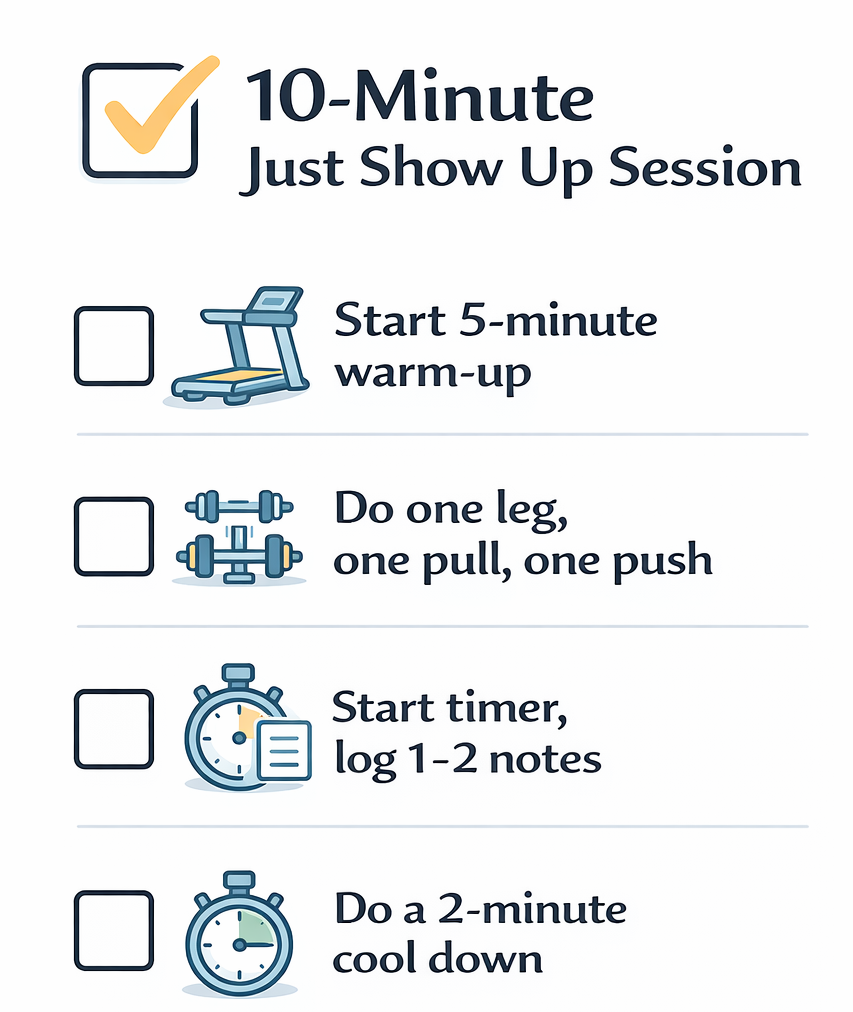
10-minute plan (set a timer):
- Minute 0–2: Walk in, check in, go to one chosen spot (treadmill area, bikes, or stretching mat).
- Minute 2–6: Easy cardio: slow walk or easy bike. You should be able to breathe through your nose.
- Minute 6–9: One simple strength move in a quiet corner:
- bodyweight squat to a bench, or
- push-ups, or
- dumbbell deadlift with very light weight (only if you already know it)
- Minute 9–10: Stop on purpose. Log one sentence: “I showed up and did X.”
Important: leaving at 10 minutes is not failing. It’s training your brain to associate the gym with success.
Seriously, leaving at 10 minutes is a strategic victory. You’re teaching your brain that the gym is a place you choose to leave, not a place you flee.
When the gym is crowded and your brain starts spiraling
Crowds amplify the feeling of being exposed. They also remove your “escape routes” (the machine you wanted is taken, the corner feels busy, the weights area looks intense).
Of course, the truth is the more people are there, the more likely it is that you will be noticed less.
Still, it can be intimidating. Use a crowd protocol so you don’t have to make decisions while anxious:
- Default to 2 options only: (1) treadmill/walk, (2) stretch zone
- Face the wall if possible: reduces the “eyes on me” feeling
- Use a single anchor exercise: one movement you repeat every time (like incline treadmill walk)
- Give yourself a “lap”: walk around once like you’re getting oriented, because you are
If your thoughts start racing, try this quick reset:
- Inhale 4 seconds, exhale 6 seconds, for 3 rounds.
Longer exhales help signal “safe enough” to your system.
If you want a simple way to feel “settled” before you enter (especially on crowded days), use this pre workout routine for beginners as a way to clear out that initial wave of anxiety.
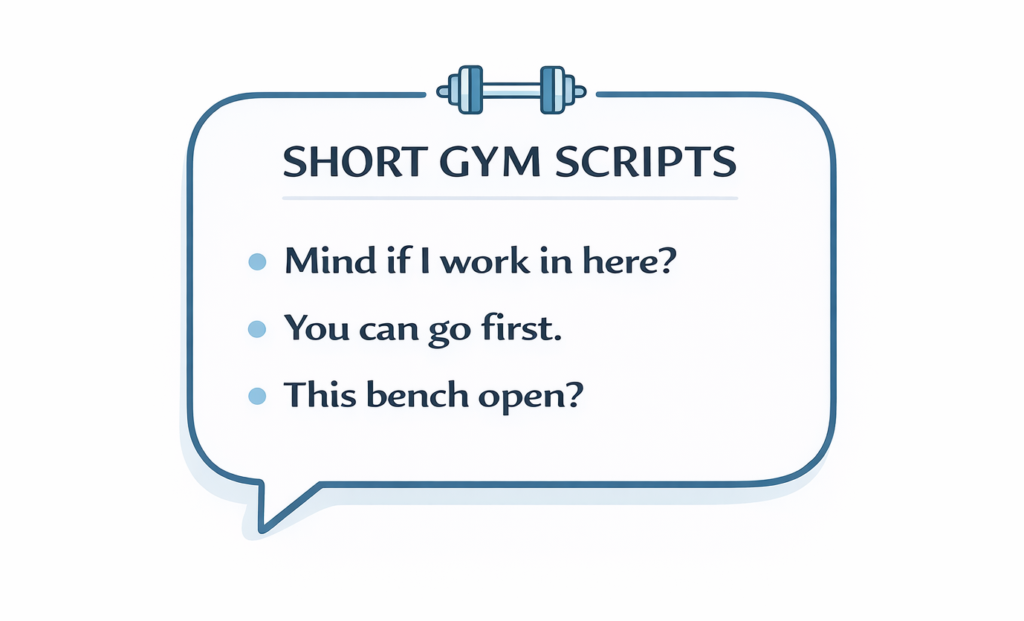
What to do if you feel judged (a script you can actually use)
First, a reality check: most people are focused on their own workout. But your feelings are still real, so let’s give you something usable.
Script 1: Asking staff for help (simple and confident)
“Hey, quick question. I’m new here. Can you show me how to adjust this machine?”
Script 2: If someone is waiting and you feel pressured
“I’ve just got a couple more sets. You’re welcome to work in if you’d like.”
Script 3: If you’re in someone’s way
“Oh, my bad! Am I in your way?”
These lines do two things:
- They reduce uncertainty fast.
- They make you feel like you belong, because you’re acting like someone who belongs.
Research on social exercise anxiety includes a clear “gym avoidance” pattern tied to fears like scrutiny and negative evaluation, which is exactly what these scripts help interrupt. (1)
The 4-week fear ladder (overview)
A fear ladder means you climb in small steps.
We’re not trying to leap from the ground to the roof in one jump. We’re going to build a ladder, one comfortable rung at a time. Your only job is to stand on the next rung until it feels solid.
Rule: repeat a step until your anxiety drops by about 20–30% or it feels boring.
Week 1: Enter and orient (2–3 visits)
- Walk in, check in, go to one anchor area
- 10 minutes max is fine
- Leave on purpose
Week 2: One machine + one “ask” (2–3 visits)
- Use one machine you can repeat (treadmill, bike, rower)
- Ask staff one question total this week (adjustment, where something is)
Week 3: Add one strength station (2–3 visits)
- Pick one: leg press, dumbbell bench, cable row
- Do 2 sets only
- Keep the rest identical to Week 2
Week 4: Mild “exposure upgrades” (2–3 visits)
Choose one upgrade:
- go at a slightly busier time
- try one new machine
- spend 5 minutes in the free-weight area
- do a simple circuit (3 exercises, 1 set each)
Once you’re ready to start lifting with a little more structure, these weightlifting routines for beginners make it easier to walk in knowing exactly what to do.
TL;DR Summary: The ladder works because it turns “the gym” into repeatable micro-situations your brain can learn from.
How to know you’re making progress (even if you still have a fear of the gym)
Progress is not “zero anxiety.” Progress is feeling your anxiety but acting with more freedom nonetheless.
Look for these signs:
- You stop googling workouts in the parking lot.
- You walk in without rehearsing a perfect plan.
- Your ‘oh crap, everyone’s looking’ moment lasts 30 seconds instead of 10 minutes before you can refocus.
- You can switch to a backup option without leaving.
- You feel nervous and still do the next step.
Also, a helpful reframe from body-related anxiety research: people can experience social physique anxiety and still continue regular activity, especially once they’re already engaged in exercising. That means anxiety isn’t a permanent stop sign. It’s a sensation you can move with. (3)
If your anxiety is severe, includes panic symptoms, or feels tied to past bullying or trauma, consider getting support from a therapist. You don’t have to brute-force this alone.
Your next gym visit: the “minimum effective courage” checklist
So, for your next visit, I want you to do the gentlest version possible. This isn’t about toughness; it’s about proof.
Pick your safe zone. Set a timer for 10 minutes. Your only goal is to leave on purpose when it goes off. That’s it. You’re not there to get fit today. You’re there to teach your brain that the gym is a place you can enter, exist in, and exit on your own terms.
Familiarity is the antidote to fear. So go build a little familiarity. You’ve got this.
If you want an easy resource to deal with gym anxiety, I put together a free one-page toolkit you can print and bring with you. It covers exactly what to do when anxiety hits, before you walk in, when you’re inside, and if you need to bail early.
References
- Levinson, C. A., Rodebaugh, T. L., Menatti, A. R., & Weeks, J. W. (2013). Validation of the Social Exercise and Anxiety Measure (SEAM): Assessing fears, avoidance, and importance of social exercise. Journal of Psychopathology and Behavioral Assessment, 35(2). https://doi.org/10.1007/s10862-012-9326-1 (PMID: 24244069; PMCID: PMC3827729).
- Streetman, A. E., Lewis, A. K., Rogers, E. L., Heinrich, K. M., & DeBlauw, J. A. (2022). Anticipatory Anxiety, Familiarization, and Performance: Finding the Sweet Spot to Optimize High-Quality Data Collection and Minimize Subject Burden. European Journal of Investigation in Health, Psychology and Education, 12(9), 1349–1357. https://doi.org/10.3390/ejihpe12090094 (PMID: 36135232; PMCID: PMC9497550).
- Portman, R. M., Bradbury, J., & Lewis, K. (2018). Social physique anxiety and physical activity behaviour of male and female exercisers. European Journal of Sport Science, 18(2), 257–265. https://doi.org/10.1080/17461391.2017.1417485 (PMID: 29320305).